Hake in green sauce: the Basque recipe with the exact thickness point
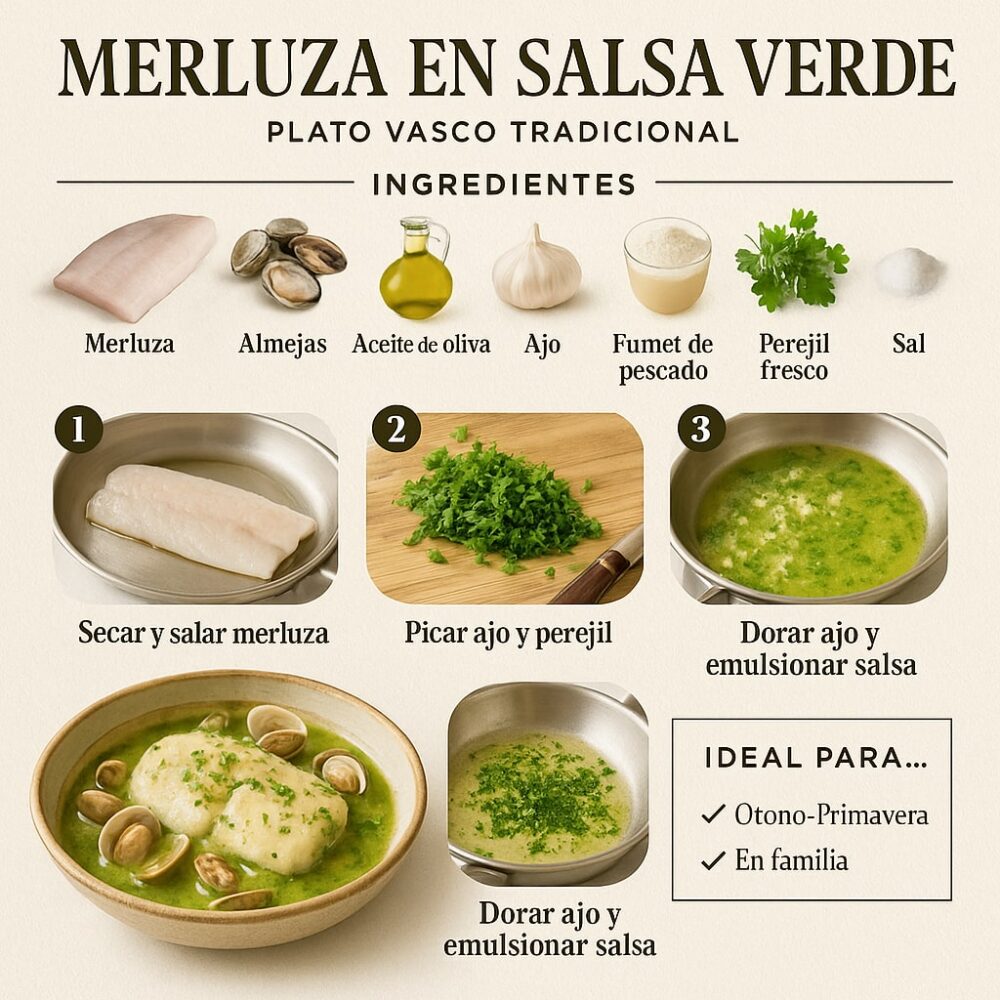
Hake in green sauce is one of those dishes that seems simple until you actually make it. Four ingredients, half an hour at the stove, and a result that is either creamy and glossy or a sad soup with fish in it. The difference lies not in the product (though that matters too), but in the technique: how you emulsify the oil with the cooking liquid and the collagen the hake itself releases.
It is a classic Basque dish, born in the farmhouses and fishermen’s guilds of the Cantabrian coast, which became popular in 19th-century San Sebastián. It can be enjoyed all year round, but it shines especially between autumn and spring, when Cantabrian hake is at its best. I’ll tell you how I make it at home, with the quantities that work and the mistakes I’ve already made so you don’t have to.
Quick recipe overview
| Detail | Value |
|---|---|
| Servings | 4 |
| Total time | 30-35 min |
| Difficulty | Medium (because of the emulsion) |
| Approx. cost | 30-40 € |
| Allergens | Fish, molluscs (clams), gluten (flour) |
Where this dish comes from
Donostiarra tradition holds that the green sauce was born in the 19th century on Puyuelo street in San Sebastián, in the kitchen of Plácida de Larrea. The technique — binding the fish cooking liquid with oil and flour by swirling the pan — is a direct offspring of Basque pot cooking: simple, seafaring, without frills. The “green” comes, obviously, from parsley, which here is not decoration but a structural ingredient.
Why thickness is everything
A well-made green sauce has no cream, no cornflour, no tricks. What thickens it is an emulsion between three things: the olive oil, the water (or fumet) from cooking, and the collagen and gelatin released by the cheeks, the bones and the hake flesh itself as it heats. That collagen acts as a natural stabiliser. That is why traditional recipes insist on thick slices with the central bone and, if you can, adding a cheek: that is where the most gelatin is.
The flour plays a secondary role — it gives some body and helps keep the emulsion from breaking — but if you overdo it, the sauce becomes pasty and tastes like a sad béchamel. Half a level tablespoon per person is enough.
Ingredients
For 4 people:
- 4 slices of hake from the Cantabrian sea, about 200 g each and 3 cm thick (ask for the “neck” or central cut)
- 300 g of clams fine or carril clams, purged in salted water for 1 hour
- 120 ml of extra virgin olive oil (preferably a mild variety, such as Arbequina)
- 4 cloves of garlic medium-sized
- 1 tablespoon of flour wheat flour (about 10 g)
- 200 ml of fish fumet (or strained clam cooking water + water)
- 80 ml of txakoli or dry white wine
- 1 generous bunch of fresh parsley (about 30 g of leaves)
- Fine salt (start with 1 level teaspoon and adjust)
- Optional but recommended: 2 hake cheeks or 4 green asparagus tips and 2 boiled eggs to serve
Step-by-step preparation
-
Prepare the hake. Dry it well with kitchen paper on both sides. Lightly salt it 5 minutes before cooking. This helps prevent it from releasing water into the pan. If it has scales, check it.
-
Chop the garlic and parsley. Garlic in thin slices, parsley very finely chopped (set aside one tablespoon for the end). Have everything ready before lighting the heat: this recipe moves quickly.
-
Brown the garlic. In a wide, shallow pan — it must have a thick base, ideally clay or cast iron — heat the 120 ml of oil over medium heat. Add the sliced garlic and leave it for 2 minutes until it starts to sizzle and takes on a pale golden colour. Neither brown nor burnt: if it overcooks, it turns bitter.
-
Add the flour. Lower the heat to minimum. Add the tablespoon of flour and stir with a wooden spoon for 30 seconds, without letting it colour. We only want it to lose its raw flavour.
-
Add the liquid. Pour in the txakoli and let the alcohol evaporate for 1 minute. Add the hot fumet little by little, stirring. You will see it start to bind. Add half of the chopped parsley.
-
Place the hake. Put the slices in the pan skin-side down. The liquid should reach halfway up the thickness of the fish, not cover it. If you are short of liquid, add a little more hot fumet.
-
The pan swirl. Here is the secret. Raise the heat to medium-low and, instead of stirring with a spoon, hold the pan by its handles and move it in circles with a continuous, gentle motion. This swirling is what emulsifies the oil with the water and the collagen the hake releases. Do it for 4-5 minutes.
-
Add the clams. Place them between the hake slices. Continue swirling for another 3-4 minutes, until the clams open and the hake is cooked (the flesh should separate into flakes when touched with a fork, but remain juicy). In total, the hake should not spend more than 8-9 minutes on the heat.
-
Finish and serve. Sprinkle the rest of the parsley over the top. Taste and adjust the salt. The sauce should be bound, glossy, the colour of lime with milk. If it looks too runny, keep swirling for 1 more minute off the heat: it keeps emulsifying by momentum.
Tips and variations
The temperature trick. The fumet must be hot when you add it, not cold. A thermal shock breaks the emulsion before you even start. And keep the heat medium-low during the swirling: if it boils vigorously, the oil separates and there is no going back.
What to do if your sauce splits. Don’t throw it away. Remove the fish to a plate, add 2 tablespoons of cold water to the pan and whisk off the heat. It usually comes back together. Return the fish and finish for 30 seconds more.
Classic garnish version. In step 8, add some cooked green asparagus tips and, when serving, half a boiled egg per person. It is the most “restaurant-style” version of all.
Gluten-free. Replace the wheat flour with the same amount of refined rice or corn flour. The emulsion works just the same, even better, though it ends up slightly less unctuous.
Pairing and serving
Serve it in the pan itself if it is clay, or in deep plates with the sauce well distributed. No stacking on the plate in a pyramid: this is spoon-and-bread cooking. Put a good loaf of bread alongside, because the sauce must be mopped up.
For wine, a well-chilled txakoli from Getaria is the natural choice — it closes the geographical circle. If you prefer something else, a young albariño from Rías Baixas or a godello from Bierzo works wonderfully. No reds here, unless they are very light.
If you enjoy Basque spoon dishes, I also recommend taking a look at bonito marmitako: the same philosophy, a different protagonist.
Frequently asked questions
Can I make it with frozen hake? Yes, but thaw it for 12 hours in the fridge and dry it very well before cooking. Frozen hake releases more water, so reduce the fumet to 150 ml and add more if needed.
Can it be prepared in advance? It is a dish that should be eaten freshly made. If you need to get ahead, prepare the base (garlic, flour, liquid) and add the hake and clams just before serving. Reheating it whole breaks the emulsion and the hake dries out.
How long does it keep in the fridge? A maximum of 24 hours, in an airtight container. When reheating, do it over very low heat with a spoonful of water, moving the pan. Do not use the microwave: the hake becomes stringy.
Can I use another fish? It works with monkfish, fresh desalted cod or cod neck. With boneless fillets it won’t be the same because the collagen from the bones is missing. If you use fillets, add a hake head to the fumet to compensate.
Cantabria Tasty Things Recipes #Cantabria #merluza #pescado #receta #salsa verde

 Lumara: the essence of Extremadura finds its home in Chamberí
 How to Make an Authentic Valencian Paella Step by Step (for 4 people, at home and in Valencia)
 Zhen and Chinese New Year: A Menu That Turns Madrid into Shanghai
Comentarios cerrados