Sollo (Fuengirola): the river restaurant on the Costa del Sol
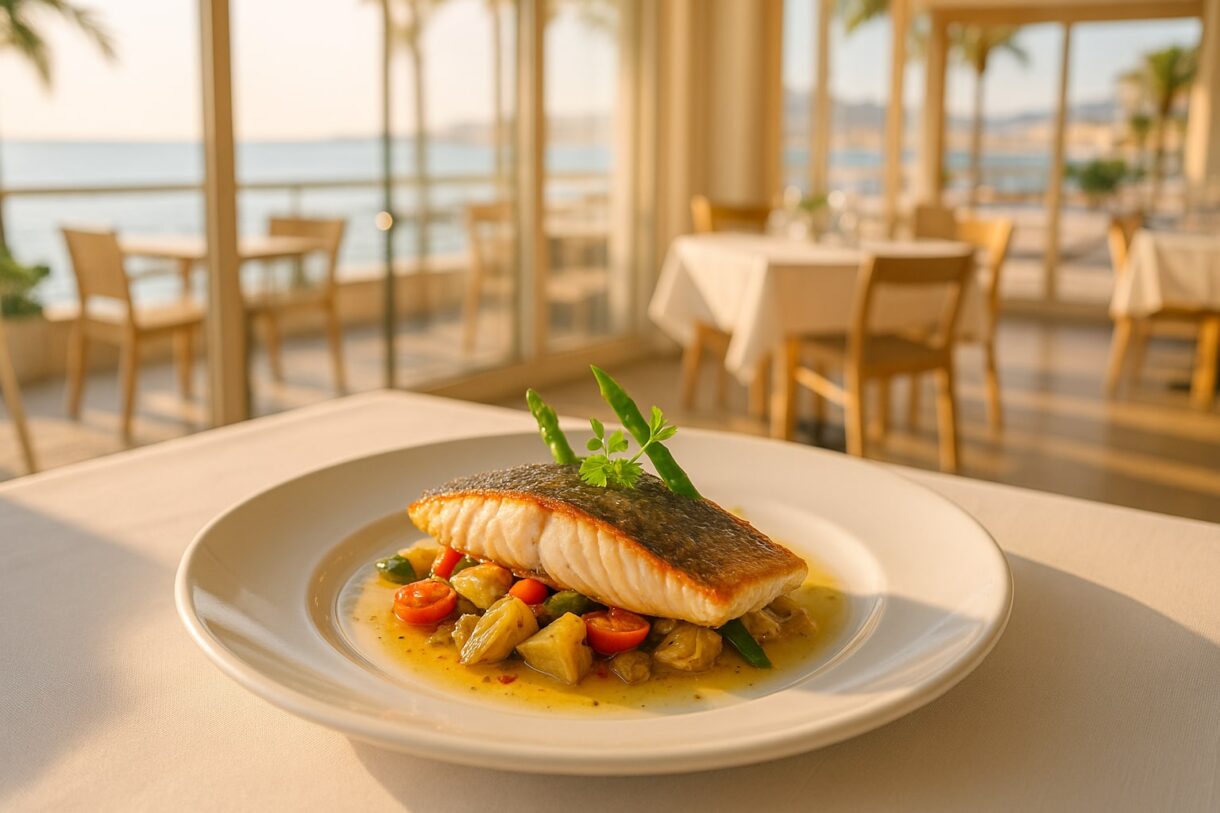
A river fish restaurant facing the Mediterranean
We booked at Sollo on a Saturday in May, for a friend’s birthday who had spent months nagging us with “you have to go and eat sturgeon raised by the chef”. There were four of us. We dined at 8:30 pm. And yes, it’s one of those places where, halfway through the menu, you understand why people drive down to Málaga just for this.
Sollo is an odd bird on the Spanish scene: a restaurant that cooks river fish two hundred metres from the sea. That paradox—being on the Costa del Sol and skipping hake and red mullet—is the backbone of the project of Diego Gallegos, a Brazilian based in Andalusia, known as the caviar chef. If you’re heading south looking for a restaurant with a Michelin star in Fuengirola, this is the one that will make you rethink things.
Quick facts
| Detail | Value |
|---|---|
| Address | Av. del Higuerón, 48 (Reserva del Higuerón urbanisation), Fuengirola |
| Chef | Diego Gallegos |
| Format | Tasting menu only (Caminho) |
| Recognition | 1 Michelin Star, 1 Michelin Green Star, 2 Repsol Suns |
| Approximate price | €180 per person for the menu; +€85 wine pairing |
| Booking | Essential, well in advance |
| Opening hours | Tuesday to Saturday, dinners only (from 7:30 pm) |
The setting: an open kitchen inside the Higuerón resort
Sollo is neither in Fuengirola’s centre nor on the seafront. It is inside the Higuerón Hotel 5* Curio Collection by Hilton, high up in the Reserva del Higuerón urbanisation, reached via exit 1008 of the Costa del Sol motorway. If you’re without a car, you’ll need a taxi.
The dining room is small and intimate, with an open kitchen and views over the coastline. It’s a charming restaurant, with the kitchen on show and marvellous coastal views, the kind that play at round tables around the pass. No stiff starched white tablecloths or solemnity: warm lighting, wood, an atmosphere for couples or small groups (we were four and, by far, the noisiest table). The Michelin Guide describes it as “romantic” and, honestly, for an anniversary dinner it works better than for a business lunch.
Important: here you dine. It opens Tuesday to Saturday from 7:30 pm to midnight, closed Mondays and Sundays, so forget the idea of a long, lazy afternoon.
The cooking: river fish, aquaponics and 90% self-sufficiency
The concept is honest and, at least in Spain, unique. Sollo runs its own aquaponics system that means 90% of the menu comes from its own resources—a figure that is not marketing: you see it as you walk in, because they’ll show you the lab if you ask.
And what is aquaponics? In brief, so as not to confuse matters: a closed circuit where fish and plants feed each other. The word combines gastro for gastronomy, aqua for aquarium and ponics from hydroponics, a method whereby the water the fish use is purified by the plants growing in the tank. The water in the tanks, loaded with nutrients from the fish, feeds the vegetables; the plants, by filtering it, return it clean to the fish. Zero discharge, zero waste.
In numbers, Sollo’s circuit holds more than 12,000 litres of water and combines the production of 2,000 vegetables of all kinds with unusual species of river fish, notably sturgeon. The living pantry also houses catfish, tilapia, piranha, Australian crayfish and tench, sourced from its own small fish farm.
Stated without exaggeration, nobody else in Spain does it this way. And that is what earned it the Michelin green star, which the French guide awards specifically for sustainability.
Diego Gallegos, the “caviar chef”
Gallegos is Brazilian by birth, the son of a Peruvian mother, professionally trained in Andalusia. He is a cook and researcher, and is known as the “caviar chef” for having devoted several years of his work to researching the recovery of the Andalusian sturgeon, in collaboration with Riofrío (Granada), where the world’s first certified organic caviar is produced.
That dual side—cook and lab—explains Sollo. In 2015, when sustainability was barely discussed in kitchens, Gallegos started a project with living water, solar panels, home-automation sensors, a small vegetable garden and tanks to work with river fish, a product that for him felt natural given his Brazilian roots.
Recognition followed. Sollo holds one Michelin Star, one Green Star and two Repsol Suns, and since 2020 has been one of the first Michelin green stars awarded in Spain.
The menu: “Caminho 2026”, 15 courses
At Sollo there is no à la carte menu, only a tasting menu. The current one, the heir to the Caminho that Gallegos renews every year, is a journey of about 15 courses through his river pantry. It costs €180 per person (plus €85 for the wine pairing) and is served in a bright dining room with an open kitchen and coastal views, inside the Reserva del Higuerón urbanisation.
Snacks and starters
It opens with a battery of bites that set the scene: cured loin with tajín and citrus, roasted red pepper canutillo, a savoury macaron of preserves and a trout tartlet in escabeche with its roe. There is also a signature nod: the morsollo, a sturgeon blood sausage. It sounds odd, but it works. It is rich, spiced and has the right mineral note of a classic morcilla.
The caviar
Two courses revolve around the Riofrío organic caviar, served in a mother-of-pearl spoon over almond and cauliflower curd, and then in a tartare with bluefin tuna and tilapia. This is where you see why he is called the caviar chef: he treats it as an ingredient, not a totem. The salinity of the caviar meshes with the creamy vegetable base and accompanies it rather than overpowering it.
Mains
The main courses champion freshwater fish without complexes. A catfish stew with tender chickpeas that could pass for an Andalusian potaje if you didn’t know what was on the plate. Smoked eel with Iberian ham broth and pickles, a brutal crossing of rich and sharp. And the course that, for me, justifies the dinner: sturgeon with foie gras and tuber cream, powerful, creamy and full of nuance, a bold yet balanced dish.
If you’re used to hake and turbot, the first bites will throw you. Sturgeon has a fatty, dense texture, nothing like a sea fish. Catfish is smooth and neutral, a blank canvas. Tilapia holds up to aggressive cooking. It’s an exercise in widening your palate.
Desserts
The sweet part begins with a mazamorra morada, a dessert from Peruvian roots that connects with the chef’s family history. It tastes of corn, fruit and memory. “Romeo y Julieta” is a reinterpreted classic that pairs cheese and quince with a more elegant, lighter touch. The close is a selection of the chef’s childhood sweets, many with Brazilian nods.
If you like restaurants with a sense of place and project like Bagá in Jaén or Maralba in Almansa, Sollo joins that same league of must-stop destinations worth the detour.
The service: educational without being tiresome
The front of house, led for years by Susana Almirón, does an essential job here: telling you what you’re eating without turning dinner into a lecture. When you ask, they explain what morsollo is, where the tilapia you just tried comes from, how the skin fermentation works. If you want to go into detail, they’ll go with you. If not, they step back.
The wine pairing (€85) is generous in glasses and varied—there are sparkling wines, aged whites, some non-wine fermented drinks. If you don’t drink at that pace, you can order wine by the glass or a bottle from the list, which is not very long but is well built around whites and natural wines.
Price and value for money
Let’s be clear. €180 for the menu, €265 with the wine pairing. Add water, coffee and, if you’re tempted, an extra glass or two: it easily comes to between €200 and €290 per person. It’s not a Tuesday whim.
Is it worth the price? For what it offers—15 courses with produce you literally won’t eat in any other restaurant in Spain, a chef with a Michelin star and a green star, polished service—it is in line with what is charged at other starred restaurants of its level. If you’re looking for “generous portions and good value”, this is not your place. If you’re looking for a singular experience within sustainable cooking in Andalusia, it is one of the few that truly delivers it.
Verdict: 3 hams 🍖🍖🍖
Sollo earns 3 hams. Not for the price, which is high, but because there is no other restaurant in Spain doing what it does: raising its own river fish, closing the water circuit and turning it into 15 coherent courses. It’s the restaurant you deliberately take someone to so they understand where fine dining can go in 2026.
Who is it for? For diners with curiosity, who aren’t looking for bluefin tuna or Dénia prawns, and who accept paying for a long format. If you’re heading south, it’s among the stops that, alongside Kabuki Raw in Casares, justify a gastronomic trip to the Costa del Sol.
Would I go back? Yes, as soon as the Caminho changes. Book with a margin—three or four weeks minimum—through the official Sollo website. And if you’re staying at the Higuerón, ask for the prior visit to the lab and the tanks: it lasts twenty minutes and completely changes how you read the dinner.
We were in... Málaga #estrella-Michelín #fuengirola #menu #pescado #restaurante
 Lumara: the essence of Extremadura finds its home in Chamberí
 How to Make an Authentic Valencian Paella Step by Step (for 4 people, at home and in Valencia)
 Zhen and Chinese New Year: A Menu That Turns Madrid into Shanghai
Comentarios cerrados