Suckling pig roasted in a home oven: temperatures, times and crispy skin
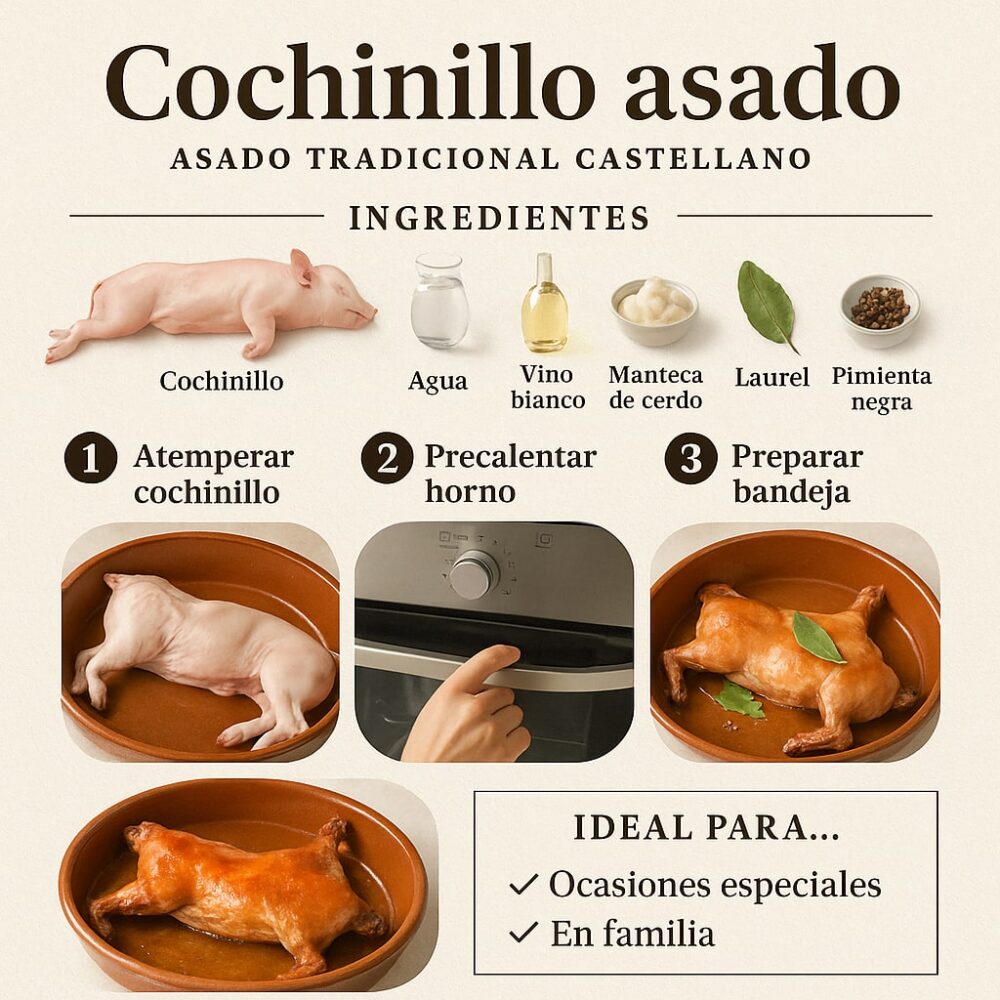
Roast suckling pig is one of those dishes that commands respect even before you turn on the oven. And rightly so: in Segovia there are roasting houses that have spent decades perfecting the method, with a wood-fired oven, clay dish and a master roaster who knows when to prick and when to wait. Replicating that at home, with a 60 cm electric oven, seems like an impossible mission.
It isn’t. If you understand what is happening inside the oven —when the meat cooks and when the skin dries out— you’ll get a suckling pig that has nothing to envy from the neighbourhood roasting house. I’m not saying as good as Cándido, let’s not get carried away. But one that you can cut with the edge of the plate, with the skin sounding like thin glass and the meat juicy inside.
This is the guide I wish I’d had the first time I tried it and wasted 45 euros of suckling pig because I took it out pale and leathery.
Which suckling pig to buy and how to order it from the butcher
Real suckling pig —tostón in old Castilian— is a piglet weighing between 4.5 and 6.5 kg that has eaten nothing but mother’s milk, around three weeks old. If it weighs more than 7 kg, it’s a different beast and doesn’t roast the same way: the skin is harder to get thin and crisp, and the meat needs more time.
If you can, look for Cochinillo de Segovia IGP. It’s sold in specialist butchers and in many gourmet shops in Madrid. Expect to pay around 55-75 € for a whole piece for 4-5 people. Outside the IGP, there is quality suckling pig at large markets (Maravillas, Chamartín) for 35-50 €.
Ask the butcher for three things:
- That he splits it along the spine without separating the two halves (opened like a book).
- That he delivers it cleaned of offal and well dried.
- That he tells you the exact weight once cleaned. It’s the key figure for calculating the time.
Table of times and temperatures by weight
This table assumes a conventional 60 cm electric oven, top and bottom heat (no fan in the first phase). It’s the reference I use at home and the one I send to anyone who asks me on WhatsApp every December.
| Weight once cleaned | Phase 1: cooking | Phase 2: browning the skin | Approx. total time |
|---|---|---|---|
| 4.5 kg | 150 °C · 1 h 50 min | 210 °C · 20-25 min | 2 h 10 min – 2 h 15 min |
| 5 kg | 150 °C · 2 h | 210 °C · 25 min | 2 h 25 min |
| 5.5 kg | 150 °C · 2 h 10 min | 210 °C · 25-30 min | 2 h 40 min |
| 6 kg | 150 °C · 2 h 20 min | 220 °C · 25-30 min | 2 h 50 min |
| 6.5 kg | 150 °C · 2 h 30 min | 220 °C · 30 min | 3 h |
The practical rule: about 25-28 minutes per kilo at 150 °C, plus the final phase at high temperature. If your oven runs weak (and many 10-year-old ovens do), add 10-15 minutes to phase 1.
Ingredients (for 4-5 people)
- 1 suckling pig of 5-5.5 kg, opened like a book
- 200 ml of water
- 100 ml of dry white wine (a young Verdejo will do)
- 40 g of pork lard Iberian
- 2 bay leaves
- 8 g of coarse salt (careful, don’t add more salt)
- Freshly ground black pepper
Nothing else. No garlic, no rosemary, no lemon. Good suckling pig doesn’t need disguises. If someone gives you a recipe with eight spices, be wary.
Step-by-step preparation
-
Bring the suckling pig to room temperature (1 hour before). Take it out of the fridge and leave it at ambient temperature. If you put it in the oven cold, cooking is uneven and the skin suffers.
-
Preheat the oven to 150 °C, top and bottom heat, no fan. Rack in the lower-middle position.
-
Prepare the dish. Use a deep dish —ideally a clay casserole, otherwise a deep metal tray— with the water and wine in the bottom. Place the bay leaves.
-
Place the suckling pig opened like a book, skin side down and meat side up. Yes, the opposite of what you’d think. Season the meat with salt and pepper (the 8 g of salt, spread evenly). Spread half the lard over the meat.
-
First phase: 150 °C for the time in the table according to your weight. Halfway through (roughly at the hour mark), baste the meat with the juices from the dish. If the liquid evaporates completely, add half a glass of hot water. Never cold: the dish will crack.
-
The decisive turn. Once the phase 1 time has passed, take out the dish. Turn the suckling pig over carefully —now skin side up— using two large spatulas or oven gloves. If a piece of skin breaks, it doesn’t matter.
-
Prick the skin. With a thick needle or the tip of a very sharp knife, prick all the skin with hundreds of small holes. Especially on the loin and ham. This is what makes it crispy: the steam escapes and the fat rises to the surface.
-
Brush with the remaining lard all over the skin. A thin layer, not a blob.
-
Second phase: raise to 210-220 °C for 20-30 minutes. Watch the last 10 minutes like a hawk. The skin goes from golden to burnt in 90 seconds. When you see it bubbling and taking on an even mahogany colour, it’s done.
-
Rest for 10 minutes outside the oven before cutting. The meat redistributes its juices.
The trick for crispy skin
Three things make the difference:
- Dry the skin with kitchen paper before putting it in the oven. If the skin is damp, it steams instead of browning.
- The pricks. Show no mercy. The more holes, the crispier.
- Lard, not oil. Iberian pork lard provides fat that withstands high heat without turning bitter. Olive oil at 220 °C starts to burn.
And a fourth: don’t open the oven in the final phase. Every time you open it, you lose 30-40 °C and the skin loses its momentum.
Cutting with the plate: myth or reality?
At Cándido and other Segovian roasting houses they do it with the edge of the clay plate. At home, with well-crisped skin and tender meat, it works. It doesn’t come out as clean as with a knife, but it works and it’s part of the show. If you have guests, do it.
If you prefer to cut neatly, use a long, sharp-bladed knife. First divide in half along the spine, then into quarters (loin and ham), and from there into portions. Each diner eats a quarter or half a quarter, depending on hunger.
Wine pairing and side dishes
Wine: young red from the Ribera del Duero or a Mencía from Bierzo. No powerful reserves that will overpower the animal. A chilled rosé from Navarra also works if it’s hot.
As a side, very little: green salad with spring onion and sherry vinegar, and bread. The suckling pig takes centre stage. At most, some panadera potatoes made in another dish while the suckling pig rests.
If you fancy adding another classic recipe to complete the table, the chicken in pepitoria with almonds and saffron is an option as a second course or for another celebration day.
Common mistakes and how to avoid them
- Pale, rubbery skin. Final temperature was lacking or you didn’t prick the skin. Raise it to 230 °C for the last 5 minutes, watching without blinking.
- Dry meat. You overdid the time in phase 1, or your oven runs hotter than it says. Buy an oven thermometer (10 €) and calibrate it.
- Skin burnt at the edges and raw in the centre. The suckling pig wasn’t flattened properly. Ask the butcher to “crucify” it well open.
- It smokes a lot. Normal in the final phase. Turn the extractor hood to maximum and open a window.
FAQ
Can I roast it in a fan oven? Better not in phase 1: it dries out. In the last 10 minutes of phase 2 you can switch it on to finish the skin.
Can leftovers be frozen? Yes, the meat keeps well for 2 months in the freezer. The skin loses all its crispness, accept it. To reheat: oven at 180 °C, 15 minutes.
How long does it keep in the fridge? Two days in an airtight container. Reheat in the oven, not the microwave.
Is frozen suckling pig acceptable? It is, but defrost it for 24 hours in the fridge and dry it very well before roasting. The skin suffers more.
What if my oven is smaller than 60 cm? Ask the butcher to split it into two halves and roast one. Reduce the phase 1 time by 20%.
Tasty Things Recipes Segovia #asado #carne #cochinillo #horno #receta
 Lumara: the essence of Extremadura finds its home in Chamberí
 How to Make an Authentic Valencian Paella Step by Step (for 4 people, at home and in Valencia)
 Zhen and Chinese New Year: A Menu That Turns Madrid into Shanghai
Comentarios cerrados