Andalusian honey pestiños: grandma's recipe for Christmas
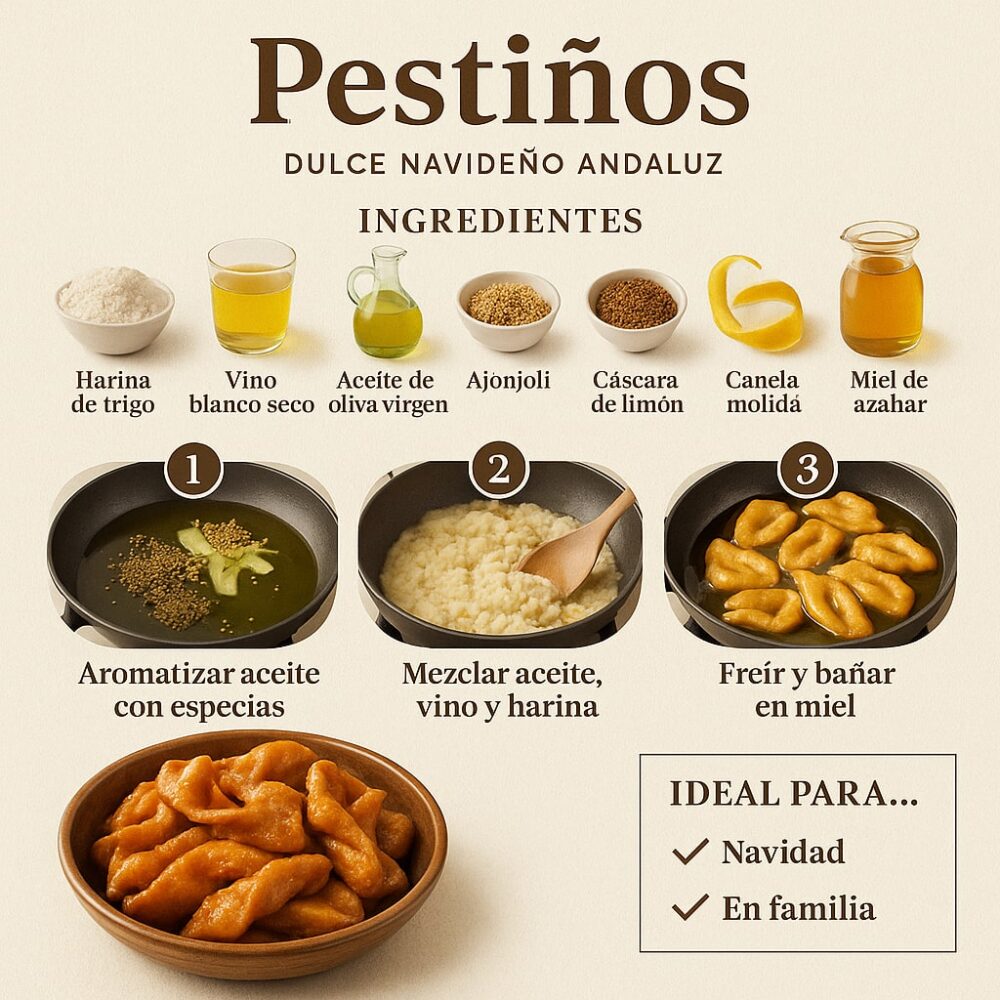
In December, in any Andalusian kitchen worth its salt, it smells of the same thing: hot oil with lemon peel, toasted aniseed and honey. These are pestiños, the quintessential Christmas sweet of the south, and one of those desserts your grandmother used to make by the kilo and yours always turned out half as good. Let’s fix that.
The pestiño is an Andalusi legacy. A thin flour dough made with white wine and flavoured oil, fried and coated in honey. It sounds simple, but there’s a trick: the oil has to be properly infused, the dough has to rest, and the honey has to be heated to just the right point or it ends up sticky instead of glossy. This is the classic version, the one made in Seville, Córdoba and Málaga with only minor variations.
Quick recipe card
| Detail | Value |
|---|---|
| Servings | 30-35 pestiños (6-8 people) |
| Difficulty | Medium |
| Dough resting | 1 hour minimum |
| Frying | 2-3 min per batch |
| Storage | 10-15 days in an airtight tin |
Where pestiños come from
Pestiños have their roots in Andalusi cooking. Very similar fried sweets are documented in Hispano-Muslim cookbooks of the 13th century, and from there they passed into Christian convent confectionery, which adopted them for Christmas and Holy Week. In eastern Andalusia (Granada, Jaén) they tend to be thicker and are sometimes coated in sugar and cinnamon; in western Andalusia (Seville, Cádiz, Huelva) honey rules. This recipe is the honey version, the traditional one.
Ingredients
For about 30-35 pestiños:
- 500 g soft wheat flour (pastry flour)
- 150 ml dry white wine (a fino sherry or a Montilla-Moriles works perfectly)
- 150 ml extra virgin olive oil (preferably a mild Aceite de Oliva Virgen Extra DOP Sierra de Cazorla or similar)
- 1 tablespoon sesame seeds
- 1 tablespoon aniseed (whole)
- The peel of 1 lemon (yellow part only)
- 1 teaspoon ground cinnamon
- 1 pinch of salt (about 2 g)
- Mild olive oil for frying (about 750 ml – 1 l)
For the honey coating:
- 400 g orange blossom or wildflower honey
- 100 ml water
- 1 tablespoon lemon juice
Step-by-step method
- Infuse the oil (10 min). In a small frying pan, heat the 150 ml of oil over medium heat. Add the lemon peel, aniseed and sesame seeds. As soon as it starts to sizzle lightly and smells of toasted aniseed, remove from the heat. It must not smoke. Strain and reserve the oil; keep the sesame and aniseed, as they go into the dough.
- Cool the oil (15 min). Let it come down to room temperature. If you pour it hot onto the flour, it will cook the flour and ruin the dough.
- Mix the liquids. In a large bowl, combine the cooled oil with the white wine, cinnamon and salt. Stir.
- Add the flour (5 min). Add the flour little by little, mixing first with a spatula and then by hand. Add the reserved sesame and aniseed too. The dough should be workable, neither sticky nor hard. If it feels dry, add a splash more wine; if sticky, add a spoonful more flour.
- Knead and rest (1 hour). Knead for 5 minutes on the worktop until smooth. Shape into a ball, cover with a cloth and let it rest for at least 1 hour. This rest is non-negotiable: it hydrates the flour and lets the dough stretch without tearing.
- Roll out very thin (15 min). Dust the worktop with flour and roll out to 2 mm. If it’s thick, the pestiño comes out hard. Cut squares of about 8×8 cm.
- Shape them. Take two opposite corners of each square and join them in the centre, pressing with a finger dampened in water or wine so they stick. This is the classic “little bow”.
- Fry (2-3 min per batch). Heat plenty of mild oil to 170 °C (if you drop in a breadcrumb, it should brown in 10 seconds). Fry the pestiños a few at a time, turning them once the bottoms are golden. Drain on kitchen paper.
- Prepare the honey (5 min). In a saucepan, heat the honey with the water and lemon juice over medium heat until fluid, without letting it boil hard.
- Coat the pestiños. Dip them one by one for 10 seconds, drain and place on a rack with a plate underneath to catch the drips.
Tips and variations
- The wine matters. A fino or a dry oloroso from DO Jerez or DO Montilla-Moriles adds depth. Any white wine will work, but the result is flatter.
- If you don’t like aniseed, reduce it to half a teaspoon. Removing it altogether changes the pestiño and it’s no longer a pestiño.
- Sugared version. Instead of coating them in honey, roll them in cinnamon sugar straight from the fryer. More Granada than Seville.
- Common mistake: frying with the oil too hot. They brown on the outside and stay raw inside. 170 °C, no more, no less. If you have a thermometer, use it.
Pairing and serving
Pestiños call for something sweet and full-bodied. A Pedro Ximénez from Montilla-Moriles or a Málaga Moscatel are the textbook pairings. If you prefer something less heavy, a sweet oloroso. On a Christmas dessert table they go well with polvorones and mantecados; serve them on a platter with a separate bowl of honey for anyone who wants to re-coat.
If you’re interested in traditional seasonal sweets, take a look at homemade milk torrijas too, to round off the Christmas-Lent cycle.
Frequently asked questions
How long do pestiños keep? In an airtight metal tin, 10-15 days. If you store them in a plastic container, they lose their crispness sooner.
Can they be frozen? Yes, but without the honey coating. Fry them, let them cool, freeze in a bag. When thawing, heat for 5 min in an oven at 150 °C and coat in warm honey.
Can I bake them instead of frying? You can, but they aren’t pestiños anymore, they’re something else. 180 °C for about 12 minutes. They come out drier and less crisp. Frying is part of the recipe.
Do they contain gluten? And is there a gluten-free version? Yes, they contain wheat flour. For a gluten-free version, replace it with a gluten-free baking flour blend (rice flour + starch + xanthan gum) and add 20 ml more wine, as it absorbs differently. The result is more crumbly but it works.
Tasty Things Recipes Seville #Andalucía #fritura #miel #Navidad #pestiños #receta

 Lumara: the essence of Extremadura finds its home in Chamberí
 How to Make an Authentic Valencian Paella Step by Step (for 4 people, at home and in Valencia)
 Zhen and Chinese New Year: A Menu That Turns Madrid into Shanghai
Comentarios cerrados