Pil pil cod: how to bind the sauce without it breaking
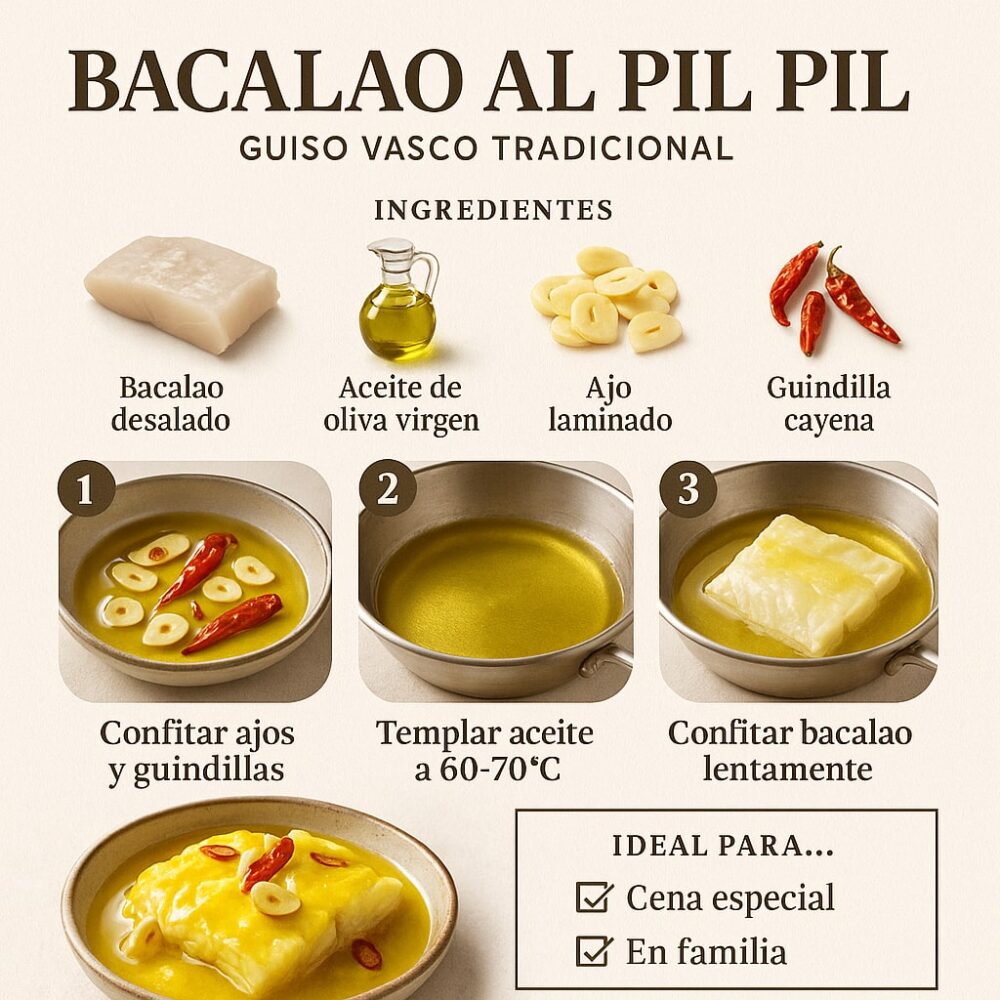
Pil pil cod is one of those dishes that separates those who cook from those who really cook. Four ingredients: cod, oil, garlic and chili. And a sauce that, when it works, seems like magic: golden, glossy, thick like a soft mayonnaise. When it doesn’t, it’s a puddle of oil with sad cod floating in it.
The good news is that it’s not magic. It’s cod gelatin emulsified into oil at low temperature. If you understand what happens inside the pot, it stops failing you. Let’s get to it.
What pil pil is and where it comes from
Pil pil is a Basque preparation from the late 19th century, born of scarcity and of salt-cured cod that arrived from the Cantabrian Sea and Norway. The popular story places it in Bilbao during the Carlist blockade of 1836, when a merchant received a huge order of cod and had to find ways to use it. The technique, in any case, took hold in farmhouses and gastronomic societies of Biscay.
The name comes from the sound: pil, pil, pil, the soft chup-chup of oil bubbling over very low heat while the cod releases its gelatin. If your pot makes fshhhh, you’re in trouble. Pil pil asks for calm.
The dish at a glance
| Detail | Value |
|---|---|
| Origin | Basque Country, 19th century |
| Servings | 4 |
| Difficulty | Medium (the emulsion has a trick) |
| Total time | 25-30 min (plus cod desalting) |
| Key oil temperature | 60-70 °C to bind |
| Allergens | Fish |
Ingredients (serves 4)
- 4 desalted cod loins with skin, about 180-200 g each (preferably from the center, thick)
- 400 ml extra virgin olive oil mild (an arbequina PDO or a young Hojiblanca; don’t use a very intense picual, it will overpower the cod)
- 6 garlic cloves thinly sliced
- 2 dried cayenne chilies (or 1 if you don’t like spice)
- Salt — only if the cod has come out bland after desalting
Nothing else. No flour, no cream, no “a splash of stock”. Real pil pil is four things.
The cod: choice and desalting
Buy salt-cured cod of good origin (Iceland or Norway, thick loins) or ready-desalted cod at the right point from a trusted fishmonger. If you buy it already desalted, ask for it “at the point” and use it within 24 h.
If you desalt it yourself:
- Rinse the loins under the tap to remove surface salt.
- Place them in a bowl of cold water, skin side up, covered by 3 fingers of water.
- Refrigerator, 36-48 h depending on thickness, changing the water every 8 h.
- Taste a small raw corner before cooking. It should be flavorful, never salty.
Before cooking, dry them very well with kitchen paper. Surface moisture is the enemy of the emulsion.
Step-by-step preparation
1. Confit the garlic (5 min)
In a shallow earthenware or cast-iron pot (essential: wide, not deep), add the 400 ml of oil with the sliced garlic and chilies. Very low heat. We want the garlic to turn golden slowly, without burning: it takes 4-5 minutes to reach a pale blond color. If it goes dark brown, it turns bitter.
Remove the garlic and chilies with a slotted spoon and set them aside. The oil is now fragrant.
2. Temper the oil (2 min)
Here is the first key. Turn off the heat and let the oil drop to about 60-70 °C. No thermometer? Dip your fingertip carefully for a second: it should be warm but bearable. If you put the cod into boiling oil, it cooks on the outside, releases its gelatin poorly and turns dry.
3. Confit the cod (8-10 min)
Place the loins skin side down, pressed firmly to the bottom. Turn the heat to the minimum. The oil should be between 70 and 80 °C: you should see fine bubbles rising from the cod, never a strong boil.
Confit 4 minutes on the skin side, then turn carefully (with a wide spatula) and another 3-4 minutes. The point: the cod flakes open when gently pressed with a finger, but remains juicy. If you overcook it, it releases water and loses gelatin.
Remove the loins to a plate and cover them with aluminum foil.
The emulsion: how to bind the pil pil
Here comes what everyone wants to know. Pil pil sauce is an emulsion of cod gelatin in oil. The gelatin (hydrolyzed collagen) released by the fish during confiting acts as a natural emulsifier, just like lecithin in mayonnaise.
At the bottom of the pot you have the oil plus a milky liquid: that is gold. It’s the gelatin.
Steps:
- Separate the hot oil from the pot into a ladle or jug, leaving only that milky juice in the pot (and a few spoonfuls of oil to start).
- Lower the pot off the heat or leave it on the lowest heat. The ideal temperature for binding is 60-65 °C. Hotter, and it splits.
- With a fine-mesh strainer or an empty whisk, start making wide, constant circular movements over the bottom, grazing the liquid. The strainer traps air and breaks the oil into small droplets that gradually integrate into the gelatin.
- Add the tempered oil slowly, in a fine stream, never stopping the movement. Like a mayonnaise. You’ll see the sauce gain body, turning paler and thickening.
- Once you’ve incorporated all the oil and the sauce is glossy and thick, taste it. Adjust the salt if needed.
It should have the color of a light custard, with enough body to coat a spoon.
The strainer trick (and other alternatives)
The mesh strainer is the modern traditional method because it introduces air while you move. It works wonderfully. Alternatives:
- Swirling the pot: the grandmother’s method. Grab the handle with a cloth and move the pot in circles over the fire, very gently. It requires wrist and patience (5-8 min). It is the “author’s” pil pil.
- Small wire whisk: it works if you’re careful not to break the cod (which is why you remove it first).
- Immersion blender on low speed: it works, but the result is denser and less elegant. Emergency option.
How to rescue a broken pil pil
If the sauce has split (oil on one side, liquid on the other), don’t throw it away. There are two proven rescues:
Rescue 1 — with cold water: Put a spoonful of very cold water in a clean bowl. Add a spoonful of the split sauce and start moving with the strainer or whisk. Once it binds, gradually add the rest of the split sauce in a thin stream. The sudden drop in temperature helps restart the emulsion.
Rescue 2 — with extra gelatin: If you have leftover cod skin, gently warm it in a little water for 5 minutes, strain, and use that gelatinous liquid as a base. Add the split oil in a thin stream while moving with the strainer.
The most common mistake: oil that is too hot. If it goes above 80 °C, the gelatin denatures and won’t bind.
Plating and service
Return the loins to the pot skin side up, spoon the sauce over them and warm for 1 minute on low heat so they come back to temperature. Crown with the sliced garlic and chilies.
Serve straight from the pot, with village-style bread on the side. It’s a dish to share at the table, not to plate on a slate.
Pairing and garnish
Pil pil calls for a white wine with acidity and some body to cut the unctuousness of the oil. A txakoli DO Getariako Txakolina is the classic partner. If you prefer something with more structure, a godello DO Valdeorras or an albariño DO Rías Baixas that has aged on fine lees.
As a garnish, nothing. Or at most some thin panadera potatoes on the side. Pil pil is already the whole dish.
If you enjoy Basque fish cooking, take a look at hake in green sauce with the exact right thickness: same philosophy of a sauce bound with the fish’s own gelatin.
FAQ
Can pil pil be made with fresh cod? Yes, but it turns out different and less bound. Salt-cured cod releases much more gelatin. If you use fresh, add an extra piece of skin to the confit to compensate.
How long does it keep in the fridge? 24 hours covered. To reheat, over very gentle heat while moving the pot; if it splits, apply the cold water trick. Don’t put it in the microwave: the sauce will certainly separate.
Can it be frozen? The confit cod yes (up to 2 months). Pil pil sauce doesn’t freeze well; it splits when thawed. Better to make it fresh with the reserved confit oil.
Why does my sauce look transparent instead of yellow? Too little gelatin. Either the cod wasn’t of good quality, or it was over-desalted (it loses proteins while soaking), or you cooked it over high heat and the juice evaporated. Insist on thick loins and minimum heat.
Recipes Biscay #aceite #bacalao #emulsión #gastronomia #receta
 Lumara: the essence of Extremadura finds its home in Chamberí
 How to Make an Authentic Valencian Paella Step by Step (for 4 people, at home and in Valencia)
 Zhen and Chinese New Year: A Menu That Turns Madrid into Shanghai
Comentarios cerrados