La Botica de Matapozuelos: eating pine-resin pine nuts in the village pharmacist's house
A village of 900 residents with a Michelin star
There are gastronomic trips you make for show and others you make because, quite simply, nobody cooks like this anywhere else. Matapozuelos, a village in Valladolid twenty minutes from the capital, falls squarely into the second group. For decades the town was known for housing Valwo, one of the most important zoos in northern Spain; now its main attraction is La Botica de Matapozuelos, and not every village can boast a Michelin star among its residents.
We went on a Saturday at midday, with a reservation made three weeks in advance, on an autumn route through Tierra de Pinares. Four adults, eager for níscalos and for that resin pine nut the gastronomic press has been talking about for years. Spoiler: we left with the feeling of having eaten an entire landscape.
Restaurant quick facts
Before getting into the details, the basic information you’ll want if you’re planning a visit:
| Detail | Value |
|---|---|
| Address | Plaza Mayor, 2 — Matapozuelos (Valladolid) |
| Chef | Miguel Ángel de la Cruz García |
| Opened | May 2002 |
| Awards | 1 Michelin star, 1 green star, 2 Repsol Suns |
| Phone | 983 83 29 42 |
| Average ticket | Approx. €70–90 per person |
| Tasting menu | From around €65 (without wine pairing) |
The restaurant opened its doors in Matapozuelos in May 2002 and is led by chef Miguel Ángel de la Cruz, with one Michelin star, one green star and two Repsol Suns.
From old pharmacy to a benchmark of pine cuisine
The name is not decorative. The restaurant occupies an old farmhouse where a pharmacy once operated, next to the village town hall. The house is more than 150 years old, was restored at the beginning of this century and retains its original materials—adobe and pine wood—combined with modern comfort. There is a private dining room that still holds the original furniture of the traditional pharmacy, a detail they explain without waiting for applause.
The project is family-run in the serious sense of the term. La Botica is both restaurant and roast house: at the stoves are Teodoro de la Cruz, the father, a master roaster belonging to the Official Association of Master Roasters of Castilla y León, and Miguel Ángel de la Cruz, head chef.
Alberto, the other brother, looks after the dining room and the cellar. In short: two generations and three brothers sharing traditional roasting, creative cooking and service. It works.
Who is Miguel Ángel de la Cruz
It’s worth knowing him because he explains the dish. Miguel Ángel de la Cruz was born in Madrid in 1976 and develops contemporary cuisine at La Botica de Matapozuelos; with one Michelin star and two Repsol Suns, the specialist press considers him one of the rising talents of Spanish cuisine, standing out for his work with the natural resources of his surroundings.
He himself describes himself as a self-taught cook and defends a natural, artisanal and local cuisine.
The label that suits him best is “forager cook”. He is a committed forager who champions botany, sustainability—biomass stove, wood-fired cooking, cheese and local livestock—and the reinterpretation of nearby resources. No green posturing: the Michelin green star was given to him for doing it for real, not for the storytelling.
What is “pine cuisine” (and why you won’t find it anywhere else)
Here lies the key to the matter. Matapozuelos sits right in the heart of Tierra de Pinares. Tierra de Pinares is a natural region in Castilla y León, comprising the north of the province of Segovia and the south of the province of Valladolid, where a dense forest of Pinus pinaster and Pinus pinea is concentrated.
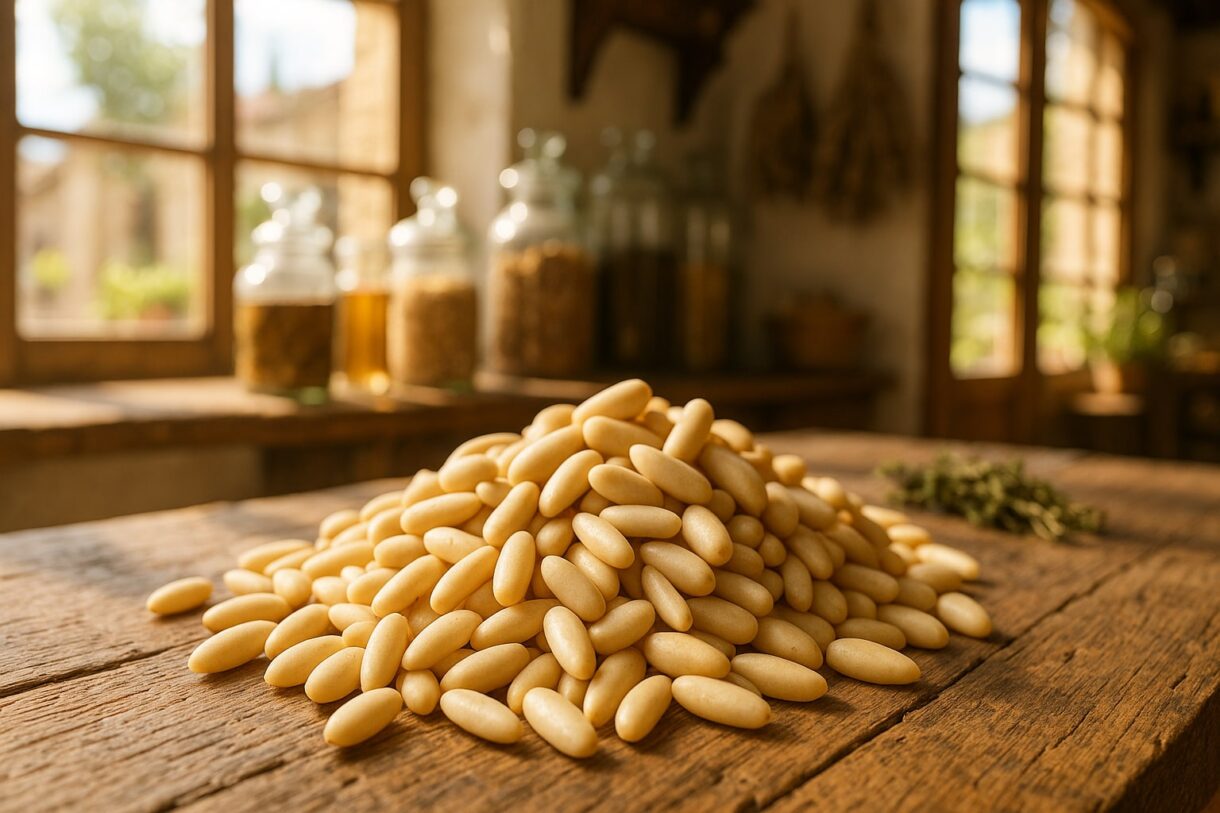
Two pines, two uses. In Tierra de Pinares the resin pine (Pinus pinaster) and the stone pine (Pinus pinea) predominate. The stone pine gives the classic white pine nut. The resin pine yields resin—the famous miera—and also a smaller cone, with a pine nut of more intense, resinous, almost balsamic flavour. That is the resin pine nut that de la Cruz has been working with, like few others in Spain, for years.
This region is known as “Tierra de Pinares”, which is why pine cones play a prominent, curious and almost magical role in the elaborate proposal, available à la carte and in tasting menus. We’re talking about pickled green pine cone, resin in ice creams and vinaigrettes, toasted and green pine nuts, young pine shoots. If it sounds like laboratory trickery, relax: on the plate it’s cooking for flavour, not for gimmicks.
And alongside it, the other pillar: Miguel Ángel de la Cruz cooks his territory with unusual delicacy; his dishes are a walk through the pine forests, the vegetable gardens and the dryland fields of Valladolid.
The menu and the “Walk Through the Surroundings” tasting menu
There is an à la carte option, but if you go once, go for the tasting menu. It is thanks to these dishes and to their “Walk Through the Surroundings” menu that La Botica has earned national recognition, alongside one Michelin star and two Repsol Suns.
What we tried, in order:
- Forest appetizers: a crisp cracker with pine resin and a bite of pickled green pine cone. You’re fully immersed in the concept from the first minute. Bitterness, acidity, balsamic aroma.
- Níscalo (Lactarius deliciosus) grilled with cured yolk: in season, this mushroom is outstanding. Exact fire point, dry on the outside and juicy within. No frills.
- Green pine cone broth with sheep’s milk dairy: the dish I mentally took home. Translucent broth, controlled bitterness, dairy fat that rounds it off. This is not eaten in any other restaurant in Spain.
- River trout marinated with dryland herbs: light, without the aggressive saltiness of poorly measured cures.
- Wood-fired oven roast lamb (the father’s part): this is where Teodoro comes in. Crisp skin, well-melted intramuscular fat, juicy meat. A reminder that, beyond vegetable haute cuisine, this is serious Castilian roasting.
- Resin pine ice cream with sweet crumbs: a dessert that rounds off the argument. The ice cream is subtle, nothing medicinal, with a faintly minty undertone.
If you’re interested in reference Castilian roast houses, you’ll also enjoy reading about how to make roast suckling pig in a home oven with crisp skin.
Service and cellar
Alberto runs the dining room and the wine service. The team has adapted to the refinement that Miguel Ángel’s cooking demands, explains the dishes with ease and answers diners’ questions with confidence. What critics wrote before us is true: pairing the subtle flavours of vegetables with the powerful wines of the region is a complicated task, and Alberto doesn’t always come out victorious. Ask for advice, but don’t commit to a 15-degree Toro if you’re eating a vegetable menu: we ordered a parcel-grown verdejo and a light red from the area, and they paired better.
If your thing is enormous wine cellars, Castilla y León has another mandatory stop: Ambivium in Peñafiel, with 3,500 wine references from vineyards.
Price and value for money
We paid around €95 per person for the long tasting menu, with water, bread, coffee and wine by the glass (two whites and a red shared among four). The published rate indicates an average price of €70 to €90, with tasting menus from €65. In other words: if you go without an expensive wine pairing, the numbers land at the lower end.
For what you’re eating—hyperlocal produce, refined technique, coherent concept, Michelin star—it’s a reasonable price. Compared with what they charge you in Madrid for dishes that don’t even remember where they came from, here there is honesty.
How to get there and when to go
Matapozuelos is 20 kilometres from Valladolid, a direct exit via the A-6 / A-62. There is parking without problems right on the Plaza Mayor. Mind the hours: they close many weeknights, so the usual approach is to go for lunch on Saturday or Sunday. Booking essential by phone or through their official website, especially in mushroom season (October–November) and in spring with the young shoots.
Verdict
3 hams 🍖🍖🍖
Essential. It’s one of those places you’d take a friend to on purpose, even if it means driving 400 km. Who it’s for: curious diners interested in the produce and the idea of “eating a landscape”, people who enjoy a long, unhurried menu, lovers of the mycological and vegetal world. It’s not for someone looking for steak-wine-dessert without more (for that, the classic roast house serves the area very well).
I’ll go back, and go back in a different season—part of the fun is seeing how the forest changes on the plate every three months. The only real drawback remains the wine pairing: if you’re really into wine, prepare the plan with Alberto before you start. Otherwise, La Botica is the most honest answer to the question of where to eat resin pine nut and pine cuisine in Spain. There is no substitute.
We were in... Valladolid #estrella-Michelín #gastronomia #piñón #restaurante #Valladolid
 Lumara: the essence of Extremadura finds its home in Chamberí
 How to Make an Authentic Valencian Paella Step by Step (for 4 people, at home and in Valencia)
 Zhen and Chinese New Year: A Menu That Turns Madrid into Shanghai
Comentarios cerrados