Yacón: the Andean tuber that tastes like pear and sweetens without raising sugar
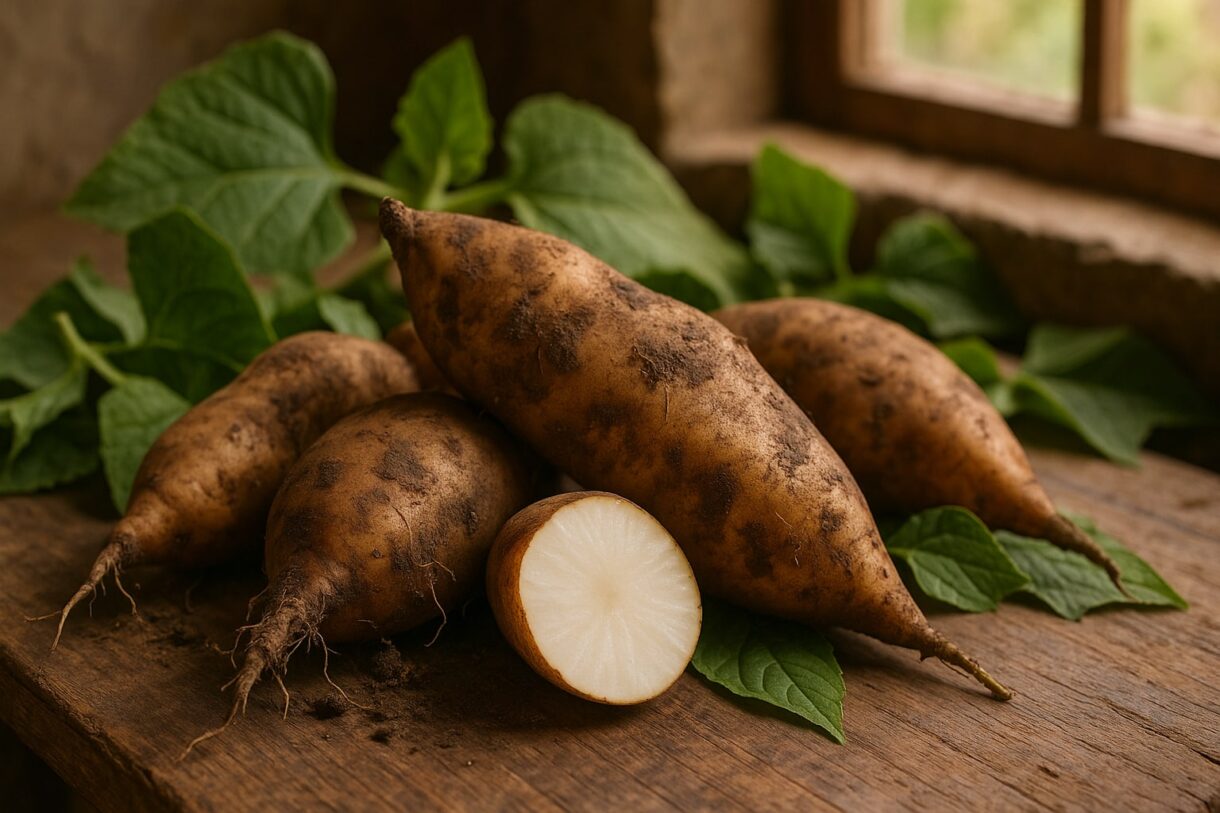
The first thing that surprises you about yacón when you bite into it raw is that it doesn’t taste like a tuber. It tastes like water pear, with a hint of watermelon and jicama. Crunchy, juicy, very hydrating texture. And here’s the strange part: it’s sweet, very sweet, yet it barely moves blood sugar. It’s not magic, it’s chemistry — and we’ve been slow to catch on in Europe.
What yacón is and where it comes from
Yacón (Smallanthus sonchifolius) is an Andean tuber from the same family as the sunflower. It has been cultivated for over a thousand years on the slopes of Peru, Bolivia, Ecuador and northern Argentina, between 1,000 and 3,500 meters above sea level. The Incas already carried it as provisions on long journeys: it’s filling, hydrating and gives a burst of sweetness without weighing down the stomach.
It looks like a sweet potato on the outside — brown skin, elongated shape — but inside it is translucent, somewhere between white and pale yellow, juicy like a fruit. In fact, in many Andean markets it is sold at the fruit stall, not the vegetable stall.
Pear flavor: why it fools the palate
That pear flavor comes from the combination of free fructose (not much) and fructooligosaccharides (plenty). FOS are long-chain sugars that the tongue perceives as sweet but the small intestine cannot break down. The result: sweetness in the mouth, zero glycemic spike in the blood.
It’s the same family of molecules you find in chicory, garlic, onion or artichoke. But in yacón the concentration is remarkable: between 40 and 70% of its carbohydrates are FOS.
Fructooligosaccharides: the metabolic trick
Here’s the key. The fructooligosaccharides in yacón reach the colon intact, where good bacteria (bifidobacteria and lactobacilli) ferment them. They act as a prebiotic — food for your gut microbiota, so to speak.
The glycemic index of yacón is around 1, compared with 65 for table sugar or 55 for honey. That’s why it has become the subject of study for diets aimed at people with type 2 diabetes, though always under medical supervision. It is not a medicine; it is a food with a curious metabolic profile.
Yacón benefits that are actually documented
- Prebiotic effect: FOS feed the intestinal microbiota. Studies published in the Journal of Agricultural and Food Chemistry confirm this.
- Low calorie content: about 22 kcal per 100 g fresh, compared with 86 for sweet potato.
- Rich in potassium: about 185 mg per 100 g.
- Feeling of fullness: the fiber bulk helps.
Beware of miracle-supplement hype. Yacón does not lose weight on its own, nor does it “cure” anything. It is a useful food within an orderly diet. If you have diabetes, consult your endocrinologist first, especially regarding the concentrated syrup.
Fresh yacón vs yacón syrup vs flour
You will find it in three formats:
- Fresh root: the best option if you can find it. Eaten like fruit, peeled and raw.
- Yacón syrup: obtained by evaporating the juice of the root. Dark honey-like texture, molasses flavor with a touch of caramel. A good syrup contains between 40 and 60% FOS.
- Yacón flour: dehydrated and ground root. Used in baking to replace part of the flour and add sweetness.
The syrup is the most practical for everyday use, but be careful: by concentrating the sugars, it also raises the glycemic index somewhat. It is not calorie-free; it provides about 130 kcal per 100 g (compared with 400 for sugar).
How to eat yacón at home
Raw, in thin slices, with a little lime and Maldon salt: a very fresh starter. Also in salads, cut into sticks (it holds up well without oxidizing much if you soak it in water with lemon), with lamb’s lettuce, pomegranate and a dressing of Sierra de Cazorla PDO olive oil and apple cider vinegar.
Cooking destroys part of the FOS — heat partially breaks them down — but it remains interesting. In Andean soups it is added at the end, for about 5 minutes, so it stays al dente.
And as a natural sweetener, yacón syrup works in yogurt, toast, granola and sponge cakes. If you’re into the world of functional foods, you may be interested in how we cover other Andean roots in our article on Andean maca and its three varieties.
Dosage: how much to take without overdoing it
Here you need a steady hand. FOS are wonderful, but in excess they cause gas, bloating and osmotic diarrhea. Individual tolerance varies greatly.
Conservative recommendation to start:
- Fresh root: 50–100 g per day.
- Syrup: 1–2 tablespoons (15–30 ml).
- Flour: 10–20 g per day in preparations.
Increase slowly over two weeks. If you notice discomfort, reduce the dose.
Where to buy yacón in Spain
In Madrid you can find it in Latin American shops in Cuatro Caminos, Usera and Tetuán — mainly Peruvian and Ecuadorian stalls. Average price of fresh root: around €6–9/kg, depending on the season.
The syrup has made its way into herbalists, organic shops such as Herbolario Navarro and some parapharmacies. It costs around €12–18 for a 250 ml jar. Check the label: the higher the FOS percentage, the better. Avoid products with added sugar or glucose (there are some, believe it or not).
Flour is harder to find, but online it is available from shops specializing in Andean superfoods.
How to store it
Fresh root keeps for 2–3 weeks in the bottom of the fridge, wrapped in kitchen paper. If you leave it in the sun for a couple of days, its sweetness increases — the starches turn into simple sugars (the “sun-ripening” effect used in the Andes).
The syrup, in a closed pantry, keeps for about 12 months. Once opened, refrigerate and consume within 3–4 months.
FAQ
Is yacón suitable for diabetics? Its low glycemic index makes it interesting, especially the fresh root. But consult your endocrinologist before replacing sweeteners, especially with the concentrated syrup.
Can it be frozen? Raw root loses texture when frozen (it becomes soft once thawed). As a purée or juice it keeps well for 3 months at -18 ºC.
Does it contain gluten? No. Neither the root, the syrup nor the yacón flour contains gluten. Suitable for coeliacs.
Can it be given to children? Yes, in moderation because of the gas issue. In small amounts (30–50 g of fresh root) it is just another fruit.
Healthy Eating Tasty Things #alimentación saludable #índice glucémico bajo #fructooligosacáridos #superalimento #tubérculo andino #yacón


 Lumara: the essence of Extremadura finds its home in Chamberí
 How to Make an Authentic Valencian Paella Step by Step (for 4 people, at home and in Valencia)
 Zhen and Chinese New Year: A Menu That Turns Madrid into Shanghai
Comentarios cerrados