The Ronqueo (Cádiz): bluefin tuna from the almadraba at Barbate's shore
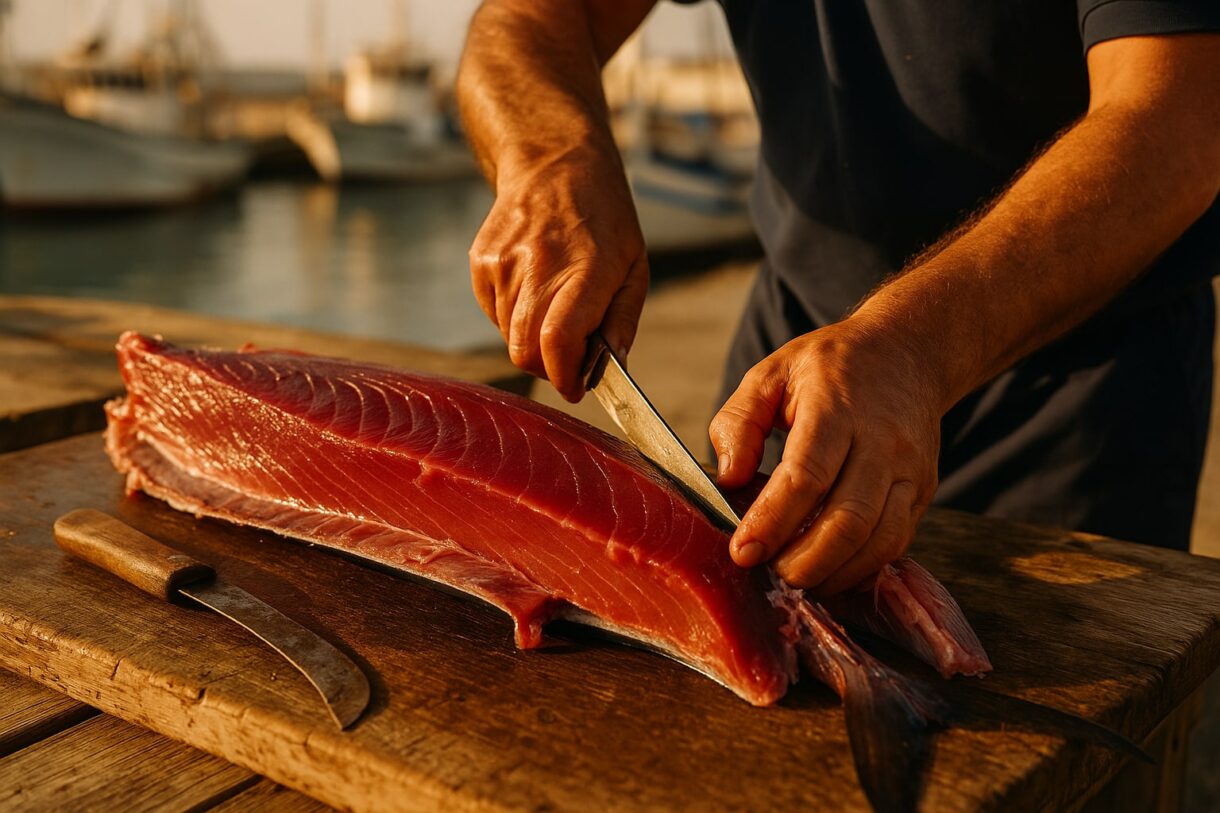
I came back from Barbate with my hands smelling of the sea and my notebook full of notes. If you have never seen a ronqueo live, it is hard to explain without sounding exaggerated: it is butchering, it is a spectacle, and it is the memory of a craft that has been practised on this coast for more than three thousand years. A long knife, a 200-kilo tuna on the table, and a sound — the one that gives it its name — that recalls a snore when the blade scrapes the backbone.
This article is about exactly that. What the ronqueo is, when to see it, where to eat the best cuts of wild bluefin tuna from Cádiz, and why it is worth heading down to Barbate in spring even if you live in Madrid.
What the bluefin tuna ronqueo is
The ronqueo is the traditional butchering of almadraba bluefin tuna. It is done by hand, with long, sharp knives, on a steel table, and it follows a very specific order that makes use of virtually the whole animal. The name comes from the noise: when the edge of the knife passes along the backbone, it produces a hoarse, dry sound, like a snore. Hence, ronqueo.
It is not a show staged for tourists, although today it can be watched live. It is the way tuna caught by the almadraba has always been butchered in Barbate, Zahara and Conil. The ronqueador, as the operator who directs the cut is called, extracts more than 20 distinct pieces from the animal, each with its own name, texture and culinary use.
Where it comes from: Phoenicians, the almadraba and three thousand years of craft
Almadraba fishing on the Cádiz coast is one of the oldest fishing techniques in the Mediterranean. The Phoenicians brought it some 3,000 years ago and the Romans later adapted it: there are remains of Roman salting factories at Baelo Claudia, a short distance from Barbate, where tuna was already being cut up to make garum. The system of nets set across the migratory route of bluefin tuna has barely changed in its essentials.
The ronqueo, as the butchering associated with that fishery, is the final phase of a very long process: the tuna enter the chamber of the almadraba, the levantá is carried out (the raising of the nets at the moment of capture), they are slaughtered and taken to the fish market. There the cutting begins.
The Barbate almadraba: coordinates, quota and season
Barbate lies on the Atlantic coast of Cádiz, between Conil and Zahara de los Atunes, at roughly 36°11′ N and 5°55′ W. Its almadraba is one of the four historic ones still in operation along the Cádiz coastline, together with those of Conil, Zahara and Tarifa.
The almadraba season in Cádiz runs from mid-April to early June. It coincides with the arrival of bluefin tuna (Thunnus thynnus) from the Atlantic into the Mediterranean to spawn. The tuna arrives at its best: laden with infiltrated fat after the journey, with the brightest and juiciest flesh of the year.
The catch is regulated by ICCAT (the International Commission for the Conservation of Atlantic Tunas), which assigns annual quotas by country and by fishing gear. Spain catches roughly 6,000 tonnes of bluefin tuna a year in total, part of which is divided among the Cádiz almadrabas. It is sustainable, selective fishing with a closed quota: when the ceiling is reached, it is over.
How a ronqueo is done, step by step
A well-executed ronqueo lasts between 20 and 40 minutes, depending on the size of the specimen. The classic order is as follows:
- The tuna is placed on the table, face up, and opened along the belly.
- The viscera are removed and cleaned separately (the heart and the roe are used).
- The facas (the fins and tails) are separated and go to salting.
- The head is cut off and from it morrillo, mormo, contramormo, galete and facera are taken.
- The loins are opened following the backbone. This is when the snoring sound occurs.
- From the loins descargado, descargamento, tarantelo, ventresca and solomillo are extracted.
- The remains clinging to the backbone are cleaned: the espineta.
A medium-sized almadraba tuna weighs between 180 and 250 kilos. More than 20 commercial pieces are obtained from a single specimen.
The parts of the bluefin tuna: a quick map so you don’t get lost
Not all parts are cooked the same way. These are the ones you will see on the menu most often:
- Ventresca: the belly. Infiltrated fat, an almost creamy texture. Grilled on a hot plate, turned once.
- Morrillo: upper part of the neck. Very juicy, ordered rare.
- Tarantelo: triangular piece between the ventresca and the descargamento. Well balanced, ideal for tataki.
- Descargado and descargamento: lean loins. For tartare, sashimi or carpaccio.
- Solomillo: small piece under the backbone. Very tender, cooked whole on the grill.
- Mormo and contramormo: from the head, with a short fibre. Stewed with onions.
- Galete: the tuna’s cheek. Long stew, unctuous texture.
- Facera: cheek meat. A small quantity per animal, much in demand.
- Espineta: the remains of the backbone. For tomato dishes or traditional stews.
If I had to choose three for a first encounter: grilled ventresca, tarantelo tataki and galete stewed with onions. That shows you the range of what the animal yields.
Where to watch a ronqueo live in Barbate
In season (April–June), there are two main ways to see it:
- Ronqueos at the Barbate fish market, organised with the local brotherhood and some almadraba companies. They usually include a visit to the port, an explanation of the fishing art and a tasting afterwards. Booking is essential.
- Ronqueos in restaurants, done as part of a gastronomic day. Less technical, more geared to diners, but with the same professional ronqueador.
In May the Barbate Tuna Route takes place, with special menus in some twenty restaurants in the town. It is the best time if you are going for the first time: more affordable prices, dishes designed to let you try variety, and the atmosphere of a town in festive mood.
Official information from the municipality and the calendar on the Barbate Town Council website.
Bluefin tuna restaurants in Barbate (and around)
These are places where the tuna is handled with expertise. Approximate average spend, always indicative:
- El Campero (Barbate). The absolute reference for almadraba bluefin tuna. A very long menu of cuts and preparations, from sashimi to stewed galete. Book weeks ahead in season. Approximate average spend 60–80 €/person. elcampero.es
- Casa Manteca (Cádiz city). Not in Barbate but worth the stop. Traditional bar, chicharrones and tuna in its own tinned preserves. Approximate average spend 25–35 €/person.
- Trasmallo de Agustino (Zahara de los Atunes). Village cooking, seasonal tuna, moderate prices. Approximate average spend 35–45 €/person.
- La Taberna del Campero (Barbate). The informal sister of El Campero, more bar-style and tapas. Approximate average spend 30–40 €/person.
If you go in high season, book. Turning up without a reservation on a Saturday in May in Barbate is a lost cause.
How to cook each part at home (if you get hold of the product)
If you buy fresh almadraba tuna from the fishmonger (or frozen at -20 °C, essential against anisakis if you are going to eat it raw), these are the quick rules:
- Ventresca: very hot griddle, 45 seconds per side, flaky salt when serving.
- Tarantelo or descargado: 20 seconds’ sear on the outside per side, raw centre. Tataki with soy sauce, ginger and sesame oil.
- Galete: 2-hour stew over low heat with onion, oloroso wine and black pepper.
- Mojama (loin cured in salt): thin slices, a few drops of extra virgin olive oil and toasted almond.
Critical point: bluefin tuna does not forgive overcooking. As soon as the flesh turns from ruby red to brown, you have lost the game. Sear hard, cut, and serve.
If you want a quick recipe using tinned tuna, here are the traditional tuna and tomato empanadillas: not the same thing, obviously, but it is the gateway for many people to oily fish.
When to go to Barbate: a practical calendar
- April: the season begins. First ronqueos, fewer people, variable weather.
- May: full swing. Tuna Route, almost daily ronqueos in restaurants.
- June: last call. The quota closes and the fishing art ends.
- July to March: outside almadraba season, but frozen tuna continues to be worked at -60 °C (ultra-freezing on board), which keeps its quality almost intact.
Combine it with Vejer de la Frontera (20 minutes), Zahara de los Atunes (15 minutes) and the Roman ruins of Baelo Claudia (40 minutes). A well-planned weekend is enough for three tuna meals without repeating a dish.
Frequently asked questions
What is the difference between almadraba bluefin tuna and bluefin from other fisheries? Almadraba tuna is wild, caught on its spawning migration route, with selective gear and a quota. Tuna from purse seine or longline may be the same species but caught in open waters, at another time of year and with different fat content.
Is it expensive to eat bluefin tuna in Barbate? It depends on the cut. A plate of stewed galete can cost around 18–22 €. A portion of grilled ventresca, between 28 and 38 €. In season, many restaurants offer set menus around 45–55 € with several cuts.
Can you take almadraba tuna home? Yes. Several companies in Barbate sell it vacuum-packed and ultra-frozen. It keeps for months at -18 °C and maintains quality if the cold chain is respected.
Is watching a ronqueo suitable for children? It is the butchering of a large animal, with blood and viscera. From 8–10 years of age it usually works well if it is explained. Very young children are better off with the tasting afterwards.
Cádiz Tasty Things #almadraba #atun #barbate #gastronomia #pescado #ronqueo
 Lumara: the essence of Extremadura finds its home in Chamberí
 How to Make an Authentic Valencian Paella Step by Step (for 4 people, at home and in Valencia)
 Zhen and Chinese New Year: A Menu That Turns Madrid into Shanghai
Comentarios cerrados