Andean maca: red, black or yellow, which to choose and what for
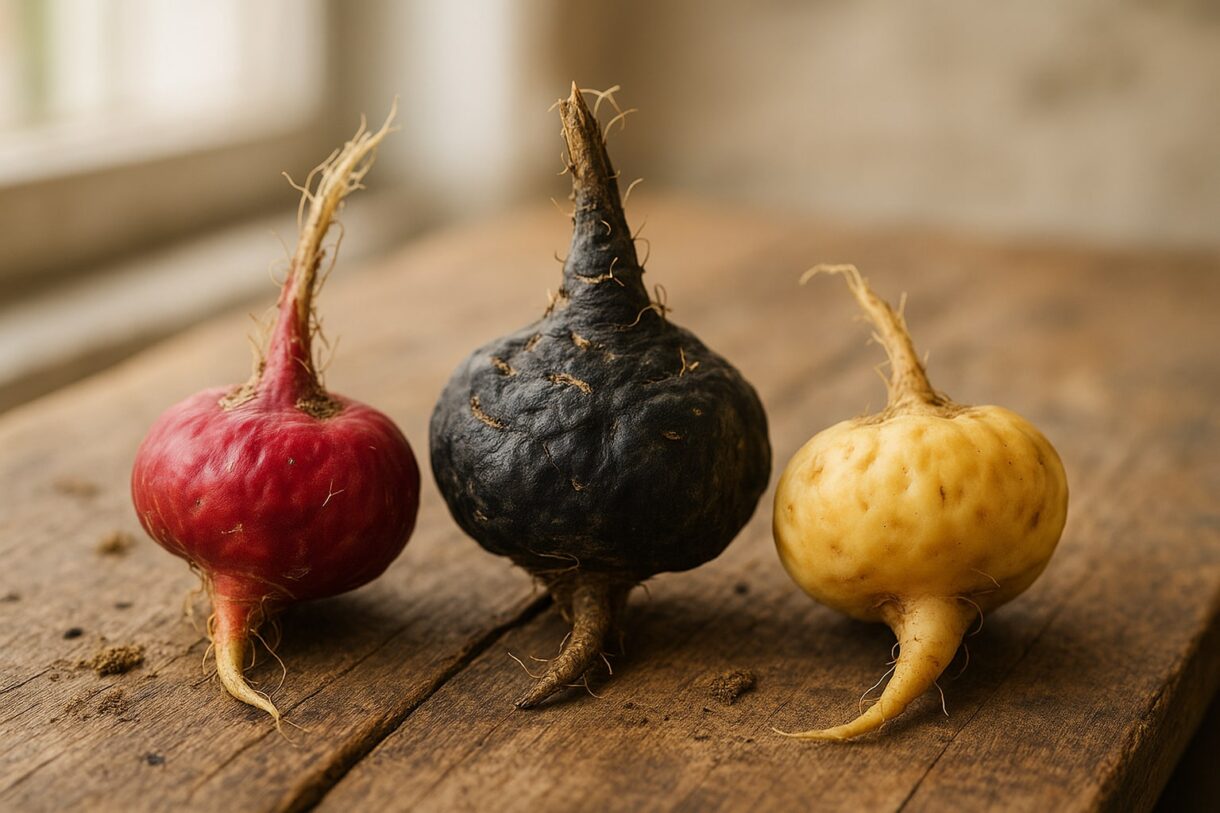
Maca has spent years sneaking onto herbalist shelves and gym shakes as if it were a single thing. It isn’t. There is yellow maca, red maca and black maca, and they don’t do the same thing even though they come from the same plant. If you’re going to spend 20-30 euros on a jar, it’s worth knowing which one you need.
Here’s what is more or less clear, what has been seriously researched, and what is shop-window hype.
What Andean maca actually is
Maca (Lepidium meyenii) is a cruciferous plant —a distant cousin of radish and broccoli— that grows above 4,000 metres in the Peruvian puna, mainly on the Junín and Pasco highlands. It has been cultivated there for more than 2,000 years and is part of the Andean diet as a cooked tuber, as flour, or as a fermented drink (the famous maca chicha).
What usually reaches Spain is most often the dried and ground hypocotyl, as powder or capsules. There are also gelatinised extracts (with the starch pre-cooked so it digests better) and standardised concentrated extracts.
Where the colour comes from: it’s not marketing
The colour doesn’t come from the packaging, it comes from the tuber itself. Every maca harvest contains variable proportions of yellow, red, purple, black and mottled roots. Serious producers separate them by hand after harvest and sell them by variety. That is what justifies the higher price of red and black: they make up only 15-25% of each harvest, compared with 60-70% for yellow.
Compositionally the three share a base —carbohydrates, fibre, amino acids, macamides, macaenes, glucosinolates— but the proportions change. And that is where the differences that matter begin.
Yellow maca: the basic one, the everyday one
It is the most common, the cheapest, and the one you get when you buy “maca” with no qualifier. It sits at around 15-20 €/250 g as powder.
It is the one most traditionally used in Peru as food. It provides sustained energy, has a complete amino acid profile, and is usually the recommended entry point if you’ve never taken maca. If you’re looking for a general boost in vitality, better rest and a bit more focus in the morning, yellow does the job without pretensions.
Flavour: earthy, slightly sweet, with a background reminiscent of malt. It pairs well with banana, cocoa and oats.
Red maca: the one for the prostate and for women in transition
Red is the variety with the most serious scientific literature behind it, and not by chance. A study published in Andrologia (Gonzales et al., 2005) showed reduced prostate volume in rats treated with red maca, an effect not observed with black or yellow. That is why it is associated with prostate health in men from around 45-50 years of age.
In women, it is credited with a good effect during perimenopause and menopause: hot flushes, mood changes, dryness. Clinical data are limited but point in that direction. It provides more polyphenols and anthocyanins than the other two, giving it a higher antioxidant profile.
Price: 25-35 €/250 g. Milder flavour, slightly fruity.
Black maca: the one for men, the gym and the mind
If you’re looking for male physical, mental or sexual performance, black is the one with the most credentials. Gustavo Gonzales’s work at the Universidad Peruana Cayetano Heredia showed improvements in memory and learning in animal models treated with black maca, and effects on seminal quality (count and motility) in adult men, something red did not replicate with the same consistency.
It is the variety most sought after by endurance athletes for its link to endurance and recovery. In Peru it is called the strength of the Incas, and this is not just folklore: it is the scarcest (10-15% of the harvest) and the most expensive.
Price: 28-40 €/250 g. Stronger flavour, bitter, with toasted notes.
Quick comparison table
| Variety | Ideal profile | Main use | Approximate price |
|---|---|---|---|
| Yellow | Anyone, beginners | General energy, mood | 15-20 €/250 g |
| Red | Men 45+, menopausal women | Prostate, hot flushes, antioxidant | 25-35 €/250 g |
| Black | Adult men, athletes, students | Physical and cognitive performance, male fertility | 28-40 €/250 g |
How to take it: dosage, format and timing
The usual dosage in studies is around 1.5 to 3 grams a day of dry powder (a level to heaped teaspoon). Start with 1 gram the first week to test tolerance, then increase.
- Raw powder: more nutrients intact, but it can sit heavily. Better if your digestion is good.
- Gelatinised powder: the starch is pre-cooked, it digests better and doesn’t cause bloating. It’s the one I recommend to most people.
- Capsules: convenient for travel, more expensive per gram.
- Standardised extracts: concentrate macamides, useful if you’re after a specific effect.
Take it in the morning or before training. At night it can disrupt sleep in sensitive people. It works well in shakes, oats, yoghurt or simply with plant milk. Don’t boil it: it loses part of its active principles above 70 °C.
A sensible protocol: 5 days on, 2 days off, or 8-week cycles with 2 weeks of rest. Maca is not a vitamin, you don’t need to take it forever.
If you’re interested in Andean and South American products with a real track record, you might also enjoy what we say about tigernuts, the Valencian chufa marketed as a superfood: the same marketing vs. data debate.
Contraindications and precautions
Just because it’s “natural” doesn’t make it harmless. Watch out for:
- Pregnancy and breastfeeding: there is not enough data, best avoided.
- Thyroid problems: glucosinolates can interfere with thyroid function, especially in raw powder. If you have hypothyroidism, consult your doctor.
- Hormonal treatments: breast cancer, prostate cancer, endometriosis. Talk to your doctor first.
- Uncontrolled hypertension: some users report rises in blood pressure.
- Insomnia: if you exceed the dose or take it in the evening, it may be stimulating.
And an obvious point: maca cures nothing. It complements a decent diet, it doesn’t replace one.
How to choose a good jar
Look for origin Peru (Junín or Pasco), a variety specified on the label —if it just says “maca”, it’s yellow or a mix— certified organic cultivation, and a gelatinised format if you have a sensitive stomach. Be wary of prices below 15 €/250 g for red or black varieties: either it’s adulterated with yellow, or it isn’t what it claims to be.
Frequently asked questions
How long does it take to notice the effect? Between 2 and 4 weeks of continuous use. If after 6 weeks you notice nothing, change variety or format.
Can it be mixed with coffee? Yes, but don’t mix it in the same cup if the coffee is very hot. Add it at the end or in a separate shake.
Does it make you gain weight? Not particularly. It provides around 90 kcal per 25 g tablespoon, similar to oats.
Is it suitable for young women? Yes, yellow or red work well for regulating cycles and energy. Black is reserved more for the male or high-performance profile.
Healthy Eating Tasty Things #alimentación saludable #maca #peru #superalimento #suplementos naturales


 Lumara: the essence of Extremadura finds its home in Chamberí
 How to Make an Authentic Valencian Paella Step by Step (for 4 people, at home and in Valencia)
 Zhen and Chinese New Year: A Menu That Turns Madrid into Shanghai
Comentarios cerrados