Etxebarri (Atxondo): the Basque country grill that remains an obligatory pilgrimage
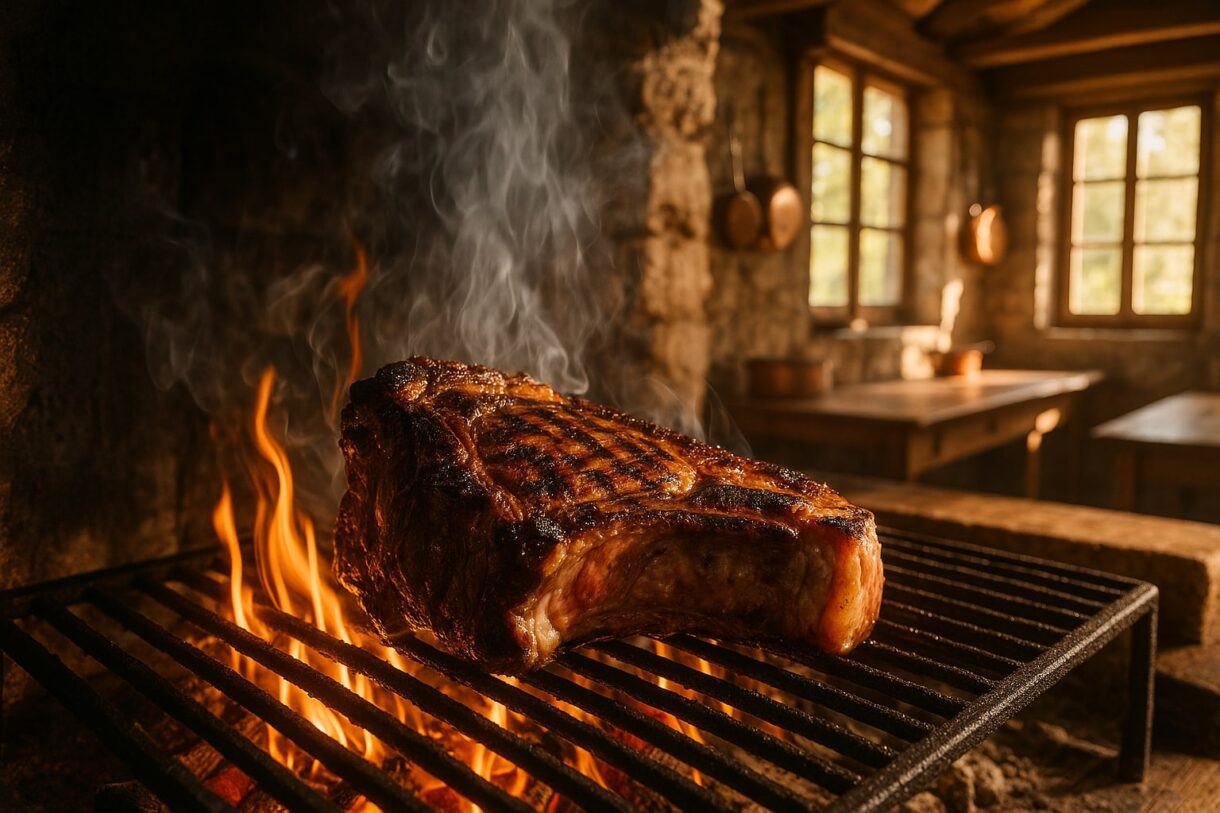
We went to Etxebarri on a Tuesday at the end of September, using the excuse of a birthday that had been waiting two years for a table. We left Bilbao by car at half past eleven, thirty-five minutes along regional roads to Axpe-Atxondo, and parked in the village square opposite the church. The stone farmhouse that houses the restaurant looked exactly as it does in all the photos: understated, with Mount Anboto behind it as a backdrop, and a chimney already sending up smoke at midday.
I won’t beat around the bush: Etxebarri is one of those places where you arrive with expectations sky-high and still leave thinking about what happened. But it is also a restaurant with cracks, things not everyone mentions, and a bill that calls for a calm discussion of value for money. Let’s take it step by step.
Quick facts
| Detail | Value |
|---|---|
| Address | Plaza San Juan 1, Axpe-Atxondo (Biscay) |
| Chef | Bittor Arginzoniz |
| Opened | 1990 |
| Awards | 1 Michelin star, high placing in The World’s 50 Best Restaurants |
| Format | Single tasting menu |
| Approx. price | 320-350 € per person without drinks |
| Booking | Mandatory, several months in advance |
Who Bittor Arginzoniz is and why his grill changed the rules
Bittor Arginzoniz was born in the Etxebarri farmhouse itself, in Axpe, and before becoming a cook he was a woodcutter and electrician. That background matters because it explains the restaurant: nobody who hasn’t cut wood understands the grill the way he does. He trained on his own, without going through cooking schools or high-gastronomy brigades, and in 1990 he opened the grill in the family farmhouse with a simple and radical idea: to cook absolutely everything over embers. And when I say everything, I mean everything. From baby eels to ice cream.
To achieve this, Arginzoniz designed his own grills, with pulleys that raise and lower the grate to the millimetre, and specific utensils for impossible products: a pan with microscopic holes for grilling caviar over embers, a fine grate for barnacles, moulds for cooking freshly milked latxa sheep’s milk. Wood is also an ingredient in its own right: he uses holm oak, old vine stock, oak or orange wood depending on the product. Nothing is left to chance.
Where Atxondo is and how to get there
Atxondo is in the Duranguesado, the Biscayan region that surrounds the Anboto massif. The village proper is Axpe, a hamlet of barely one hundred inhabitants 40 kilometres from Bilbao and 80 from San Sebastián. It is easy to reach by car: AP-8 to Durango and then BI-623 towards Elorrio, turning off to Axpe. By public transport it is feasible but inconvenient (train to Durango and a taxi), so if you plan to drink wine, the sensible option is to sleep in the area. There are a couple of agrotourism farms in the valley itself and hotels in Durango.
The setting is part of the experience. Anboto, at 1,331 metres, dominates the landscape and on clear days it seems you could touch it from the terrace. Green pastures, latxa sheep, whitewashed farmhouses. If you come from Madrid, the cultural contrast hits hard, and in a good way.
The place: a farmhouse that has not been contaminated by noise
The restaurant occupies the ground floor and first floor of a restored 16th-century farmhouse. Downstairs, a bar where locals still come in for a glass of wine. Upstairs, the dining room: wooden beams, exposed stone, raw linen tablecloths, simple chairs. Limited capacity, about ten or twelve tables. There is no music, no menu on display, no theatre. You can hear the conversation at the next table and the distant crackle of the kitchen.
At midday the atmosphere was of global pilgrimage: two tables speaking English, one French, a Japanese couple, us. Nobody raised their voice. There is a certain silent ceremony to the service that makes you lower your tone without anyone asking you to.
The menu: a single tasting menu, no alternatives
Etxebarri operates with a closed tasting menu that changes with the season and the market. There is no menu to look at, you don’t choose dishes. What they do ask when booking is whether there are serious allergies or intolerances. The menu runs to around 14-16 courses and lasts about two and a half hours. Here is what we tried, in order:
Homemade chorizo on bread. Made in-house, melted fat on bread toasted over embers. Simple and emphatic, the appetiser that sets the scene.
Home-cured anchovy. Whole fillet, clean, with a hint of light salting. Nothing like the oily industrial anchovy. Here you understand why the Japanese come to learn.
Palamós red prawn. The iconic dish. Two pieces, body grilled 40 seconds per side over holm oak embers, head served separately for sucking. The texture of the flesh is somewhere between raw and cooked, what in Japan they call tataki but without the aggressive smoking. If you could only try one dish at Etxebarri, it would be this one.
Caviar over embers. Osetra served lukewarm, with a light smoke. It divides opinion: I found it brilliant, my companion preferred classic cold caviar. Both are legitimate.
Smoked butter with sourdough bread. Butter from raw cow’s milk, churned in-house, barely brushed by the smoke. They bake the bread there.
Old Galician cow chop. A dry-aged cut, grilled for nearly 20 minutes over indirect heat, rested and served in two rounds: loin first, then flank. Pink centre, crisp crust, deep flavour of yellow fat.
Dessert of reduced latxa sheep’s milk with roasted beetroot. Smooth, not too sweet, with the ember aftertaste that runs through the whole meal.
There are courses I won’t name (barnacle, kokotxa, pea shoots in season), but the pattern repeats: exceptional product, minimal handling, grill as the only technique.
If you are interested in how Basque cuisine works fish beyond the embers, our hake in green sauce recipe with the exact thickness gives you the domestic counterpoint.
The cellar and the service
The wine list is extensive and well built, with a strong presence of artisan txakolis, Rioja Alavesa, Burgundy and sherry. The sommelier recommends without pretence and adjusts to budget if you ask. We had a Txakoli from Ameztoi with the first courses (about 55 €) and a red from Ribeira Sacra with the chop (85 €). There are reasonable by-the-glass options from 9 €.
The service is formal but warm, in Spanish, Basque and English without a commercial tone. The timing between courses is measured: no long waits and no rush. If you ask about the grill, they will tell you. If not, they won’t bore you with it.
Price and value for money
The tasting menu costs around 320-350 € per person without drinks (confirm the exact price when booking, as they update it each season). With one shared wine and water, our bill came to about 450 € per head. That is a lot of money. Compared with the great Spanish three-star restaurants, it sits in the upper bracket but is not the most expensive.
Is it worth it? It depends on what you are looking for. If you come expecting fireworks, foams, strange crockery and thirty waiters, no. If you come to eat the best possible product cooked with a technique taken to its limit by one person over thirty-five years, yes. There is no middle ground.
Verdict: 3 hams 🍖🍖🍖🍖🍖🍖
Etxebarri earns 3 hams: essential, the kind you take someone to on purpose. I justify it in one sentence: it is the only place where a technique as simple as the grill has been taken to a level no one else has matched, and that only happens in Axpe.
Who it is for: the diner who understands that high cuisine can also be subtraction, not addition. If you prefer conceptual cooking in the style of Mugaritz or DiverXO, Etxebarri will leave you cold.
Booking: essential and several months in advance. Quarterly booking windows open on their official website (asadoretxebarri.com). Saturdays sell out in minutes; Tuesdays and Wednesdays are more accessible. They do not accept walk-ins or an in-person waiting list.
Frequently asked questions
Why is Etxebarri considered the best grill in the world? Because of the combination of product, control of the fire and Arginzoniz’s craft, who has spent 35 years refining a single technique. International rankings (The World’s 50 Best, the Michelin Guide) have consistently placed it at the top of the grill segment for more than a decade.
How much does it cost to eat at Etxebarri? The tasting menu runs to around 320-350 € per person without drinks. With a shared wine, the real bill usually comes to between 420 and 500 € per diner.
How do you book a table at Etxebarri? Only through its official website, with booking windows opening every three months. Keep an eye on the reservation calendar, as the most sought-after days sell out within minutes.
Which other Basque restaurants are worth the trip if Etxebarri is full? Within the same grill and product register, Elkano in Getaria plays in the same league with fish. If you want more conceptual Basque haute cuisine, Azurmendi and Mugaritz. And if you are travelling through the north looking for houses with their own character, you may also be interested in Auga e Sal in Santiago, although its register is Galician rather than Basque.
Are there options for vegetarians or people with allergies? Yes, with prior notice when booking. The menu adapts with seasonal vegetables from their own garden (tomato, pea shoots, mushrooms, artichoke) and dairy products from local shepherds. If you are a strict vegan, let them know in advance, because butter and dairy are central to the menu.
Tasty Things We were in... Biscay #asador #bittor-arginzoniz #caviar #gastronomia #parrilla #restaurante
 Lumara: the essence of Extremadura finds its home in Chamberí
 How to Make an Authentic Valencian Paella Step by Step (for 4 people, at home and in Valencia)
 Zhen and Chinese New Year: A Menu That Turns Madrid into Shanghai
Comentarios cerrados