Octopus a la Gallega at home: how to tenderize it and the right cooking point
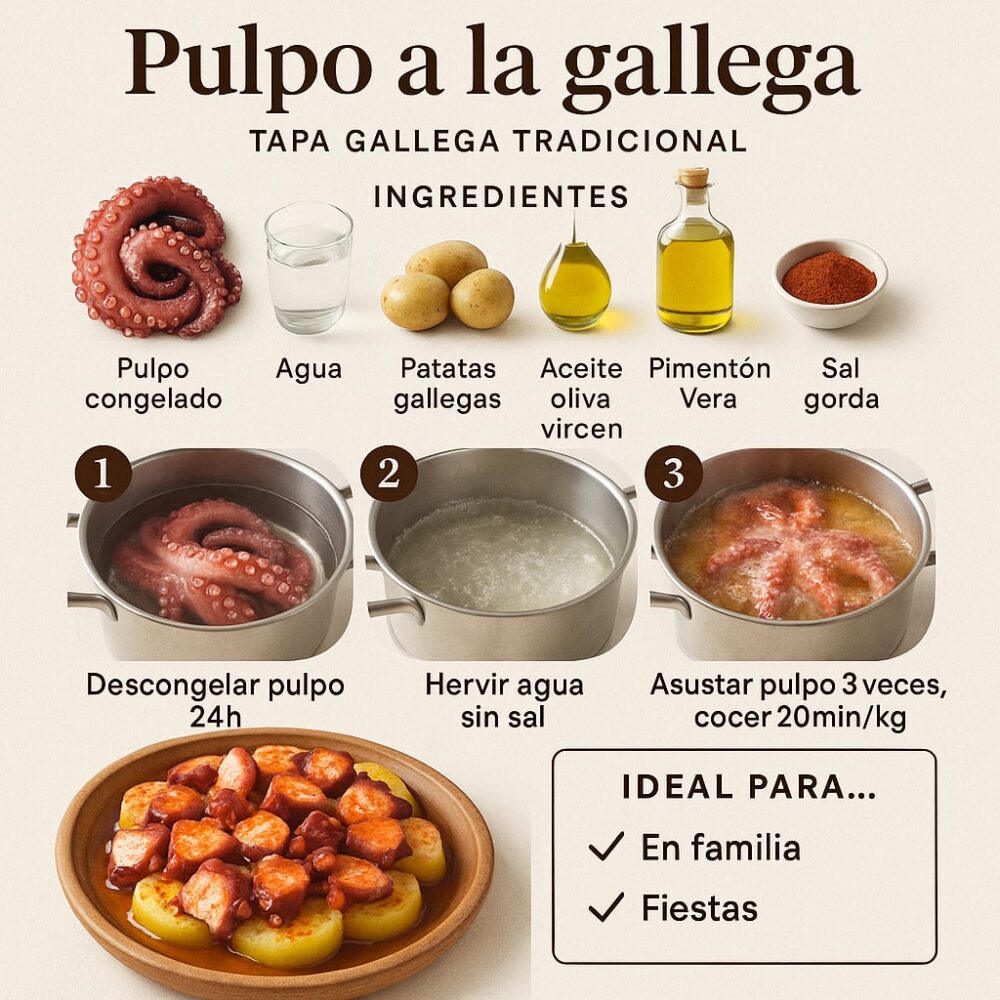
Octopus a la gallega (or pulpo á feira, as it is called in its place of origin) is one of those dishes that seem simple and then, when you make it at home, end up in disaster. Either it comes out as tough as a sneaker, or the tentacles fall apart in the water and lose their skin. Neither one nor the other: there is a method, it comes from the Galician fairs, and it works.
The good news is that, with frozen octopus from the supermarket and a large pot, it turns out perfectly at home. You don’t need copper pots, firewood, or to be from Melide. You need time, good paprika, and to respect the resting step. Let’s get to it.
Quick facts: octopus a la gallega at a glance
| Detail | Value |
|---|---|
| Origin | Fairs and festivals of Galicia (Carballiño, Melide) |
| Servings | 4 as a main portion, 6-8 as a tapa |
| Recommended octopus | Frozen, 2-2.5 kg |
| Cooking time | Approx. 20 min/kg (frozen) |
| Final rest | 15-20 min in the water |
| Difficulty | Medium (the trick is in the timing, not the technique) |
Where pulpo á feira comes from
The dish was born at the livestock fairs of inland Galicia, especially in Ourense. Interestingly, it is an inland dish, not a coastal one: the pulpeiras bought dried octopus on the coast and cooked it in copper cauldrons in the village. That is where the wooden plate, the olive oil, the paprika, and the coarse salt come from. Nothing more. And nothing less.
Today dried octopus is almost never used, but the technique (shocking, cooking, resting) remains intact. And that is the one we are going to explain to you.
Which octopus to buy: fresh vs frozen
Here there is a popular belief that, for once, is true: for octopus a la gallega at home, frozen is better. The reason is mechanical: freezing breaks the muscle fibers of the octopus, which are very tough, and saves you the work of beating it against a rock as was done in the past.
Fresh octopus needs a prior tenderizing (literally, with a mallet or against the sink) for several minutes. And even then, it is a gamble. Frozen octopus, thawed for 24 hours in the fridge, will almost certainly turn out tender.
Look for pieces of 2 to 2.5 kg. Smaller ones will shrink to nothing when cooked; larger ones are hard to handle in a domestic pot. And make sure the skin is not torn: that indicates rough handling before freezing.
Ingredients for 4 people
- 1 frozen octopus of 2 to 2.5 kg (thawed 24 h in the fridge)
- Water (enough for the pot; no salt)
- 1 medium Galician potato per diner (optional, for the "octopus with cachelos")
- Extra virgin olive oil, 60 ml for serving
- Pimentón de la Vera PDO, half sweet and half spicy (about 2 teaspoons in total)
- Coarse salt, 1 level teaspoon
- Wooden plates, if you have them (otherwise any flat plate will do)
Step-by-step preparation
-
Thaw the octopus properly. 24 hours in the fridge, inside a bowl so it doesn’t drip. If you’re in a hurry, under cold running water, never in the microwave. It must be completely thawed before cooking.
-
Put a large pot with plenty of water on to boil. No salt: the octopus has its own saltiness and the coarse salt goes at the end. The water must cover the octopus comfortably when you submerge it. Wait until it comes to a rolling boil with large bubbles.
-
Shock the octopus. Hold it by the head with tongs or by hand (be careful, it splashes) and dip it whole into the boiling water for 5 seconds. Lift it out. Wait for the water to come back to a vigorous boil. Dip it again for 5 seconds. Lift it out. And a third time. On the third time, you leave it in. This is "shocking" it: the tentacles curl and the skin sets, so it won’t peel off during cooking.
-
Cook over medium-high heat. The water should be bubbling, but not in wild boil. Time 20 minutes per kilo for frozen octopus. If it weighs 2 kg, 40 minutes. If it weighs 2.5 kg, 50 minutes. For fresh, calculate 25-30 min/kg.
-
Check the doneness. With 5 minutes to go, pierce a tentacle with a toothpick or a thin knife at its thickest part. It should slide in with very slight resistance, like cold butter. If it goes in with no resistance, you’ve overdone it. If it’s tough, give it 5 more minutes.
-
Rest it in the water. Turn off the heat and leave the octopus in the hot broth for 15-20 minutes. This step is not optional: this is where it finishes cooking through residual heat and the texture settles.
-
If you’re making cachelos, cook them separately in salted water for about 20 minutes, until soft but whole. You can also make use of the octopus water when you take it out (it is wonderfully flavorful for potatoes, rice, or a broth).
-
Cut and plate. Take out the octopus, cut it with scissors into slices of 1 cm (thinner ones dry out, thicker ones are hard to chew). Place on the wooden plate, over a bed of cachelos if you made them. Drizzle with the oil, sprinkle the paprika evenly (not in the center: it turns into a paste) and finish with the coarse salt.
Tricks and common mistakes
- Don’t add salt to the water. It is the most repeated mistake. Salt toughens the fibers during cooking. Salt goes at the end, on top, and coarse.
- If you overcook it, there is no going back. The octopus becomes rubbery or falls apart into strands. It is better to undercook and give it 5 extra minutes than to overcook it by 10.
- Onion in the water is a myth that changes nothing. If you like the idea, go ahead, but it won’t improve the result.
- For a faster version, you can use a pressure cooker: 8 minutes per kilo from when it whistles, same resting time. You lose some control over the doneness, but it works.
- If you have leftover cooked octopus, cold with a good extra virgin olive oil and paprika it makes an amazing salad. It also goes well sautéed with garlic on toast.
Pairing and serving
Pulpo á feira calls for Galician white wine, nothing complicated. A young Albariño from the Rías Baixas, or a Godello from Valdeorras or Monterrei. Chilled, but not frozen: between 8 and 10 °C.
If you prefer red, a light Mencía from Ribeira Sacra, served fresh (14 °C), holds up well to the paprika. Beer also works, as long as it is a lager and not too hoppy.
Serve it on a wooden plate if you have one: it is not just for show, it keeps the temperature better and absorbs excess water. As a starter in a Galician meal it goes before a marmitako or a fish stew, or as a single dish with corn bread and the cachelos.
And if you feel like continuing with northern cuisine, take a look at how to make hake in green sauce: same philosophy of respecting the product and not complicating things.
Frequently asked questions
Why is the octopus tough? Almost always for two reasons: you added salt to the water, or you undercooked it and didn’t rest it. Check that the octopus is well thawed before starting and respect the 20 minutes per kilo plus the resting time.
Can cooked octopus be frozen? Yes, and it holds up well. Cut it into slices, wrap them tightly in film and put them in a freezer bag. It lasts up to 2 months. Thaw in the fridge and warm in the microwave for 30 seconds before seasoning.
How long does cooked octopus keep in the fridge? Whole and covered, 2-3 days. Once dressed with oil and paprika, it is best consumed within 24 hours: the paprika loses its punch.
Can I use regular paprika instead of Pimentón de la Vera PDO? You can, but you will notice the difference. Pimentón de la Vera PDO is smoked and provides the depth that defines the dish. If you use regular sweet paprika, add a pinch more and accept that it’s not quite the same.
Is the wooden plate necessary? It is not essential, but it helps. It keeps the heat, absorbs residual water and stops the oil from sliding around. If you don’t have one, a flat plate preheated in the oven at 60 °C will do.
Ourense Recipes #cocina #Galicia #pulpo #pulpo-a-la-gallega #receta


 Lumara: the essence of Extremadura finds its home in Chamberí
 How to Make an Authentic Valencian Paella Step by Step (for 4 people, at home and in Valencia)
 Zhen and Chinese New Year: A Menu That Turns Madrid into Shanghai
Comentarios cerrados