Extremaduran migas with pancetta and grapes: the shepherd's recipe
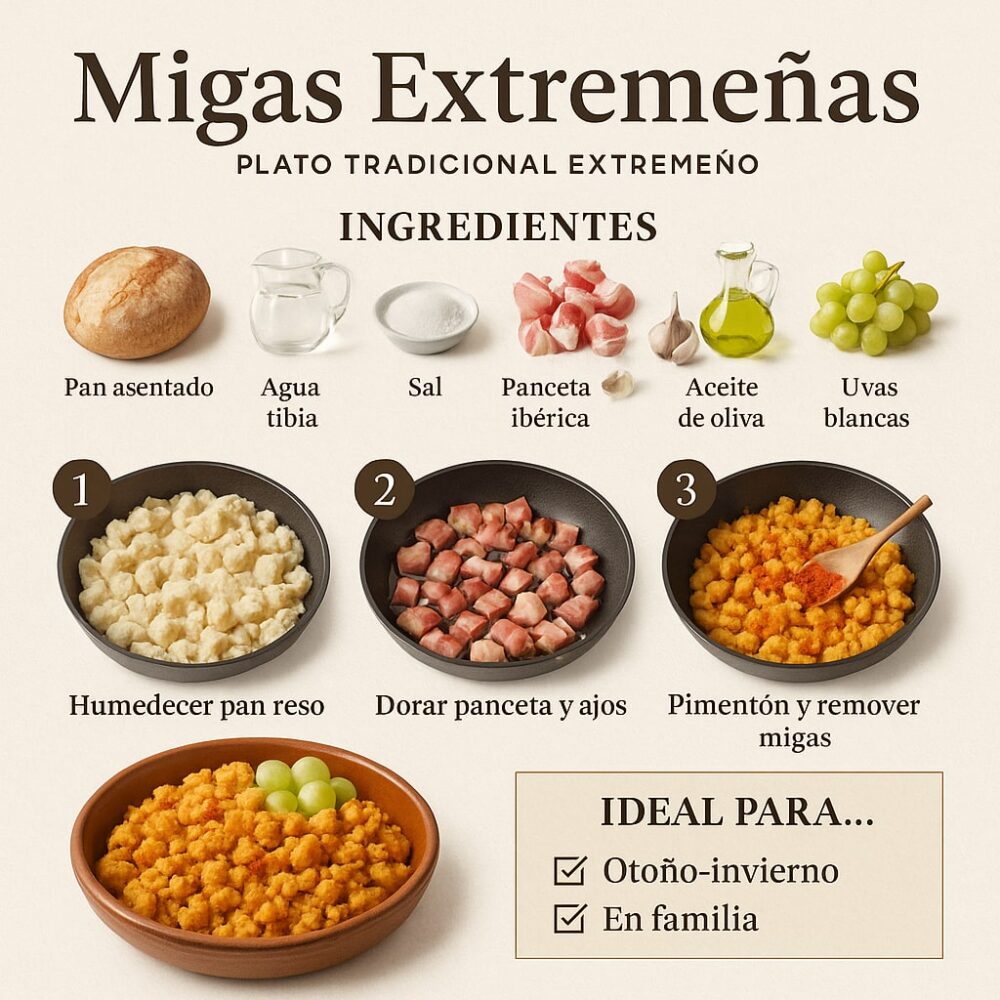
Extremaduran migas are not just any Sunday dish. They are food of the transhumant shepherds, those who crossed the Cañada Real from the summer pastures to the winter grazing of the dehesa, with several days’ bread in their knapsack and little else. That is the charm: making the most of what was at hand and turning it into something that warmed the body at six in the morning in the fog.
Today they are a pig-slaughtering dish, a cold-day dish, a family gathering dish. In Extremadura they are eaten with white grapes in autumn, with sardines in summer, with a fried egg almost always. And although shepherd’s migas are cousins of the La Mancha or Aragonese versions, they have their own character: La Vera paprika, Iberian pancetta and that sweet contrast of the grape that cleanses the palate between mouthfuls.
I’ll tell you how to make them at home without shortcuts. And above all, how to avoid the classic mistake: ending up with a stodgy mass.
Quick dish profile
| Detail | Value |
|---|---|
| Origin | Extremadura (shepherd dish of transhumant herders) |
| Difficulty | Medium |
| Active time | 40 min (plus overnight resting of the bread) |
| Servings | 4 |
| Allergens | Gluten (bread) |
| Ideal season | Autumn-winter |
Ingredients for 4 people
- 500 g of day-old bread (2-3 days old, candeal or country loaf, dense crumb)
- 200 ml of lukewarm water
- 10 g of fine salt
- 150 g of Iberian pancetta fresh, diced
- 100 g of Extremaduran chorizo (optional, mild)
- 6 cloves of garlic, unpeeled
- 100 ml of extra virgin olive oil (best quality, Aceite Monterrubio PDO or Gata-Hurdes PDO if you can find it)
- 1 heaped teaspoon of La Vera PDO smoked paprika (sweet, or a mix with a pinch of hot)
- 300 g of seedless white grapes (Muscat if in season)
- Salt to taste (start with little, the pancetta is already salty)
Step-by-step preparation
1. The night before: dampen the bread (10 min + resting)
Cut the bread into thin slices and then into small cubes, about 1 cm. Put the pieces in a large bowl or a clean cotton cloth.
Mix the lukewarm water with the salt, dissolve it well, and sprinkle the bread with a spray bottle or by hand, little by little, stirring. Do not soak it: the bread should be damp but not wet. If you squeeze a handful and water comes out, you’ve gone too far.
Wrap in the cloth, press lightly and let it rest for 8 to 12 hours in a cool place. This step is non-negotiable: without it, the migas dry out on the outside and stay raw inside.
2. Brown the pancetta and garlic (8-10 min)
In a deep frying pan or a shallow cast-iron casserole (about 30 cm), heat the oil over medium heat. Add the unpeeled garlic cloves, crushed with the flat of a knife. Fry them for 2-3 minutes until they perfume the oil and begin to colour. Remove and set aside.
In the same oil, add the diced pancetta. Let it release its fat and brown for 5-6 minutes, until crisp on the outside. If using chorizo, add it in the last minute so it does not turn bitter. Remove everything and set aside with the garlic.
3. Paprika and migas (20-25 min)
Lower the heat to minimum. This is important: La Vera PDO smoked paprika burns in seconds and will ruin the dish. Add the teaspoon of paprika to the oil, stir for 10 seconds with a wooden spatula and raise the heat back to medium.
Add the dampened bread all at once. Stir with the wooden spatula, without stopping for the first 5 minutes, so that each crumb absorbs the oil and paprika.
From then on, stir every 2-3 minutes for another 20 minutes. The migas should loosen, breaking into small clumps and browning evenly. The exact point: loose, golden, with the reddish colour of the paprika and crisp on the outside but tender inside. If you see them sticking, add a minimal splash of oil.
4. Final assembly (3 min)
Return the pancetta, chorizo and garlic (you can peel them or leave them unpeeled; in Extremadura the garlic is sucked out of its skin). Mix well. Taste for salt and adjust if needed.
Serve in an earthenware casserole, with the white grapes washed and very cold on the side, in bunches or loose. The hot-cold, sweet-savoury contrast is the key to the dish.
Tips and variations
- Bread: it must be candeal or country loaf, with a tight crumb. Sliced sandwich bread or baguette will not do: they fall apart into mush.
- Moisture: if you forgot to dampen it the night before, do it at least 2 hours in advance, but the result will not be the same.
- Sardine version: in summer, replace the pancetta and chorizo with salted sardines desalted for 1 hour in water. Add them at the end.
- Fried egg on top: if you want a one-pot meal, a free-range egg fried with crispy edges per diner. It pairs wonderfully.
- Gluten-free: there are gluten-free loaves that work reasonably well, but the result is drier. Compensate with a little more oil.
Pairing and serving
Young red wine from the area: a fresh tempranillo Ribera del Guadiana PDO, served at 14-15 °C. A Extremaduran clarete also works. If you prefer beer, a blonde wheat beer or a mild amber ale.
Serve straight from the casserole to the table, hot. The grapes separately, in a bowl. In Extremadura it is eaten with a wooden spoon and few other utensils.
If you want it as a hearty starter before a softer spoon dish, accompany it with good bread and a glass of wine. It also goes perfectly alongside other classics of thrifty cooking such as Madrid three-course cocido if you are organising a winter lunch with friends.
Frequently asked questions
Can migas be frozen? Yes, once made and cold, in an airtight container for up to 2 months. To reheat, use a frying pan with a splash of oil over medium heat, stirring. In the microwave they turn rubbery.
How long do they keep in the fridge? 2-3 days in a closed container. Always reheat in a frying pan, never in the microwave.
What is the difference from La Mancha or Aragonese migas? La Mancha versions usually use semolina flour instead of just bread, and sometimes pancetta and grapes too. Aragonese migas (Pyrenean shepherd’s migas) are served with grapes or chocolate and tend to be thicker and less paprika-heavy. Extremaduran migas are distinguished by La Vera PDO smoked paprika and dehesa Iberian pancetta.
Can I use bread from the same day? No. Fresh bread does not absorb well and becomes doughy. You need bread that is 2-3 days old, with a settled crumb. If you only have fresh bread, cut it into cubes and leave it uncovered for 24 hours before starting.
Cáceres Tasty Things Recipes #Extremadura #migas #panceta #pimentón #receta
 Lumara: the essence of Extremadura finds its home in Chamberí
 How to Make an Authentic Valencian Paella Step by Step (for 4 people, at home and in Valencia)
 Zhen and Chinese New Year: A Menu That Turns Madrid into Shanghai
Comentarios cerrados