Extremaduran migas with pork belly and grapes: the proper shepherd's recipe
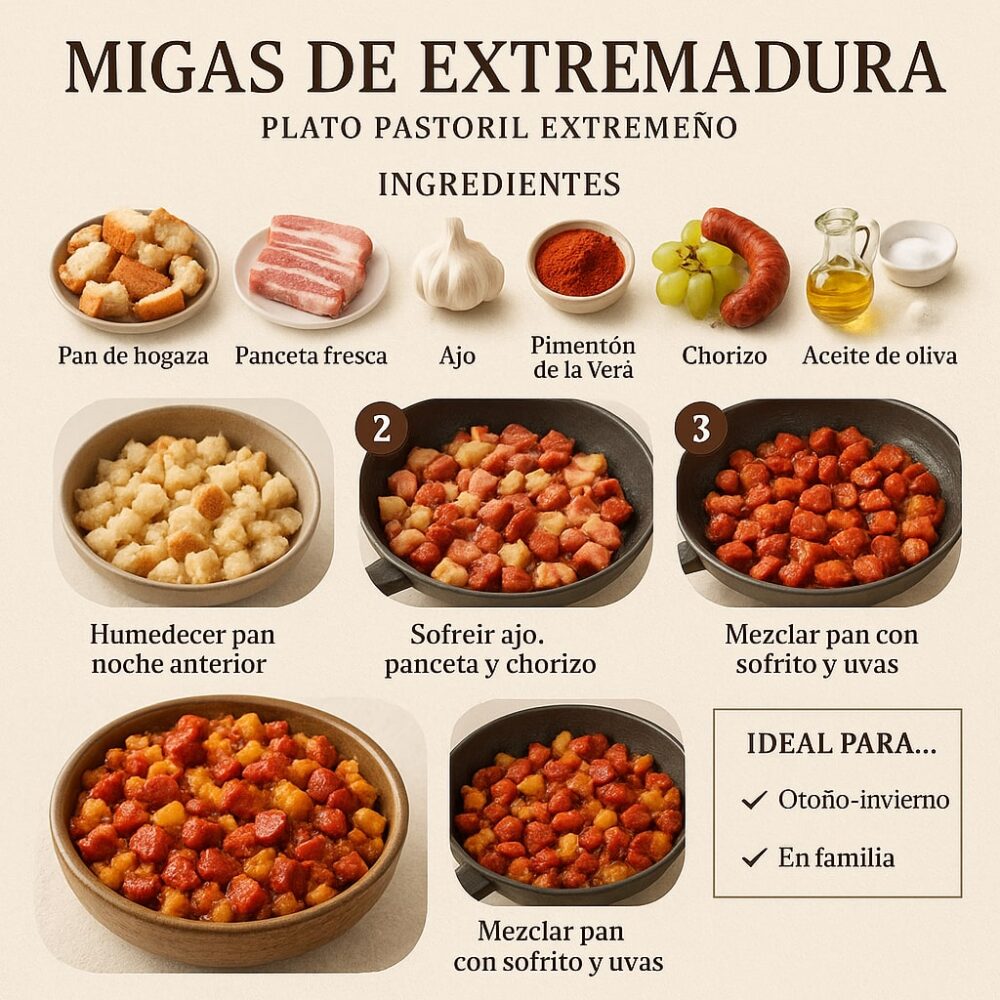
Migas are one of those dishes that explain a country better than any book. They were born out of hunger and necessity: the transhumant shepherd carried his bread in the zurrón, it went hard by the third day, and you had to make do. Water, garlic, a little fat and into the iron pan over the embers. From there to the Sunday table is a long road, but the spirit remains intact.
In Extremadura the canonical version includes pork belly, garlic, Vera pimentón DOP and, when in season, fresh grapes that break the fat with a sweet and sour hit. Let’s make them the way they should be made: with time, with the bread dampened the night before, and without strange shortcuts.
Quick recipe card
| Detail | Value |
|---|---|
| Servings | 4 people |
| Active time | 40 min |
| Bread resting | 8-12 h (night before) |
| Difficulty | Medium (technique, not complexity) |
| Origin | Extremadura, transhumant pastoral cooking |
| Ideal season | Autumn-winter (table grapes still available) |
Where shepherd’s migas come from
Migas are not exclusive to Extremadura: there are versions in Aragon, Castile, Andalusia, La Mancha and Murcia. Each has its own personality. But Extremadura’s carry a clear signature: bread that has been left to settle (never grated), dampened with water and salt, and a garlic sofrito with smoked pimentón. Pork belly and chorizo come in by right, and the grapes are the garnish that sets them apart from almost all the others.
It was food for transhumant shepherds of the Mesta: ingredients that travel well, an iron pan over the fire, and ready in the time it takes to set up camp. When they descended to the Extremaduran dehesas in winter, the grapes from the last vines were the dessert and the contrast. That combination stuck.
Differences from Manchegan, Aragonese and Andalusian migas
To orient yourself before cooking:
- Extremaduran: hard country loaf bread cut by knife, dampened, Vera pimentón, pork belly, grapes.
- Manchegan: similar, but usually with more bits added (chorizo, pork belly, sometimes sardine) and less pimentón.
- Aragonese (Pyrenean shepherd’s): finer bread, sometimes with egg and chocolate (yes, chocolate) or longaniza added.
- Andalusian (mountain): some areas use coarse flour instead of bread. It is a different dish that shares the name.
If someone serves you migas with industrial breadcrumbs, that isn’t migas. It’s something else.
Ingredients for 4 people
- 400 g of day-old country loaf (better at 2-3 days, well settled, with crust)
- 120 ml of water lukewarm
- 8 g of fine salt (one level teaspoon) to dampen the bread
- 200 g of fresh pork belly streaked with fat, in 1.5 cm cubes
- 100 g of chorizo for cooking (optional but usual), in thick slices
- 8 garlic cloves with skin, crushed with the back of a knife
- 100 ml of extra virgin olive oil (a Sierra de Gata DOP or Monterrubio DOP if you want to play at home)
- 2 teaspoons of Vera pimentón DOP (1 sweet + 1 bittersweet, or all sweet if you prefer it mild)
- 300 g of fresh grapes (preferably muscat or any sweet seeded variety; seedless also works)
- Salt at the end to adjust
Allergen note: contains gluten (bread) and, if you use chorizo, may contain traces of lactose or sulphites depending on the brand.
The bread: why it is dampened the night before
This is the step that separates shepherd’s migas from a mush of toasted bread. The bread must be hard but not dry, and must absorb moisture slowly and evenly.
- Cut the bread with a knife into thin slices of 2-3 mm, then chop them into irregular pieces about 5-8 mm. Do not use a grater or food processor. Migas need texture, not to be powder.
- Mix the 120 ml of water with the 8 g of salt and wet your hands. Sprinkle the bread by handfuls, stirring with the other hand. The bread should be moist but without puddles at the bottom.
- Transfer everything to a bowl, cover with a clean cotton cloth (not plastic) and let it rest for 8 to 12 hours at room temperature. If it is very hot at home, put it in the fridge.
The next day the bread will be soft on the outside and with body inside. That is the point.
Step-by-step preparation
- Brown the pork belly: in a large iron or steel pan (preferably deep, about 32 cm), put the pork belly over medium heat without oil. It will release its own fat. When golden on the outside (about 6-7 minutes), remove and set aside.
- Add the chorizo if using: 2 minutes per side, until it releases red oil. Set aside with the pork belly.
- Garlic and oil: in the same pan add the 100 ml of extra virgin olive oil and the 8 garlic cloves crushed with skin. Medium-low heat. Let them confit for 4-5 minutes until golden but not burnt. Remove the garlic (you can leave a few if you like them).
- The critical moment, the pimentón: take the pan off the heat, let the temperature drop for 20 seconds, add the 2 teaspoons of Vera pimentón DOP and stir quickly. If the oil is too hot, the pimentón burns and makes everything bitter. There is no fixing this, so be careful.
- Add the bread: return to medium heat and incorporate the dampened bread. Stir with a wooden spoon or spatula, moving from the bottom upward, without stopping. For the first 5 minutes it will seem nothing is happening. From minute 8-10 you will see it start to loosen and brown.
- Patience: between 20 and 25 minutes of constant stirring over medium heat. The migas should be loose, each with its golden colour and crispness on the outside. If you notice they stick, add a little more oil.
- Return the pork belly and chorizo set aside in the last 3 minutes, so they heat through and combine.
- The grapes: wash them, dry them and add them to the serving dish or scatter them over the migas in the last minute in the pan, just to warm through. Do not cook them, or they will turn to mush.
Tips and common mistakes
- If the bread is very dry, add 20 ml more water. If the next day you find it has turned gummy, there was too much water: it can still be rescued by spreading it out for 10 minutes on a tray before frying.
- Do not cover the pan while stirring. The migas need to breathe to evaporate moisture.
- Burnt pimentón is the number one mistake. Always off the heat. Always.
- Pork-free version: replace the pork belly with 200 g of seasonal mushrooms (níscalos or boletus) sautéed separately. It is not traditional, but it works.
- A Thermomix will not do for this dish. The texture is achieved by stirring by hand in a wide pan. Don’t even try.
Pairing and serving
Migas call for a young red with body and little oak. A Ribera del Guadiana DOP tempranillo goes perfectly, or a local pitarra if you can find one. Also a young Extremaduran pitarra red, which is like drinking the countryside directly.
They are served in a deep plate or clay pot, with the grapes on top and, if you want to do it the old way, with a fried egg on top or a bota sardine on the side. For a hearty breakfast at pig-slaughtering time, they are eaten with coffee with milk and aguardiente. I’m not saying it, tradition is.
If you’re interested in exploring well-founded thrift cooking, take a look at the Madrid cocido in three pours with quantities for 6: another long-simmered pot dish with honest produce.
Frequently asked questions
Can I use sliced sandwich bread or breadcrumbs? No. Sandwich bread contains sugar and fat, and breadcrumbs give powder, not crumb. A 2-3 day loaf or nothing.
Can they be frozen? Yes, once made and cooled. They keep well for 1 month in the freezer. To reheat, pan over medium heat with a little oil, 8-10 minutes stirring. In the microwave they turn rubbery.
How long do they keep in the fridge? Up to 3 days in an airtight container. They improve the next day, like almost all dry spoon dishes.
What if I don’t have Vera pimentón? Use the pimentón you have, but it won’t be the same. The smoked Vera DOP is part of the dish’s identity. It is easy to find in large supermarkets and online shops.
Are the grapes essential? In the Extremaduran shepherd’s version, yes. It is what sets it apart. If it is not the season, you can try raisins soaked in red wine, but the freshness will not be the same.
Cáceres Tasty Things Recipes #Extremadura #gastronomia #migas #panceta #receta
 Lumara: the essence of Extremadura finds its home in Chamberí
 How to Make an Authentic Valencian Paella Step by Step (for 4 people, at home and in Valencia)
 Zhen and Chinese New Year: A Menu That Turns Madrid into Shanghai
Comentarios cerrados