Catalan-style roasted escalivada: temperature, time and hot peeling
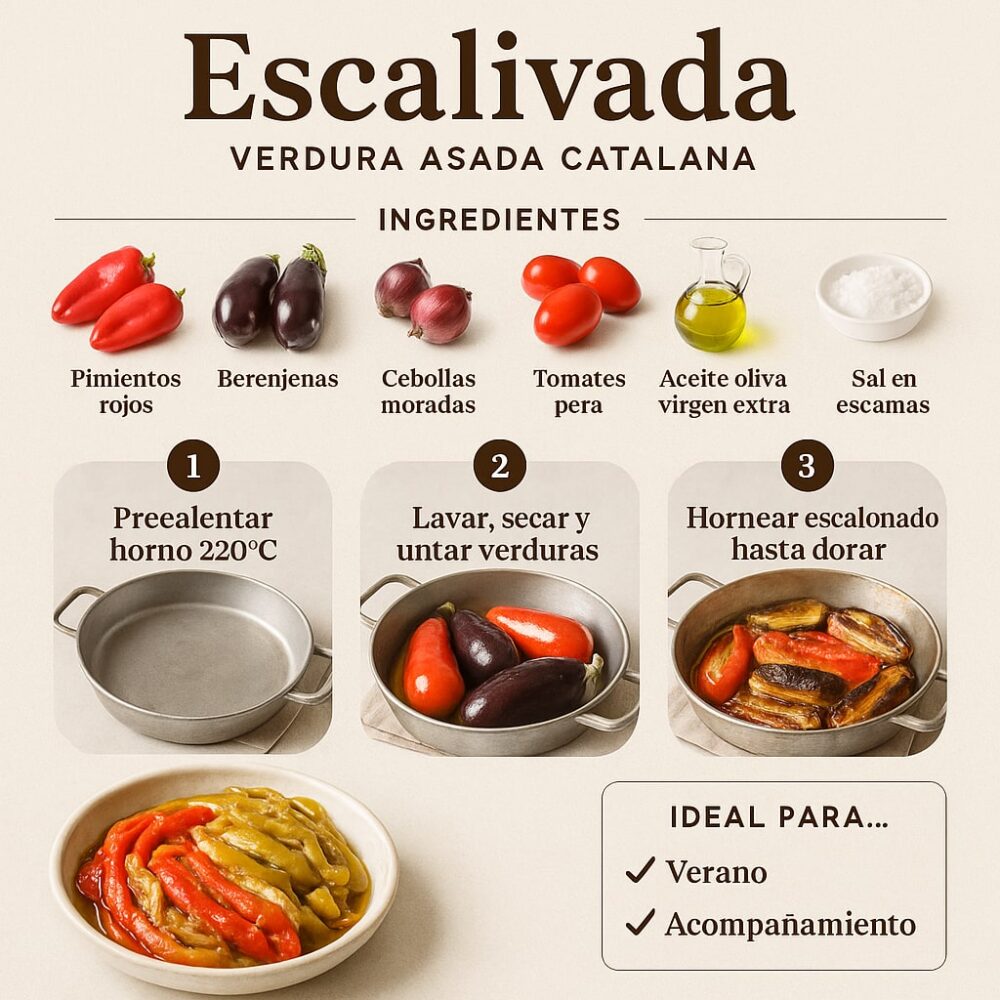
Escalivada is one of those Catalan recipes that seems easy until you get it wrong. Roasted vegetables, oil, salt. Four ingredients. And yet there’s a world of difference between a well-made escalivada —with creamy eggplant, sweet pepper and melting onion— and a watery one, with half-peeled skins and no flavour at all.
The name comes from the Catalan escalivar, meaning to roast over embers. The canonical version is made over firewood, but in reality, in a flat in Madrid or Barcelona, what you have is an electric oven. And it works. You only need to understand three things: high temperature, different times for each vegetable and peeling while hot inside a covered bowl. Let’s get to it.
Quick recipe card
| Detail | Value |
|---|---|
| Servings | 4 people |
| Total time | 70-80 min |
| Oven temperature | 200-220 ºC |
| Difficulty | Easy |
| Origin | Catalonia (the Girona and Camp de Tarragona area) |
| Allergens | None (vegan and gluten-free) |
What escalivada is and why hot peeling changes everything
Traditional Catalan escalivada includes red pepper, eggplant and, depending on the household, onion and tomato. It is roasted whole, with the skin on, and once cooked it is peeled, torn into strips by hand and dressed with extra virgin olive oil and salt. Nothing more. No raw garlic, no vinegar (that’s a different dish), no chopped parsley. Deliberate simplicity.
Hot peeling is the trick that separates the home version from the restaurant one. When you take the vegetables out of the oven and put them in a bowl covered with cling film or a plate, the steam they release as they cool loosens the skin from the flesh. Then it comes away on its own, in one go. If you peel them cold the next day, you lose juice, tear the pepper flesh and end up with skins stuck everywhere.
Ingredients for 4 people
- 2 red peppers large (about 400-500 g in total)
- 2 eggplants medium (about 500-600 g)
- 2 onions purple or sweet (about 300 g)
- 2 ripe pear-shaped tomatoes (optional, about 200 g)
- 4 tablespoons of extra virgin olive oil (about 50 ml), preferably with a PDO if you have one to hand
- Flaky salt, 1 teaspoon, adjust at the end
- 1 small garlic clove (optional, for rubbing the bread)
If you want to be really particular, a Siurana PDO or Les Garrigues PDO extra virgin olive oil works perfectly because they are Catalan and have just the right bitterness. A Sierra de Cazorla PDO oil also works wonderfully.
Step-by-step preparation
-
Preheat the oven to 220 ºC with top and bottom heat, without the fan. Ten minutes. If you have a rack and tray, place the tray on the lower level to catch the juices.
-
Wash and dry the vegetables. Prick the eggplants with a fork in 4-5 places so they don’t burst. Leave the peppers and onions as they are. Peel the onions but keep them whole.
-
Lightly brush with oil (one tablespoon spread across all of them) and place on the tray or directly on the rack with baking paper underneath. Sprinkle with salt.
-
Roast, staggering the times. This is the key. The vegetables are not ready at the same time:
- Red peppers: 40-45 minutes. Look for blackened patches on the skin and flesh that yields when squeezed.
- Eggplants: 45-55 minutes. They should be completely soft and collapsed, like a punctured balloon.
- Onions: 50-60 minutes. Toasted outer skin and a soft, creamy centre.
- Tomatoes (if using): 20-25 minutes. Add them at the end.
Halfway through cooking, turn them over with tongs.
-
Lower to 200 ºC if you see the skin burning too quickly before the inside is cooked. Better 10 extra minutes at a lower temperature than a vegetable charred outside and raw inside.
-
Take the vegetables out and put them in a large bowl. Cover with cling film or a plate that fits well. Let them steam for 20 minutes. This is hot peeling: the steam does the work for you.
-
Peel by hand. The pepper skin comes off whole. The eggplant, split in half, is scooped out with a spoon or peeled from the stalk end. The onion separates into layers. Don’t use water to clean the skin, you’ll lose flavour.
-
Tear into strips. The pepper into 1-2 cm strips with your fingers. The eggplant into lengthwise wedges. The onion into petals. Always by hand, never with a knife.
-
Keep the juice that has collected in the bowl. It’s liquid gold. Strain it through a fine sieve.
-
Assemble the dish. Arrange the vegetables neatly, spoon over the strained juice and add 3 tablespoons of extra virgin olive oil and flaky salt. Rest for 10 minutes before serving.
Tips and common mistakes
- Don’t peel under the tap. Water washes away the concentrated roasted flavour. If a bit of skin is stuck on, remove it with a dry cloth or your fingers.
- The eggplant must be VERY well cooked. If you feel resistance when you prick it, give it another 10 minutes. A half-roasted eggplant is bitter and rubbery.
- If the pepper skin is completely burnt, that’s fine. That black layer isn’t eaten, it’s discarded. What matters is that the flesh is cooked, not raw.
- Charcoal version: if you have a barbecue or grill, over moderate embers for 30-40 minutes, turning. The smoky flavour can’t be achieved in an oven; it’s a different, if related, recipe.
- Never use the fan setting at the start. It dries out the skin before the flesh is cooked. If your oven only has a fan, lower to 190 ºC and extend the time by 10 minutes.
Pairing and serving
Escalivada is served at room temperature, never straight from the fridge. It works as a starter, a side dish or part of a pa amb tomàquet with Cantabrian anchovies on top (a classic Catalan combination).
For wine, a white from the Empordà or a Garnacha rosé from the Terra Alta DO stand up well to the bitterness of the eggplant and the sweetness of the pepper. If you prefer red, go for something young and fresh, never a heavily oaked reserva that will overpower the vegetables.
As a side, it’s excellent with grilled fish, roast white meats or even confit cod. If you’re interested in fish in sauce, take a look at our hake in green sauce cooked to the perfect point, which pairs very nicely with a lukewarm escalivada on the side.
Frequently asked questions
How long does escalivada keep in the fridge? In a closed container, covered with its oil and juices, 3-4 days. It improves on the second day as the flavours blend. Take it out 30 minutes before serving.
Can it be frozen? Yes, but the texture suffers. The eggplant becomes more watery when thawed. If you’re freezing it, do so already peeled and in strips, in an airtight freezer bag, for up to 2 months.
Does it contain garlic or vinegar? The traditional Catalan recipe contains neither. Garlic rubbed on the bread is common. If you add vinegar or raw chopped garlic on top, you’re making a salad of roasted vegetables, not an escalivada.
Is it suitable for coeliacs and vegans? Yes, it is naturally gluten-free, dairy-free and vegan. Just vegetables, oil and salt. If you are strictly coeliac, check that the olive oil has not been cross-contaminated, but based on the ingredients there is no problem.
Girona Recipes #aceite-de-oliva #berenjena #cocina catalana #escalivada #receta #verduras
 Lumara: the essence of Extremadura finds its home in Chamberí
 How to Make an Authentic Valencian Paella Step by Step (for 4 people, at home and in Valencia)
 Zhen and Chinese New Year: A Menu That Turns Madrid into Shanghai
Comentarios cerrados