Madrid-style cocido in three courses: quantities for 6 and real cooking times
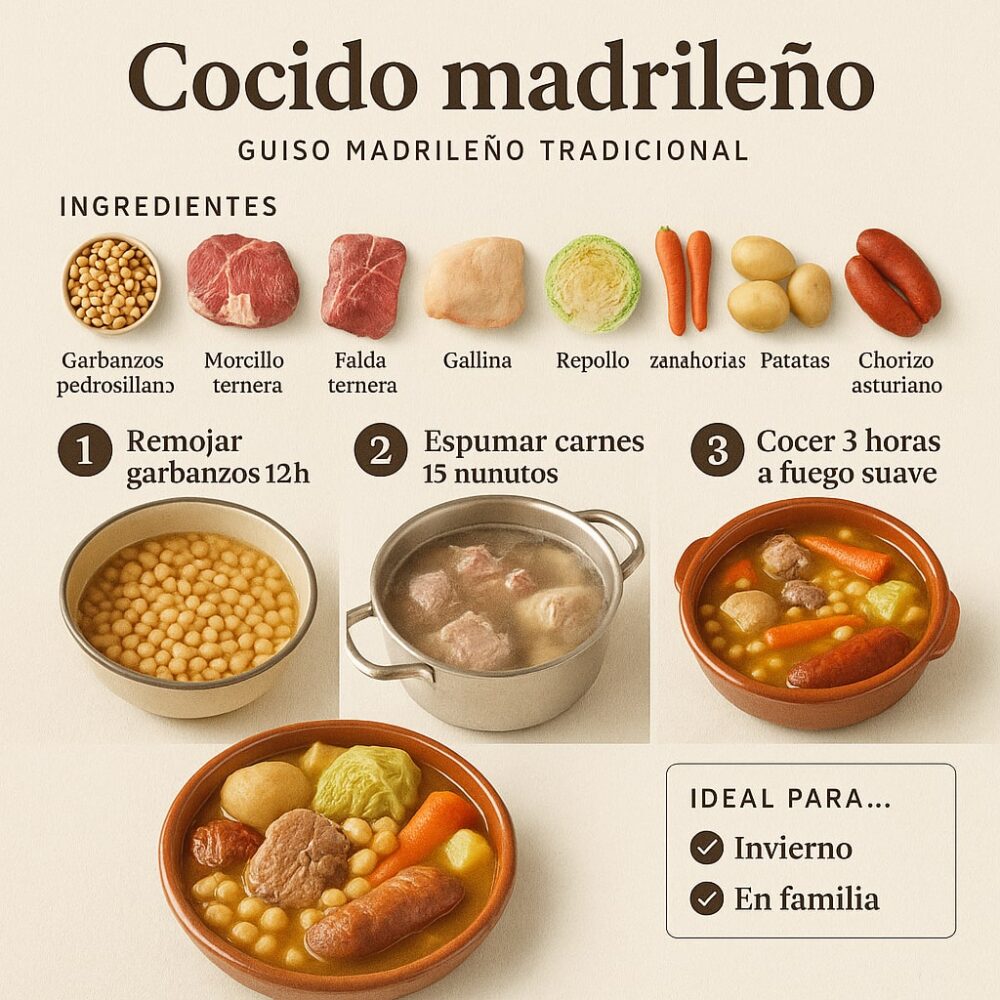
Cocido madrileño is one of those dishes that either gets made with care or ends up as a sad stew, with rock-hard chickpeas and watery broth. There’s no mystery to it, but there is order: correct proportions, cooking times respected, and the famous ritual of the three courses. If you do it right, a winter Sunday with cocido on the table justifies not leaving the house all day.
This is the version I’ve been refining at home for years, designed for 6 diners with Sunday appetites (that is, with room for all three courses). No strange shortcuts or fusions. Cocido with pedrosillano chickpeas, a broth that stands on its own two feet, and sautéed cabbage as the canon dictates.
What the three-course cocido is and why it’s served this way
The “vuelco” (literally “overturn”) is exactly that: the pot is tipped and each part is separated as it comes out. First the soup (the strained broth with fine noodles), then the chickpeas with the vegetables, and finally the meats and sausages. It’s served in this order because it’s the one that’s kind to the stomach: liquid, legume, protein. It also keeps each part’s character intact, which is lost when everything sits on the same plate.
It’s a Madrid tradition from taverns and canteens. In places like La Bola (Centro) or Malacatín (Lavapiés) they’ve been doing it this way since the 19th century. At home, the protocol is the same.
Quick reference: quantities and times for 6
Here’s the summary that will save your Sunday morning. The rest is development.
| Item | Value |
|---|---|
| Diners | 6 |
| Dried chickpeas | 600 g (pedrosillano) |
| Chickpea soaking | 12 h in lukewarm salted water |
| Traditional pot cooking | 3 h over low heat |
| Pressure cooker time | 50-55 min from when it whistles |
| Noodles for the soup | 150 g (cabellín nº 0) |
| Initial water | 4.5-5 litres |
Ingredients for 6 people
Legumes and vegetables
- 600 g of dried pedrosillano chickpeas (or castellano)
- 1 medium cabbage (about 800 g)
- 6 medium carrots
- 6 small potatoes or 3 large ones, cut
- 1 small turnip (optional, but it adds something)
- 1 leek
- 1 stick of celery
Meats
- 500 g of veal shin
- 300 g of veal flank (or chuck)
- 1 hen leg and thigh (about 500 g)
- 200 g of marbled fresh pork belly
- 1 ham bone (from Jamón de Teruel DOP or similar, not a peeled, dry one)
- 1 veal shank bone
- 1 salted pork spine bone (desalted for 12 h)
Sausages
- 1 Asturian chorizo (about 150 g)
- 1 Asturian onion blood sausage (about 150 g)
- 1 piece of Cecina de León IGP or ham tip (optional, 100 g)
Soup
- 150 g of cabellín nº 0 noodles
- Salt
Step-by-step preparation
1. The day before: soaking and desalting (12 h ahead)
Put the chickpeas in a large bowl with lukewarm water and a tablespoon of coarse salt. Cover them with three fingers of water above the chickpeas. In another container, put the salted pork spine bone in cold water, changing the water 2-3 times. This is not optional: a poorly desalted spine will ruin your broth.
2. First cooking: meats and bones (15 min + 2 h)
In a large pot (at least 8 litres) put 4.5 litres of cold water with the shin, the flank, the hen, the pork belly, the ham bone, the veal shank bone and the desalted spine. Bring to a strong boil and, as soon as it breaks, lower the heat and skim the foam for 10-15 minutes. This is key: the grey foam that rises is blood and coagulated protein, and if you don’t remove it, the broth turns cloudy.
Once clean, add the drained chickpeas inside a cocido mesh or net (so you can retrieve them whole without fishing them out one by one). Keep over low heat, with the pot half covered, for 2 hours. It should simmer gently, not bubble vigorously (the chickpeas will split their skins).
3. Vegetables and sausages (45-60 min)
Strain 1.5 litres of the broth separately and in another pan cook the cabbage cut into julienne with the chorizo and blood sausage for 40 minutes. This is done separately because if you cook chorizo and blood sausage with the chickpeas, you stain the soup and make it bitter.
In the main pot, add the carrots, leek, celery, turnip and potatoes. Leave for 45 more minutes over low heat. Adjust the salt at the end (the bones and pork belly already salt quite a bit).
4. The soup (5 min)
Strain 1.5 litres of broth from the main pot into a saucepan. Bring to a boil, add the 150 g of cabellín noodles and cook for 3-4 minutes. The noodles must stay whole, not fall apart.
Pressure cooker version: real times
If you don’t have 4 hours, the pressure cooker works. Same order, same ingredients:
- Meats and bones: skim with the lid off for 10 min, close and 20 min from when it whistles.
- Open, add the chickpeas in a mesh and the vegetables (except potato): 25 more min.
- Release pressure, add the potato and cook 10 min with the lid off.
- Cabbage and sausages, separately, 25 min in the pressure cooker.
Total: about 90 real minutes of cooking versus the 3 hours of the traditional method. The broth loses some nuance, but for a Tuesday cocido it’s more than good enough.
The three courses: how to serve
First course – the soup. Strained broth with cabellín noodles. Serve in a hot tureen. A splash of chopped mint in the bowl is a classic Madrid trick. Don’t add chickpeas to the soup; each thing in its own course.
Second course – chickpeas and vegetables. Chickpeas in the centre of the platter, carrot, potato and turnip around them, and the sautéed cabbage separately (two thinly sliced garlic cloves golden in extra virgin olive oil, poured over the top). Serve with homemade tomato sauce and vinegar-pickled chilli peppers.
Third course – the meats. Shin and flank cut into thick slices, boneless hen, pork belly in cubes, chorizo and blood sausage cut into rounds. All on one platter, well separated by type.
Tips and common mistakes
- Chickpeas go into hot water, never cold. If you put soaked chickpeas in cold water to heat up, the skin hardens.
- No baking soda in the soaking. It’s an old wives’ trick that softens, yes, but it destroys the chickpea and strips its flavour.
- Carton stock is not acceptable. If you’re making cocido, you make broth. Full stop.
- If the soup comes out bland, don’t add salt at the end: add a ladleful of reduced broth you set aside. If you don’t have any, you’ve learned for next time.
If you like hearty legume dishes, also check out this Seville chickpea and spinach recipe with egg: a different world, but the same neighbourhood.
Pairing and serving
A young Garnacha red from Madrid (the San Martín de Valdeiglesias area) or a Ribera del Duero DO crianza handle the cocido well. If you prefer something lighter, a clarete from Cigales. No whites: the fat from the pork belly and chorizo sweeps them away.
Serve in deep bowls for the soup and wide platters for the other two courses. Country loaf, ideally from the day before, toasted. And plan for a siesta: cocido is a dish that demands respect after the meal.
FAQ
Can cocido be frozen? Cooked chickpeas and meats keep 2 months frozen in an airtight container. The broth too, best in 500 ml portions. The sautéed cabbage and potato don’t freeze well: they turn mealy.
How long does it keep in the fridge? 3-4 days in an airtight container, with broth and solids stored separately. Reheat the broth to a boil and the meats by steaming or in the microwave with a little broth on top.
What do I do with leftovers? Ropa vieja: shred the leftover meats, sauté them with stewed onion and pepper, and serve with a fried egg. Cocido croquettes with the shredded hen and thick béchamel.
Can I make it without pork? Yes: leave out the pork belly, chorizo, blood sausage and ham bone. Double the amount of shin and add a turkey breast or an extra piece of hen. It loses punch but it’s still cocido.
Madrid Recipes #cocido-madrileño #garbanzos #gastronomia #madrid #receta
 Lumara: the essence of Extremadura finds its home in Chamberí
 How to Make an Authentic Valencian Paella Step by Step (for 4 people, at home and in Valencia)
 Zhen and Chinese New Year: A Menu That Turns Madrid into Shanghai
Comentarios cerrados