Creamy cod croquettes: béchamel just right and a breading that doesn't open
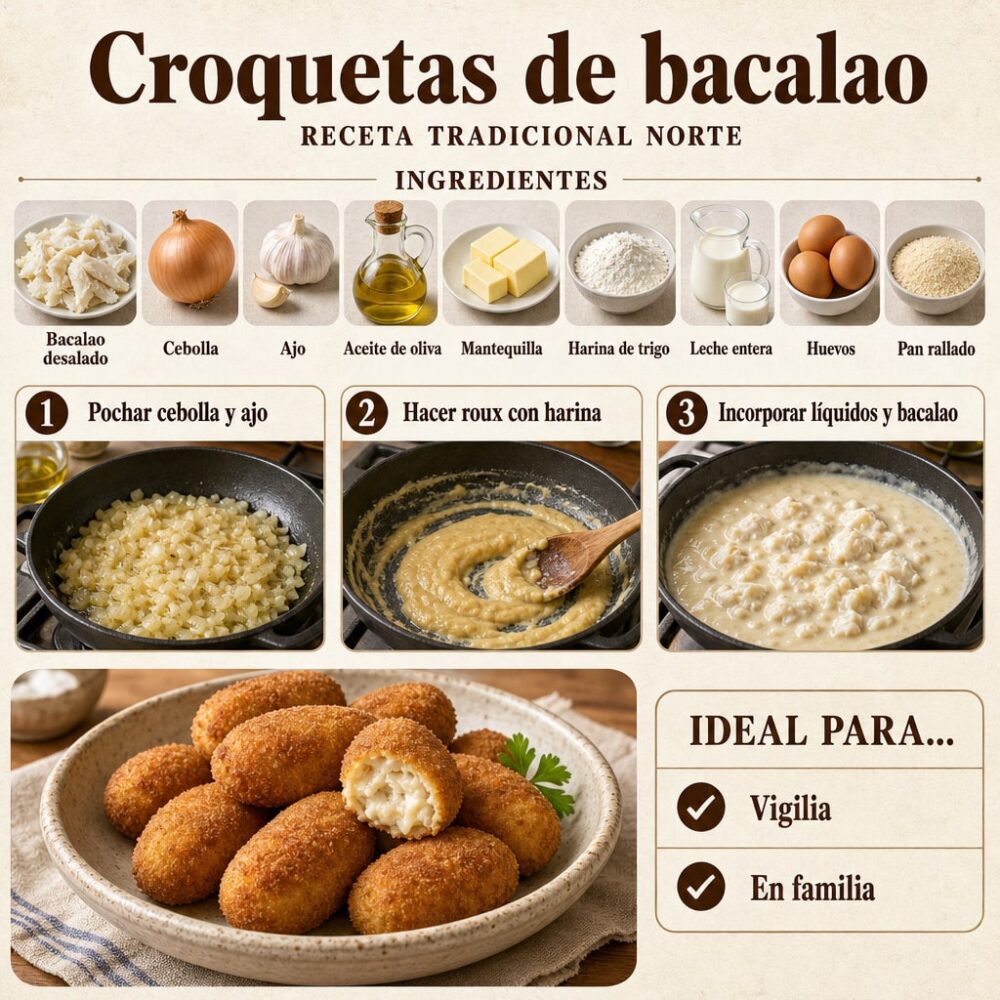
Cod croquettes are one of those recipes we’ve all eaten badly at least once. A dough like a brick, a béchamel that tastes of raw flour, the fish lost in the salting, or—the final drama—that croquette that opens in the pan and releases all its cream into the oil. If you’ve made it this far, it’s because some of this has happened to you.
They’re a classic thrifty recipe from northern Spain, closely tied to Lenten meals and the salted cod that was always in the pantry. Today you find them at any bar in Madrid for €2.50 a piece, but homemade ones, done well, are on another level. Let’s make them with real quantities, times and temperatures.
Quick recipe card
| Detail | Value |
|---|---|
| Servings | 6 (about 30-36 croquettes) |
| Active time | 45 min |
| Dough rest | At least 4 h (ideally 12 h) |
| Difficulty | Medium |
| Allergens | Gluten, dairy, egg, fish |
Why most cod croquettes fail
Two problems, always the same ones. One: the béchamel is poorly calculated. Too much flour and it turns pasty; too much milk and you can’t even shape it. Two: the breading isn’t airtight. If the croquette opens when frying, it’s because the egg didn’t seal the bread properly or because the dough was too soft and warm when you breaded it.
There’s a third, silent error: not cooking the flour enough. If it tastes like paste, you haven’t gone past the 2-3 minutes of roux. You need to reach 5-6 minutes over medium heat, until the mixture pulls away from the walls and smells like biscuits.
Ingredients
For the cod and the sofrito:
- 300 g of desalted cod (loin or flakes, either works)
- 1 medium onion (about 150 g)
- 2 garlic cloves
- 60 ml of extra virgin olive oil
- 20 g of butter
For the béchamel:
- 90 g of wheat flour
- 700 ml of whole milk
- 200 ml of the cod poaching water (strained)
- Nutmeg: 2 gratings
- White pepper to taste (start with ¼ teaspoon)
- Salt: careful, the cod already contributes
For the breading:
- 2 L eggs
- 200 g of breadcrumbs (panko for extra crunch, or a 50/50 mix)
- 100 g of flour (optional, for triple breading)
For frying:
- 1 l of high-oleic sunflower oil or mild EVOO
Step-by-step preparation
1. Desalt and prepare the cod (24-36 h ahead)
If you buy salted cod, 36 h in the fridge in water, changing it every 8 h. The loin needs more time than flakes. If you buy it already desalted at the point of sale, skip this step.
Put the cod in a pot with 300 ml of cold water, bring to a gentle simmer and turn off as soon as it starts to bubble (about 3-4 minutes). Don’t cook it longer: it dries out and loses its gelatin. Reserve the water. Flake by hand removing skin and bones. You should have about 250 g of clean flesh.
2. Sweat the onion and garlic (15 minutes)
Chop onion and garlic very finely (2-3 mm brunoise). In a deep pan, heat the oil and butter over medium-low heat. Add onion and garlic with a pinch of salt and sweat 12-15 minutes until translucent and starting to brown at the edges. If it browns quickly, lower the heat. This is the flavor base.
3. The roux (5-6 minutes)
Add the flour all at once and stir with a whisk or wooden spoon for 5-6 minutes over medium heat. Look for a light golden colour and a biscuit smell. If it stays white, it will taste raw.
4. Incorporate the liquids (10-12 minutes)
Mix the milk and cod water, warm (not cold, not boiling: about 50 °C). Add a third, whisk until incorporated. Next third, same. Last third. Cook stirring constantly for 10-12 minutes over medium heat until the mass pulls away from the walls when you drag the spoon and you see the bottom for a second.
5. Add the cod and adjust (3 minutes)
Off the heat, fold in the flaked cod, nutmeg and pepper. Taste before adding salt. Usually nothing more is needed. Stir 2-3 more minutes on the heat to integrate.
6. Cool (at least 4 h, ideally 12 h)
Pour into a wide dish, spread in a layer 2-3 cm thick, cover the surface with cling film (touching the mass, so it doesn’t form a skin). Fridge. This rest is non-negotiable if you want to shape them well.
7. Shape and bread
With two spoons or a piping bag, form portions of 25-30 g. For airtight breading (the kind that doesn’t open):
- Pass through light flour (optional but recommended)
- Beaten egg, full coverage
- Breadcrumbs, pressing well
- Second egg + second breadcrumbs if you want maximum security
Let the breaded croquettes rest 30 minutes in the fridge before frying. This seals the breading.
8. Fry (2-3 minutes per batch)
Oil at 180 °C (without a thermometer, when a small piece of bread browns in 20 seconds). Fry 4 at a time, never more. If the temperature drops, they absorb oil and burst. 2-3 minutes until hazelnut colour. Drain on a rack, not on paper (paper makes them soggy underneath).
Tricks so they don’t open when frying
- Truly cold dough. If it’s lukewarm, the béchamel expands inside and breaks the breading.
- Double breading at the seam (the line where you shaped them).
- Oil at a steady 180 °C. Below 170, they open. Above 190, they burn outside and the béchamel doesn’t heat through.
- Don’t move them the first 30 seconds. Let the bread seal before turning them.
If you want to review fish-doneness technique, the approach used in hake in green sauce cooked to the exact thickness will help: the logic of thickening with protein and starch is the same.
Variations that work
- With interior pil-pil: add a splash of the cod confit oil to the béchamel. It becomes more unctuous. If you don’t control the emulsion, check how to bind a pil-pil without it breaking.
- Thermomix version: sofrito 8 min/120°/speed 1. Add flour 3 min/100°/speed 2. Liquids and 15 min/90°/speed 4. Cod at the end, 2 min/80°/speed 2 reverse.
- Gluten-free: replace the flour with cornstarch (70 g instead of 90 g) and the breadcrumbs with gluten-free panko or crushed cornflakes.
- With raisins and pine nuts: 30 g of each, Catalan style. They go very well with cod.
Pairing and serving
A white wine with body and acidity: a Godello DO Valdeorras or a young txakoli. If you prefer red, a young Mencía DO Ribeira Sacra holds up to the fat of the breading. Serve freshly fried, 4-5 per person as a portion, 2-3 as a tapa. A quarter lemon on the side and little else: a good croquette doesn’t need sauce.
Frequently asked questions
Can I freeze them? Yes, and it’s the best way to have them ready. Freeze breaded, separated on a tray, for 2 h. Then into a bag. They last 2 months. Fry straight from frozen at 170 °C (lower so the inside heats without burning the bread), 4-5 minutes.
How long do they last in the fridge once made? The raw dough, 48 h covered with skin contact. Breaded but unfried, 24 h. Once fried, eat them the same day. Reheated, they lose their crispness.
Why is my dough too runny? Not enough cooking or too much milk. Return it to the heat for 5 minutes, stirring. If it doesn’t thicken, add a tablespoon of breadcrumbs and mix.
Can I make them in the oven or an air fryer? Yes. Air fryer at 200 °C, 8-10 minutes, spraying oil on top. They aren’t quite as crisp as oil-fried, but they’re decent. Oven with grill at 220 °C, 10 minutes.
Tasty Things Recipes #bacalao #bechamel #croquetas #fritura #receta
 Lumara: the essence of Extremadura finds its home in Chamberí
 How to Make an Authentic Valencian Paella Step by Step (for 4 people, at home and in Valencia)
 Zhen and Chinese New Year: A Menu That Turns Madrid into Shanghai
Deja un comentario