Fabes with Asturian clams: the recipe that never breaks
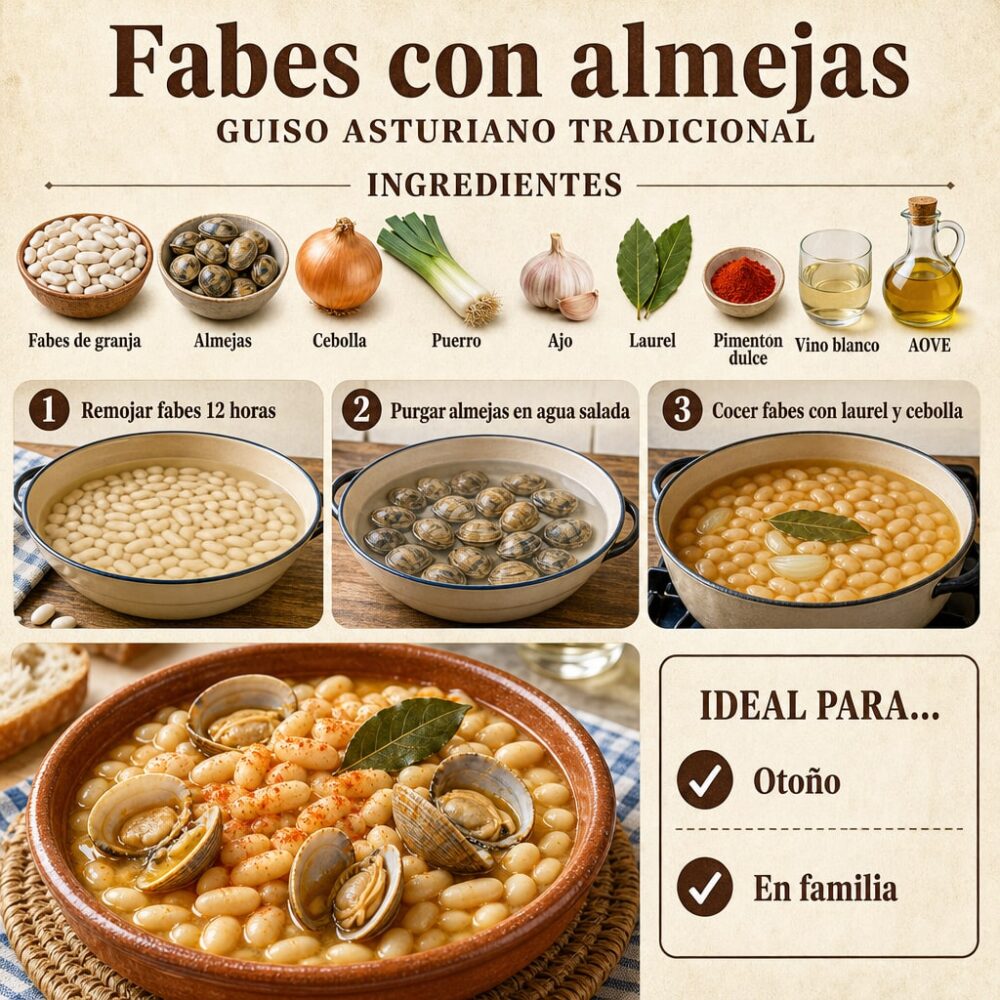
There are dishes that seem easy until you actually make them. Fabes with clams is one of them. Legume, bivalve, an honest sofrito and not much else. And yet half of Spain serves them with split beans, cloudy broth and rubbery clams. A shame, because when done right they are one of the finest spoon dishes of the north: less hearty than fabada, more refined, perfect for a Sunday lunch in the middle of autumn.
Here is my version, cooked an indecent number of times, with real timings (no “until tender”) and the trick of scaring the fabes that makes the difference between an Asturian restaurant dish and a sad bean stew.
Quick recipe card
Before getting into the details, the summary:
| Detail | Value |
|---|---|
| Servings | 4 people |
| Soaking time | 12 h in cold water |
| Total cooking time | About 2 h 15 min |
| Difficulty | Medium (it’s all about the heat) |
| Allergens | Mollusc. Gluten- and dairy-free. |
| Bean variety | Faba Asturiana IGP (from the farm) |
Where this dish comes from
In Asturias, farm-grown fabes are sacred. Fabada with compango is the flagship dish, but fabes with clams are its refined sibling: the one you order in the cider houses along the coast, from Llanes to Cudillero, when you want a spoon dish but not something heavy. It was born as a seafaring way of making the most of ingredients, combining the inland legume with the Cantabrian shellfish. Today it appears on the menu of almost any cider house worth its salt.
It is not a summer dish. It calls for cold weather outside, cider or albariño inside and, if you ask me, an afternoon with nothing to do afterwards.
Ingredients for 4 people
The quantities matter. Especially the bean-to-clam ratio and the amount of cooking water.
- 400 g of farm-grown fabes (Faba Asturiana IGP if you can get it)
- 600 g of clams (fine or babosa; avoid Japanese clams if you have a choice)
- 1 medium onion (about 150 g)
- 1/2 leek, white part only (80 g)
- 3 garlic cloves
- 1 bay leaf
- 1 level teaspoon of sweet Pimentón de la Vera PDO
- 1 glass (150 ml) of dry white wine (an albariño or a godello work well)
- 60 ml of EVOO (extra virgin olive oil)
- 1 level tablespoon of flour
- A good handful of freshly chopped parsley
- Salt (adjust at the end)
Cold water, mineral or filtered, as the cooking requires. Chlorine in tap water toughens the bean skin.
Step-by-step preparation
1. Soaking (the night before, 12 h)
Put the fabes in a large bowl with plenty of cold water, at least 3 fingers above them. Leave them for 12 hours. Not 6, not 18. Less time and the skin resists; more and they start to ferment and turn slightly bitter.
2. Purging the clams (2 h before cooking)
Clams in cold salted water (about 30 g per litre, sea-level salinity). Two hours in the fridge. They release the sand. Discard any that are open and do not react when touched.
3. Starting the cooking (10 min)
Drain the fabes and transfer them to a wide, shallow pot (important: wide, not narrow, so they do not pile up). Cover them with cold water, 3 fingers above. Add the bay leaf, half the onion whole and a splash of the EVOO (10 ml).
High heat until it starts to boil. You will see grey foam: skim it off with a slotted spoon.
4. Scaring the fabes (the anti-breakage key)
Here comes the Asturian trick. When it comes to a boil, add half a glass of cold water. This stops the cooking abruptly. Repeat twice more over the first 30 minutes. Why does it work? The sudden change in temperature keeps the skin from separating from the bean. Scared fabe, whole fabe.
From then on, very gentle heat. The liquid should tremble, not bubble. If it boils hard, they break. Always. Cover partially.
5. Long cooking (1 h 30 min to 1 h 45 min)
Farm-grown fabes need time. Between an hour and a half and an hour and three quarters on minimal heat. Move the pot by its handles, turning it gently, never with a spoon: you would break them. If you need to add water, always cold and in small amounts.
They are ready when, blowing on a bean, its skin wrinkles. And when you bite into it, it gives way without being mushy.
6. The sofrito (15 min, in parallel with the last 20 minutes of cooking)
Meanwhile, in a separate pan: 50 ml of EVOO, the remaining onion and the leek, very finely chopped. Sweat over medium-low heat for 12 minutes, until translucent and just beginning to colour at the edges. Add the chopped garlic, one more minute.
Off the heat, add the Pimentón de la Vera (off the heat so it does not turn bitter), stir, return to the heat and add the tablespoon of flour. Toast for 30 seconds. White wine, raise the heat, reduce for 2 minutes until the alcohol evaporates.
7. The clams (5 min)
Add the drained clams to the sofrito, cover and wait for them to open. Between 2 and 4 minutes. As soon as they open, turn off the heat. Overcooking turns them to rubber.
8. Combine and rest (10 min)
Pour the sofrito with clams over the fabes. Move the pot by the handles, never with a spoon. Adjust the salt (note: the clams already contribute salt). Chopped parsley on top. Turn off the heat and let it rest covered for 10 minutes. The rest thickens the broth and the bean finishes absorbing flavour.
Tips to keep them from breaking (and common mistakes)
- Wide, shallow pot, never narrow. If they pile up, the ones at the bottom burst.
- Cold water at the start, not hot. The gradual rise in temperature hydrates the skin without cracking it.
- No baking soda and no salt at the start. Salt toughens the skin and baking soda dissolves it.
- Do not stir with a spoon. Always move the pot in a circle. It seems trivial until you see the difference.
- If you use a pressure cooker, bring it down to 20 minutes from the moment the valve reaches pressure 2, but you lose control over the “scaring”. I like it less.
Honest variations
Some people add a splash of natural cider instead of white wine. It is Asturian and it works, though it adds a more acidic note. You will also find versions with a cayenne chilli in the sofrito: a hint, not a blaze.
For an alcohol-free version, replace the wine with 100 ml of light fish stock and 1 teaspoon of cider vinegar. It is not quite the same, but it holds up.
If you want to get closer to the classic, take a look at our cod in pil-pil sauce recipe: another northern dish, another emulsifying technique, same principle of respect for the product.
Pairing and serving
Serve in a deep plate, not a soup bowl. The broth should look creamy but not thick: if it is too thin, let it rest longer; if it is too thick, a little hot water and swirl the pot.
To drink: natural Asturian cider poured from height, an albariño from Rías Baixas PDO with a couple of years in the bottle, or a godello from Valdeorras PDO. No reds: they mask the shellfish.
No side dish. Crusty bread to mop up the sauce, and that is it. If you complicate it, you spoil it.
Frequently asked questions
Can I use ordinary supermarket fabes?
You can, but it is not the same. Faba Asturiana IGP has a thinner skin and a buttery texture. Generic fabes tend to break more and absorb flavour less well. If you invest 2 hours in the kitchen, invest in the legume too.
Can it be made a day ahead?
Yes, and it improves. Store it in the fridge in a wide container, not piled up. The next day, reheat over very gentle heat, moving the pot by the handles. Do not boil it or you will break the beans that survived.
Can it be frozen?
The fabes can, well drained and without clams. The clams cannot: they turn leathery when thawed. If you plan to freeze it, make the fabes stew and add freshly cooked clams when reheating.
How long does it keep in the fridge?
48 hours, well covered. From the third day onwards, the clams start to taste metallic.
Why are my fabes still hard even after cooking them for 2 hours?
Two likely causes: water with a lot of limescale (try mineral water) or old-harvest fabes. This year’s beans need less soaking and less cooking; beans more than a year old can stay hard no matter how long you persist. Check the packaging date when you buy.
Asturias Tasty Things Recipes #almejas #Asturias #fabes #marisco #receta #sidra

 Lumara: the essence of Extremadura finds its home in Chamberí
 How to Make an Authentic Valencian Paella Step by Step (for 4 people, at home and in Valencia)
 Zhen and Chinese New Year: A Menu That Turns Madrid into Shanghai
Deja un comentario