Galician Caldo with Collard Greens and Unto: The Traditional Winter Recipe
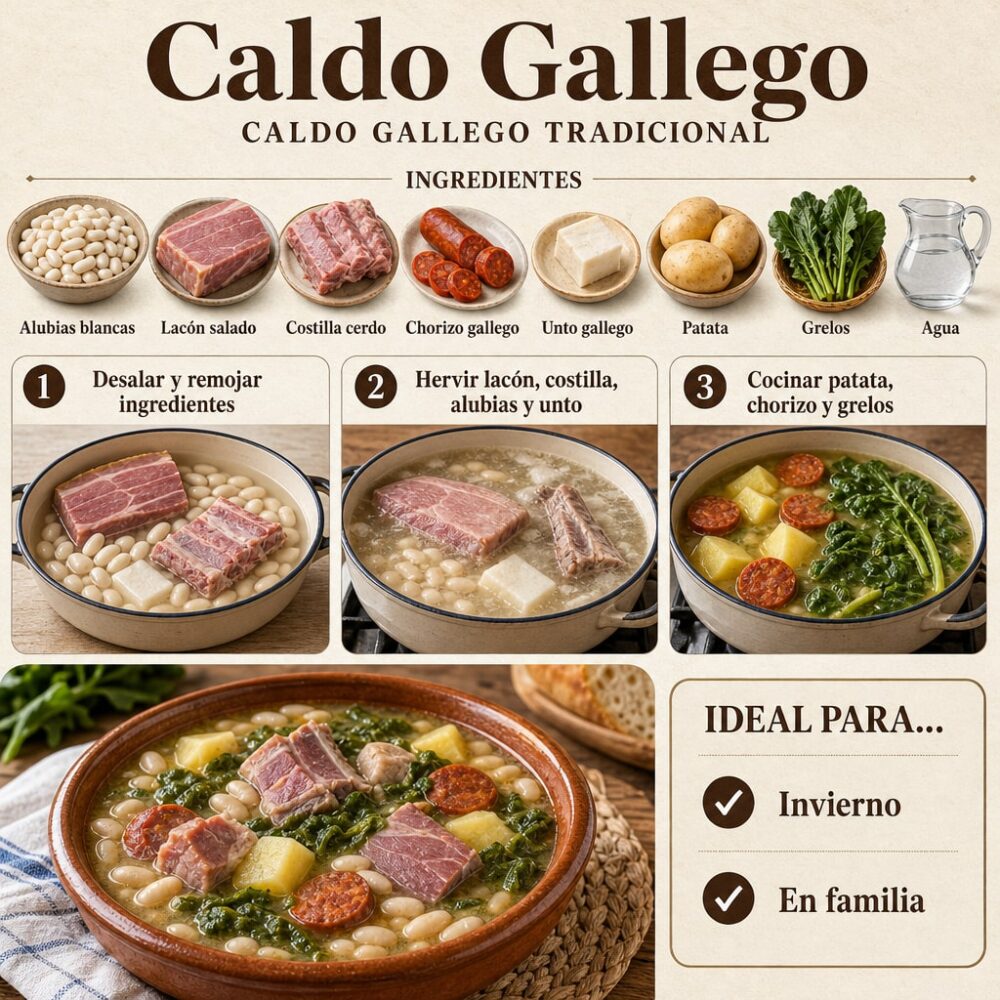
Some dishes can’t be understood without the cold outside. The Galician caldo is one of them: a pot simmering on low heat while it rains, pork fat melting between the green leaves, and the smell of cabbage drifting through the whole house. It isn’t a soup, it isn’t a stew, it’s caldo. And it contains unto, which is what makes it Galician and nothing else.
If you come from the north, you already know this. If not, here is the recipe I’ve made dozens of times, learned by asking questions in Lugo and correcting things at home. No light versions and no “I’ll use chard, it’s similar.” It isn’t.
What exactly is Galician caldo
It is a white broth of pork and legumes, thickened by the potato itself as it breaks down, with leafy greens (grelos or cabbage) and the fatty touch of unto. In Galicia it is eaten in winter, every day of the week, and it is the starter of the set lunch in any eatery from Monforte to Pontevedra.
The unto is cured and smoked pork fat, traditionally wrapped in casing. It gives the characteristic flavor: that smoky, slightly rancid note that distinguishes real caldo from watery imitations. Without unto, it is something else. You can ask for it at Galician butcher shops or look for vacuum-packed versions in northern specialty stores.
Quick recipe sheet
| Detail | Value |
|---|---|
| Origin | Galicia, rural cooking |
| Type | Spoon dish, thick broth |
| Season | October to March |
| Total time | 2 h 30 min (plus soaking) |
| Servings (this recipe) | 6 |
| Allergens | May contain traces of gluten (cured lacón) |
Ingredients for 6 people
- 300 g of white beans (fabas or small judión), soaked the night before
- 400 g of salted lacón (desalted 24-36 h, changing the water 3 times)
- 200 g of salted or fresh pork rib
- 1 Galician chorizo smoked (about 150 g)
- 80 g of Galician unto
- 600 g of Galician potatoes (Kennebec variety if you can find it)
- 500 g of fresh grelos (or 400 g of cabbage if not available)
- 2.5 liters of water
- Salt (careful, the lacón is salty)
If you use canned grelos, 1 large jar (about 400 g drained), added at the end. It is not the same, but it gets you out of trouble.
Step-by-step preparation
-
Desalting and soaking (the day before). Put the lacón in plenty of cold water for 24-36 hours in the fridge, changing the water three times. Soak the beans for 12 hours in lukewarm water. Without this, there is no caldo.
-
Starting the pot (15 min). In a large pot, put the 2.5 liters of cold water with the desalted lacón, the rib, the drained beans and the unto. High heat until it starts to boil. Skim off the brown foam that rises in the first minutes with a slotted spoon.
-
Slow cooking (90 min). Lower to minimum heat, partially cover and let it simmer gently. The beans must stay whole but creamy inside. If the water drops, always add hot water, never cold (the beans “get scared” and break their skins).
-
Preparing the grelos (10 min). Wash the grelos well and remove the tougher stems. Blanch them separately in boiling salted water for 5 minutes and drain. This removes just enough bitterness so they don’t overpower the rest.
-
Potato and chorizo (25 min). Peel the potatoes and break them (press the knife in and snap the piece, don’t cut cleanly: this releases starch and thickens the broth). Add them to the pot with the whole chorizo. Cook 20-25 minutes over medium-low heat.
-
Grelos in (15 min). Add the drained grelos. Cook another 15 minutes. The caldo should be slightly thick, with the potatoes starting to fall apart at the edges.
-
Rest and serve. Remove the lacón, the rib and the chorizo. Cut them into pieces. Adjust the salt (probably not needed). Let it rest 10 minutes covered. Serve the broth in a deep bowl with a couple of pieces of meat on top.
Tricks and variations that work
- Unto is non-negotiable. If you can’t find it, you can substitute 60 g of finely chopped cured Iberian bacon, but it tastes different. Don’t use unsmoked pork belly: it adds fat, not flavor.
- Break the potato, don’t cut it. I repeat it because it’s the trick that separates a thickened caldo from a watery one.
- It improves overnight. Make it the day before, cool it and reheat gently. The flavors settle and the caldo gains body.
- Lighter version: reduce the unto to 40 g and use only lacón, without the rib. It loses depth but is still Galician caldo.
- Gluten-free: check that the chorizo and lacón you buy don’t contain traces (some do). The other ingredients are naturally gluten-free.
Pairing and serving
A hot deep bowl, a soup spoon, bread from Cea PGI if you can find it (or any round loaf with a thick crust), and young Galician red wine: a Mencía from Bierzo or Ribeira Sacra, served chilled (14 °C). A white Ribeiro also works if you prefer. No heavy reds: this dish calls for wine with fruit and acidity.
For a second course, if you’re really hungry, a piece of lacón with grelos on the side, with cachelos and Vera smoked paprika. Otherwise, close the night with the broth and a board of San Simón da Costa PDO cheese.
If you like substantial spoon dishes, the Madrid cocido in three servings plays in the same league of long-simmered pots and generous quantities.
Frequently asked questions
Can I freeze it? Yes, it keeps for 2 months in the freezer. Better without the potato, which turns mealy when thawed. Freeze the broth with beans and vegetables, and add freshly cooked potato when reheating.
How long does it last in the fridge? 3-4 days in an airtight container. In fact, day 2 is better than day 1.
What do I do if I can’t find grelos? Galician cabbage (wide-leaf kale). Chard and spinach don’t work: they add water and the wrong flavor. In large supermarkets in Madrid you can find fresh grelos from November to February; out of season, use a glass jar.
Is it very heavy? It is a fatty dish, I won’t deny it. If you make it with the quantities above and don’t eat half the chorizo yourself, it is a hearty dinner but not an outrage. Like any winter spoon dish.
Tasty Things Lugo Recipes #caldo gallego #cocina gallega #grelos #platos de cuchara #receta

 Lumara: the essence of Extremadura finds its home in Chamberí
 How to Make an Authentic Valencian Paella Step by Step (for 4 people, at home and in Valencia)
 Zhen and Chinese New Year: A Menu That Turns Madrid into Shanghai
Deja un comentario