Roast suckling lamb Aranda-style: cuts, water and timing
A practical guide to roasting suckling lamb in the style of Aranda de Duero in a home oven: cuts, water and salt ratios, temperatures and exact timings per kilo.
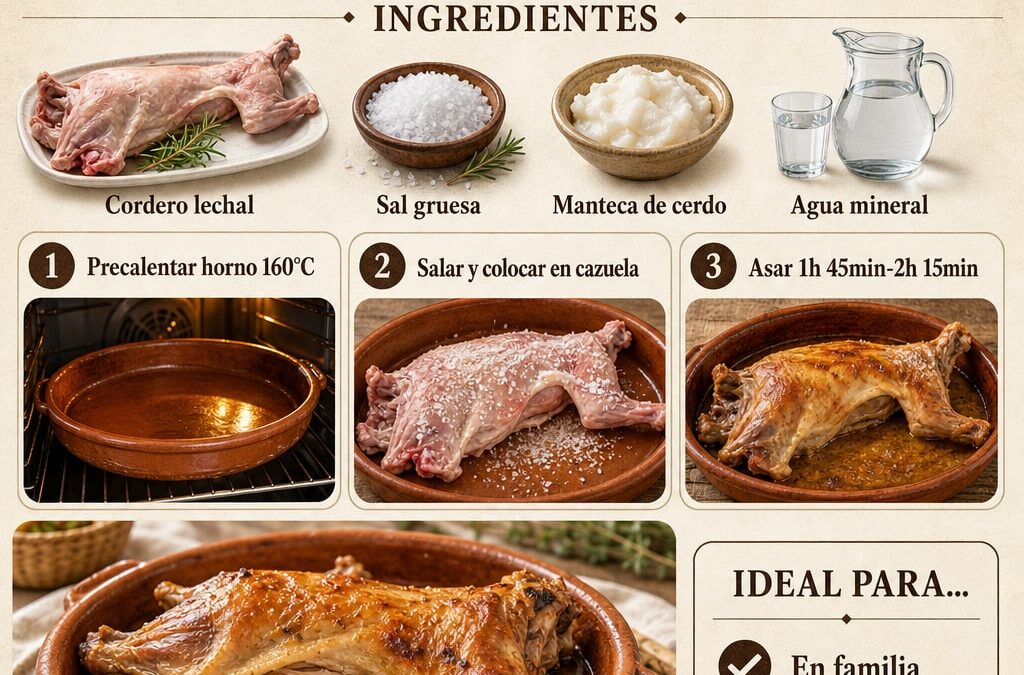
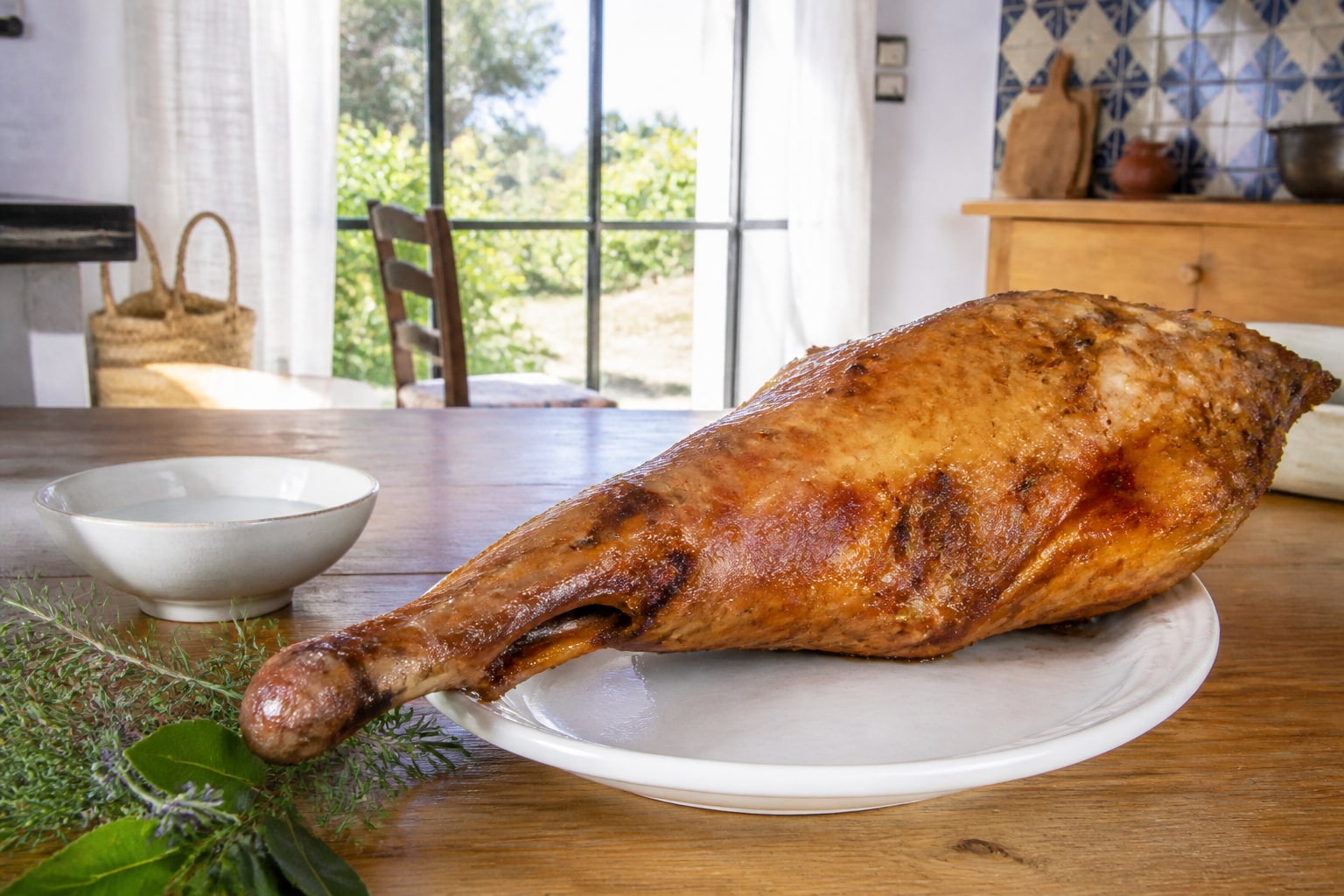
If you’ve spent a Sunday lunchtime in Aranda de Duero, you already know what this is about. Clay casserole, wood-fired oven at full blast, a quarter of lechazo arriving with crackling skin and meat that falls off the bone without a knife. No sauce, no exotic herbs, no 24-hour marinade. Water, salt, lard and patience. That’s it.
The good news: at home, with a regular electric oven and a clay casserole, you can get quite close. The bad news: any shortcut shows. Here is the recipe as the Aranda roasting houses make it, with quantities, timings and the reasons behind each step.
What suckling lamb is and why Aranda leads
The suckling lamb is slaughtered before weaning, fed only on mother’s milk. Carcass weight is between 4.5 and 7 kg. The meat is pale pink, the fat white, the flavour mild and milky. Nothing to do with ternasco (older, redder) or pascual.
In the Ribera del Duero, roast meat has been a religion for centuries. Aranda has more than 40 registered roasting houses in the area, many with holm oak or vine-shoot wood-fired ovens, and it is the heart of the IGP Lechazo de Castilla y León, which covers lechazo from the native breeds churra, castellana and ojalada, slaughtered at under 35 days and 5.5-8 kg carcass weight with head.
Quick reference for Aranda-style roast
| Detail | Value |
|---|---|
| Ideal cut | Hind quarter (leg) or fore quarter (shoulder) |
| Weight per quarter | 1.1 – 1.4 kg |
| Diners per quarter | 2 people |
| Oven | 160 °C top and bottom, no fan |
| Total time | 1 h 45 min – 2 h 15 min per quarter |
| Water in the casserole | 200 ml initially + top-ups |
| Salt | 6 g per kilo of meat |
The cut: hind quarter or shoulder
In Aranda it is served by quarters, not small pieces. Two options:
- Hind quarter (leg with part of the loin): more meat, less fat, better for those who don’t want to fight with small bones. It is the one usually ordered by visitors.
- Fore quarter (shoulder with rack): fattier, tastier, more bone. For the initiated. The skin comes out crisper.
Ask the butcher for it already portioned and with a cut through the joint so it sits properly in the casserole. If it carries the oval seal of the IGP Lechazo de Castilla y León, even better: it guarantees breed and age.
For 4 diners, two quarters (2.2 – 2.8 kg in total). For 6, three quarters. Don’t skimp: the bone takes away.
The casserole: clay, always
This is non-negotiable. Glazed clay casserole, round or oval depending on the shape of the quarter, at least 4 cm deep. Clay distributes heat slowly and releases moisture, which is exactly what we want.
No clay? A cast-iron dish is the second option. The metal trays in the oven give a dry roast and a leathery skin. Forget them.
Before first use, season the casserole: soak it for 12 hours in water with a crushed garlic clove. Then oil it and put it in the oven for 30 min at 150 °C. It won’t crack any more.
Ingredients for 4 people
- 2 quarters of IGP suckling lamb (about 2.4 kg in total)
- 15 g coarse salt
- 30 g Iberian pork lard
- 250 ml mineral water
- 1 garlic clove (optional, for the casserole)
Nothing else. No rosemary, no bay, no wine, no garlic rubbed on the meat. Aranda doesn’t use them. If you add herbs, you’re making something else, not Castilian roast lamb.
Step-by-step preparation
-
Preheat the oven to 160 °C, top and bottom, no fan. 15 minutes. It is the temperature of a wood-fired oven once stabilised, not the blazing heat of the first batch.
-
Prepare the meat. Take the quarters out of the fridge 1 hour beforehand. Dry them well with kitchen paper. Any drop of water on the skin turns to steam and robs you of the crust.
-
Rub in the lard. Spread the 30 g of lard over the whole skin with your hand. A thin layer. It’s not about frying, but about helping the browning.
-
Place in the casserole skin side down. Yes, down. Salt the meat side that faces up (about 3 g per quarter). Add 200 ml of water to the bottom.
-
First phase: 50 minutes at 160 °C. The meat cooks in its own juices, the water generates steam, the fat melts. At 25 minutes, open up and baste the surface with the casserole’s own juices.
-
Turning. After 50 min, take the casserole out. With two large spoons (careful, they’re hot), turn the quarter over. Now skin side up. Salt the skin with the rest of the coarse salt, spread evenly.
-
Second phase: 40-50 minutes at 160 °C. Every 15 min, baste the skin with the casserole juices. If the water has evaporated completely, add 50 ml more. The casserole must never run dry, but it shouldn’t swim in broth either.
-
Final blast: 10-15 minutes at 200 °C. Raise the temperature to set the skin. You’ll see it tighten, brown and start to blister. That’s the point. If it still looks pale, give it 5 more minutes.
-
Rest: 5 minutes out of the oven, uncovered. Serve in the same casserole, straight to the table. In Aranda it is eaten with a spoon and clay plate, and sometimes with the hands.
Water and salt: the two ratios that are not negotiable
These are the only two numbers that matter:
- Water: 100 ml per kilo of meat at the start, plus top-ups of 50 ml if it dries out. Without water, the skin burns before the meat is cooked. With too much, you boil instead of roast.
- Salt: 6 g per kilo. 2 g go on the meat before the oven, 4 g on the skin when turning. If you salt everything at the beginning, the skin turns leathery.
Timings by quarter weight
| Quarter weight | Phase 1 (skin down) | Phase 2 (skin up) | Final blast 200 °C |
|---|---|---|---|
| 1.0 kg | 45 min | 35 min | 10 min |
| 1.2 kg | 50 min | 45 min | 12 min |
| 1.4 kg | 55 min | 50 min | 15 min |
| 1.6 kg | 60 min | 55 min | 15 min |
Always 160 °C in the first two phases. The final blast, 200 °C.
Tricks and common mistakes
- Don’t open the oven in the first 30 minutes. The steam that escapes doesn’t come back.
- If your oven heats more on one side, rotate the casserole 180° when you turn the meat.
- Skin not crackling is usually due to excess moisture at the end. In the last 15 min, remove excess liquid with a spoon and keep it to baste on the plate.
- Oven with mandatory fan? If you only have convection, lower to 145 °C and shorten each phase by 5 minutes. But the result is never quite the same: the air dries it out.
- Shoulder-only version (without a full quarter): same process, but reduce each phase by 15 minutes. A 900 g shoulder comes out in 1 h 25 min total.
Side dish and pairing
In Aranda it is served with green salad (lettuce, spring onion, a good extra virgin olive oil and sherry vinegar) and country loaf to mop up the juices. No potatoes: they would compete with the lamb’s fat. If you want potatoes, make oven-roasted chicken with lemon and panadera potatoes another day.
Wine: Ribera del Duero DOP crianza, naturally. A tempranillo aged 14-18 months in barrel holds up to the lechazo’s fat without masking it. If you fancy something less obvious, a young Toro DOP with black Toro grapes also works.
To start the meal, a Castilian garlic soup with stale bread and paprika rounds off the classic Aranda menu.
Frequently asked questions
Can I roast it the day before and reheat it? You can, but it loses something. If there’s no alternative, roast through the full phase 2, cool, store covered in the fridge and the next day give it 25 minutes at 180 °C plus the final blast at 200 °C. The skin recovers; the meat, not entirely.
Can it be frozen? Raw lechazo, yes, well wrapped, up to 3 months. Thaw 24 h in the fridge before roasting. Once roasted, it’s not worth it: the texture is ruined.
How long does it keep in the fridge once cooked? Up to 3 days in an airtight container. To use leftovers, bone, shred and make croquettes or a filling for empanadillas.
Is recental or ternasco lamb acceptable? It is, but it isn’t the same. Recental weighs twice as much and needs more time (around 2 h 30 min) and more water. The flavour is stronger, the fat more yellow. If you buy it, ask for one under 90 days old.
What if I can’t find Iberian lard? Regular pork lard works. What doesn’t work is olive oil: it changes the flavour and doesn’t give the same crust. Butter won’t do either; it burns.
As an Amazon Associate, I earn from qualifying purchases.

0 comentarios · Comentar