Homemade Meat Empanadillas: Dough That Doesn't Break When Fried
The definitive guide to making homemade meat empanadillas with a dough that holds up to frying without splitting open. Hydration, flour type, oil temperature and a step-by-step recipe.
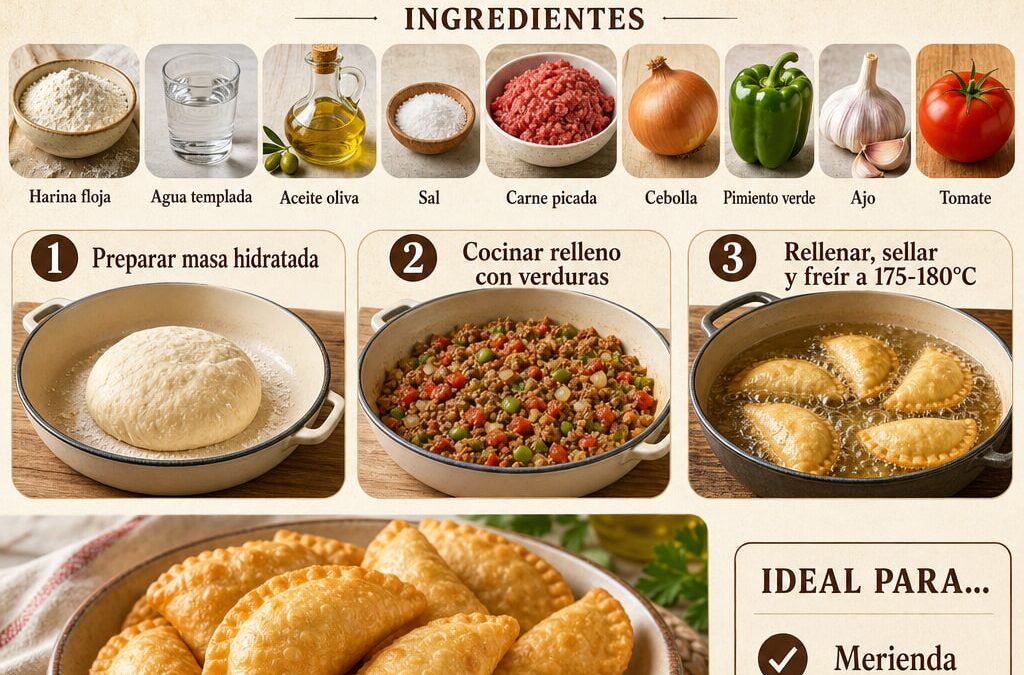
Fried empanadillas are that dish everyone remembers from their mother’s or grandmother’s kitchen, but almost nobody gets them right on the first try. It happens to you every time: you fill them with enthusiasm, seal them nicely, drop them into the oil… and half of them split open and spill the filling as if they were in a hurry to escape. It’s not bad luck. It’s the physics of the dough and the oil temperature, and you can control it.
This recipe works for a Sunday afternoon snack, for home tapas before a match, or for bringing to a family meal without them falling apart in the container. If you like crispy shortcrust dough and a juicy minced meat filling, keep reading.
Why empanadilla dough breaks when fried
There are three usual culprits, and they almost always act together.
The first is the dough hydration. A dough that is too dry lacks enough elasticity to stretch when the steam from the filling pushes from inside during frying. It cracks at the edges, which is exactly where you have the least margin. A dough with hydration between 45% and 50% (that is, 45-50 ml of liquid per 100 g of flour) gives the flexible consistency you need.
The second is the type of flour. Strong bread flour (W300 or higher) develops too much gluten for this: the dough becomes elastic but also shrinks when fried, and that tension ends up opening poorly sealed seams. For empanadillas, a soft or all-purpose flour (W130-W170) is best, as it gives a more manageable dough with less “memory”.
The third is the oil temperature. If the oil is cold (below 160 °C), the empanadilla absorbs grease before the dough sets, softens and opens. If it is too hot (above 190 °C), the surface seals instantly, the internal steam has nowhere to escape and bursts the dough from within. The right point is between 175 and 180 °C.
On top of this, there is the edge sealing: if there isn’t enough contact surface between the two layers of dough, no matter how well hydrated it is, it will come apart all the same.
| Cause | What it causes | Solution |
|---|---|---|
| Dough with low hydration (under 40%) | Cracks when stretched or fried | Raise hydration to 45-50% |
| Strong bread flour | Elastic dough that shrinks and opens seams | Use soft or all-purpose flour |
| Oil below 160 °C | Absorbs grease, softens and opens | Fry at a steady 175-180 °C |
| Oil above 190 °C | Seals instantly, internal steam bursts the dough | Control with a kitchen thermometer |
| Sealing with the fingers, without pressure | Comes apart during frying | Seal with a fork and a little water on the edge |
| Filling too hot when assembling | Dampens the dough before closing | Let the filling cool for at least 20 minutes |
Ingredients
For 20-22 empanadillas (4 people as a main dish, 6-8 as an appetiser):
For the dough:
- 400 g soft or all-purpose flour (W130-170)
- 180 ml lukewarm water (about 35 °C)
- 50 ml extra virgin olive oil
- 1 teaspoon salt (5 g)
- 1 egg (optional, for sealing the edges)
For the filling:
- 400 g mixed minced meat (equal parts beef and pork)
- 1 medium onion (120 g), finely chopped
- 1 Italian green pepper (80 g), finely chopped
- 2 garlic cloves, chopped
- 2 ripe tomatoes (200 g) grated or 150 g of crushed tomato
- 2 hard-boiled eggs, chopped (optional, classic version)
- 1 teaspoon sweet smoked paprika from Vera PDO
- 50 ml white wine
- 30 ml extra virgin olive oil for sautéing
- Salt and black pepper (start with half a teaspoon of salt and adjust at the end)
For frying:
- Mild olive oil or sunflower oil, enough to cover 3-4 cm of the pan or deep fryer
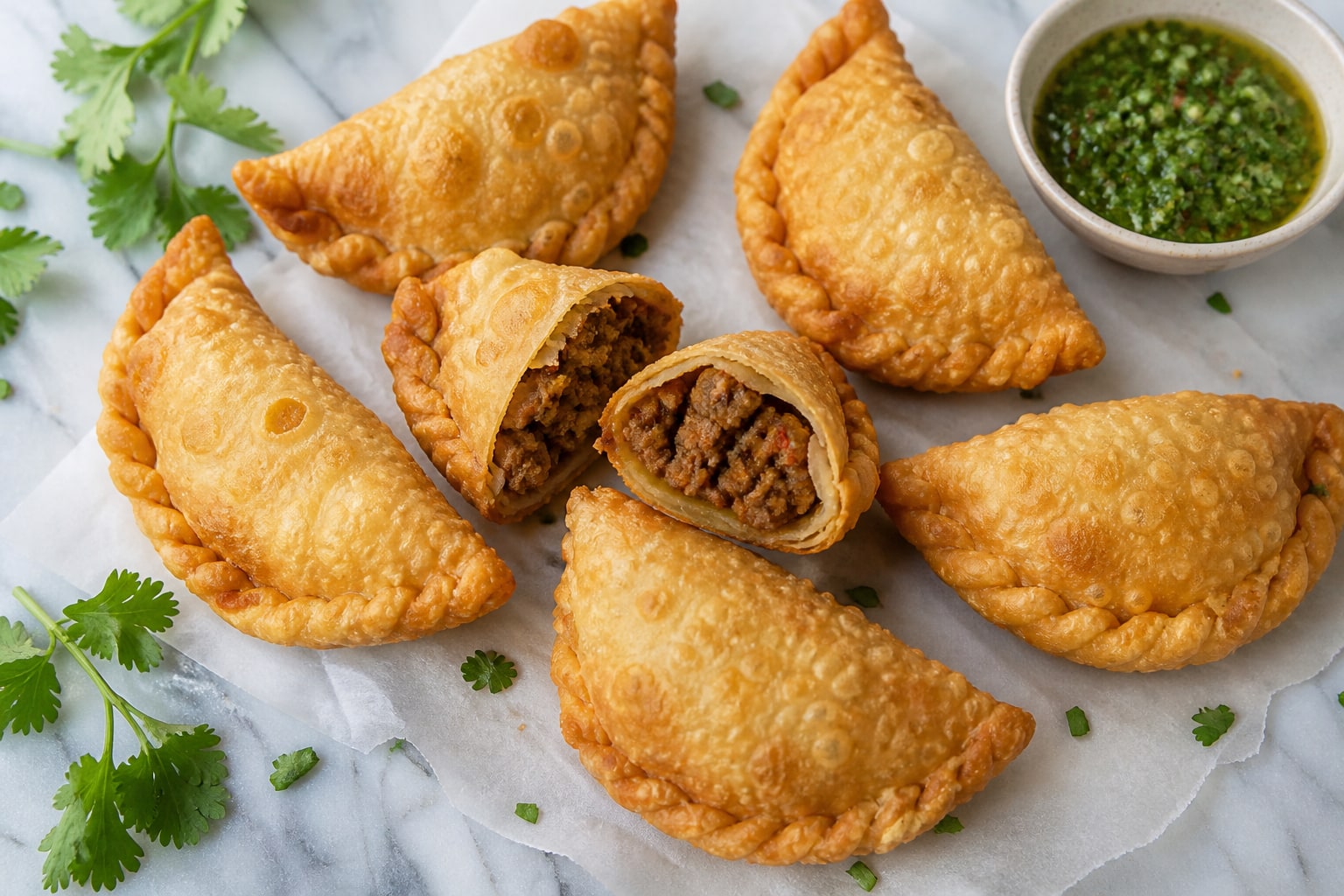
Step-by-step preparation
- Make the dough: mix the flour with the salt in a bowl. Add the oil and lukewarm water little by little, kneading by hand. Work for 5-6 minutes until you have a smooth dough that doesn’t stick to your fingers but is still flexible. Test: if you stretch it a little with two fingers, it doesn’t break or tear.
- Rest: shape into a ball, brush with a little oil, cover with cling film and let it rest for 30 minutes at room temperature. This rest relaxes the gluten and is key so that it doesn’t shrink when stretched.
- Prepare the filling: sauté the onion, pepper and garlic in the oil over medium-low heat for 10-12 minutes, until they are translucent and not before. Add the minced meat, turn up the heat and brown it for 5 minutes, stirring so it doesn’t clump.
- Reduce: add the white wine and let the alcohol evaporate for 2 minutes. Stir in the tomato and the paprika from La Vera, season with salt and pepper and cook over low heat for 10 more minutes, until there is no loose liquid left in the pan. Test: the filling should be practically dry, not soupy.
- Cool the filling: transfer the filling to a plate and let it cool for at least 20 minutes. If you fill them while hot, the dough gets damp and becomes more prone to splitting during frying.
- Stretch and cut: divide the dough into two portions, roll out on a floured surface until 2-3 mm thick. Cut circles 10 cm in diameter with a pastry cutter or a large glass.
- Fill and seal: place a heaped tablespoon of filling (about 25 g) in the centre of each circle, without reaching the edge. Moisten the edge with a finger dipped in water or beaten egg, fold into a half-moon and press firmly with your fingers. Finish by pressing the whole perimeter with a fork: this gives the double seal that prevents opening.
- Fry: heat the oil to 175-180 °C (check with a thermometer or by dropping in a small piece of dough: it should bubble immediately without darkening). Fry the empanadillas in batches of 4-5, without crowding, for 3-4 minutes per side, until evenly golden. Drain on kitchen paper.
Tips so the dough doesn’t break when frying
- Don’t overcrowd the pan: if you add too many empanadillas at once, the oil temperature drops sharply and they soften before sealing. Fry in small batches.
- Double seal: wet finger + fork. The water acts as glue between the two layers of dough; the fork gives extra mechanical pressure along the whole edge.
- Dry filling, not soupy: if loose juice remains in the pan after cooking the meat, that liquid turns to steam under pressure inside the empanadilla and bursts it from within.
- Oven version: if you prefer not to fry, brush with beaten egg and bake at 200 °C for 18-20 minutes. The dough won’t be as crispy, but there is no risk of opening from excessive oil heat.
Variations
You can replace the meat with tuna in oil, drained (200 g), with tomato sauce and hard-boiled egg, the most classic Spanish snack version. For a gluten-free version, replace the flour with a mix of gluten-free bread flour and 1 teaspoon of xanthan gum per 400 g, although the dough will be somewhat more fragile and needs more careful handling when rolling. If you like a spicy kick, add a chopped fresh chilli to the onion and pepper sauté. For those watching their fat intake, baking with beaten egg on top is the option, though you lose the characteristic crunch of frying.
Pairing and serving
Meat empanadillas call for something with bubbles or acidity to cut through the richness of frying: a brut cava or a well-chilled beer works wonderfully. If you prefer wine, a young red with little oak, such as Mencía, won’t clash with the paprika in the filling. Serve them freshly made, never reheated in the microwave as the dough goes soft; if there are leftovers, it’s better to reheat them in the oven or in a dry pan for 5 minutes.
FAQ
Can you freeze uncooked empanadillas? Yes. Freeze them already shaped, unfried, separated by layers of paper so they don’t stick together. Fry them straight from frozen, adding 1-2 more minutes of frying and lowering the heat slightly so they cook through without burning on the outside.
How long do they keep in the fridge once made? Between 2 and 3 days in a closed container. They lose their crispiness, so I recommend reheating them in the oven at 180 °C for 8-10 minutes before eating.
Why does the dough stick to the rolling pin when I stretch it? There isn’t enough flour on the work surface or the dough hasn’t rested long enough. Flour generously and respect the 30-minute rest from step 2.
Can I make the dough in a Thermomix? Yes: put the flour, salt, water and oil in the bowl and run it for 2 minutes on the dough-kneading speed. The result is the same as kneading by hand; only the working time changes.
If you enjoy this kind of dough that requires mastering through practice, the same care with temperature and sealing applies to creamy cod croquettes, with a coating that doesn’t open. And if your thing is avoiding breakages in general in spoon-based cooking, the Asturian fabada with clams also has its own recipe that doesn’t break.
As an Amazon Associate, I earn from qualifying purchases.
0 comentarios · Comentar