Homemade Beef Wellington: crispy puff pastry and beef cooked to perfection
Step-by-step recipe for homemade beef Wellington with mushroom duxelles, crispy puff pastry and exact temperatures for the perfect doneness. Ideal for Christmas or a dinner with guests that's worth the effort.
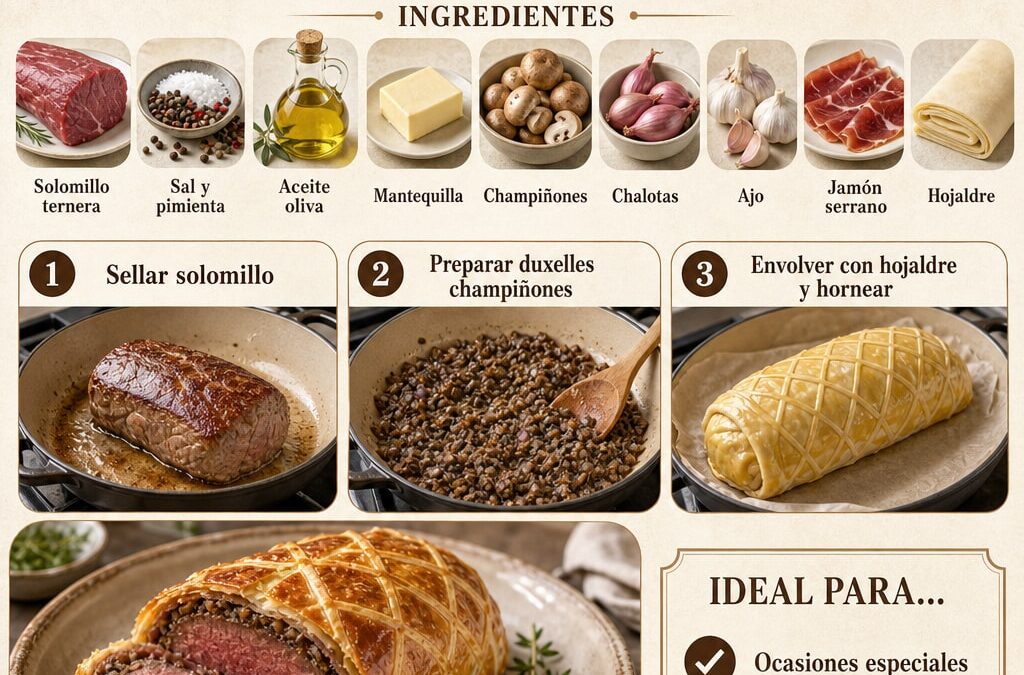
Beef Wellington has a reputation as an untouchable dish, the kind you only order in a restaurant. And it’s true that if you get it wrong — raw pastry underneath, grey meat inside — it’s a real letdown. But if you do it right, with the timings under control, it’s one of those recipes that impresses the most for the real effort it takes.
It’s an occasion dish. Christmas Eve, a big birthday, that dinner where you want something other than the usual roast. It’s not a weeknight recipe, and it doesn’t need to be. Here are the quantities and timings with no room for improvisation, because with this dish, improvising costs you dearly.
Ingredients for the beef Wellington (6 people)
- 1 clean, centre-cut beef tenderloin, 900 g to 1 kg
- Salt and ground black pepper
- 30 ml extra virgin olive oil
- 50 g butter
- 500 g mushrooms, very finely chopped (for the duxelles)
- 2 shallots (about 100 g), finely chopped
- 2 garlic cloves, chopped
- 100 ml dry white wine
- 150 g thinly sliced Serrano ham (or Teruel Ham PDO, which holds up well as a wrapping thanks to its curing)
- 20 g Dijon mustard
- 1 rectangular sheet of all-butter puff pastry, 320–400 g
- 1 whole egg, beaten, for brushing
- Flour for rolling
Step-by-step method
Searing the tenderloin
Season the whole tenderloin with salt and pepper. Heat the oil in a frying pan over high heat, almost smoking. Sear the meat on all sides, 1–2 minutes per side, about 8 minutes in total. Look for an even golden crust, not burnt. Remove and let it cool completely on a wire rack, at least 15 minutes. If you wrap it while warm, the pastry will end up soggy, guaranteed.
Mushroom duxelles
In the same pan, with the butter, sweat the shallot and garlic for 3–4 minutes over medium heat. Add the chopped mushrooms and turn up the heat. Here lies the secret of the whole dish: you need to evaporate the water they release, about 10–12 minutes stirring, until the mixture is dry, dark and almost paste-like. If you leave it wet, that water goes straight into the pastry during baking. Add the white wine halfway through cooking to deglaze and let it evaporate completely. Season with salt and pepper and transfer to a plate to cool.
Assembling with the pastry
Spread cling film over the work surface. Lay the slices of ham overlapping to form a rectangle. Spread the now-cold duxelles over the top. Brush the tenderloin with the mustard and place it centred on the duxelles. Using the cling film as a guide, roll tightly, as if forming a compact cylinder. Seal the ends and refrigerate for 20–30 minutes: this lets it firm up and seals the moisture inside.
Roll the cold pastry out on a floured surface into a rectangle large enough to cover the cylinder with plenty of overlap. Remove the cling film from the tenderloin and place it on the pastry. Wrap it well, seal the edges with a little beaten egg and trim the excess. Brush the entire surface with egg, make a few shallow decorative cuts and 2–3 small holes so steam can escape. Chill for another 15 minutes before baking.
Baking and doneness
Preheat the oven to 200°C, top and bottom heat, with the tray in the lower-middle position. Place the Wellington on baking paper, on a wire rack if you can, so heat circulates underneath too. Bake for 20–25 minutes for a 900 g–1 kg tenderloin.
Doneness is checked with a meat thermometer, inserted into the centre:
| Doneness | Internal temperature |
|---|---|
| Rare (deep pink) | 50–52°C |
| Medium rare (pink) | 54–56°C |
| Medium | 58–60°C |
| Well done | above 62°C |
Take the Wellington out a couple of degrees before your target: the meat keeps rising in temperature while it rests. Let it rest for 10 minutes covered with aluminium foil before cutting. If you cut it hot, it bleeds and loses the juices that should stay inside.
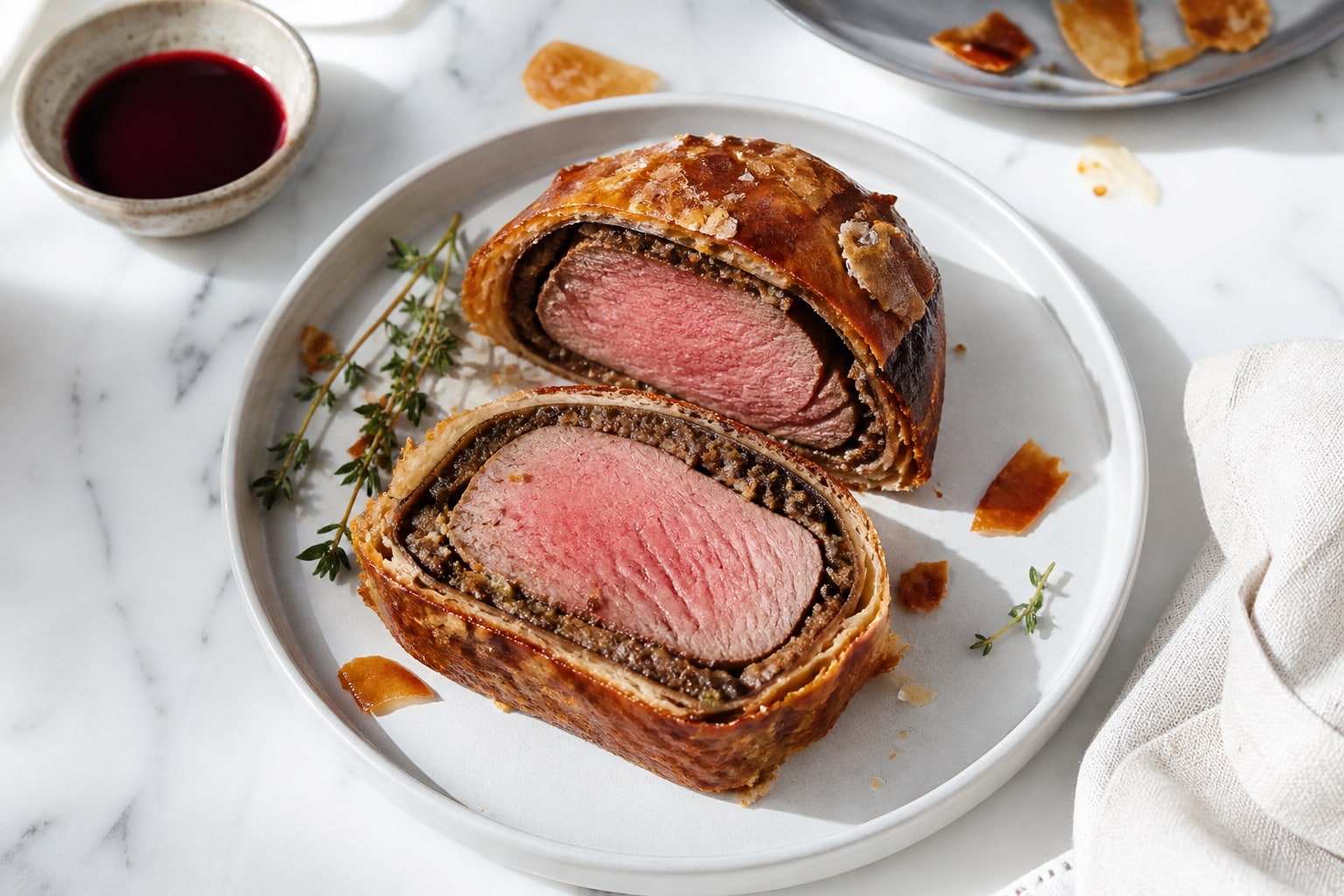
Tips so the pastry is neither raw nor soggy
- The pastry must always be cold before it goes into the oven. If it warms up during assembly, the butter melts too early and it won’t rise properly.
- The ham acts as a barrier between the duxelles and the dough: it absorbs any residual moisture the duxelles might release.
- Bake on a wire rack, never directly on a solid tray where juices can pool.
- The steam cuts aren’t just decoration: without them, the pastry puffs unevenly and turns gummy inside.
Variations on the Wellington
You can replace the Dijon mustard with a little foie gras pâté, a more classic and unctuous version. For a vegetarian version, swap the tenderloin for a cylinder of roasted sweet potato and large portobello mushrooms, keeping the same duxelles. If you use a Thermomix for the duxelles, chop the mushrooms for 3 seconds on speed 5 and then sauté them the same way in a separate pan, because in the bowl the water doesn’t evaporate well. If you can’t find good-quality all-butter puff pastry, avoid the basic supermarket margarine version: with so much cold handling, the difference in how it rises is very noticeable.
Pairing and serving
This dish calls for a full-bodied wine. A Ribera del Duero crianza or a Rioja Reserva works well, with tannins that cut through the richness of the pastry and butter without clashing with the mushroom flavour. For a side, keep it simple: buttered mashed potatoes, or seasonal vegetables roasted in the oven. It’s a dish for a set table, a sit-down Christmas dinner, not for nibbling. If you’re looking for more ideas for those dates with a traditional recipe behind them, the home-roasted suckling pig remains another solid option for the same table.
FAQ
How do I stop the pastry from being raw? Always bake with the oven properly preheated to 200°C, use a wire rack instead of a flat tray, and make sure the meat and the duxelles are completely cold before wrapping. The ham between the duxelles and the pastry helps prevent moisture from reaching the dough.
How long do you bake a 1 kg Wellington for? Between 20 and 25 minutes at 200°C for a pink centre (54–56°C internal temperature). If you prefer it more cooked, raise it to 28–30 minutes, but watch the pastry so it doesn’t burn before the meat reaches temperature.
Can it be prepared in advance? Yes. You can keep the tenderloin wrapped in pastry, unbaked, for up to 24 hours in the fridge, well covered. Put it straight into the oven from the fridge without letting it come to room temperature, and add 3–4 minutes to the baking time.
Can beef Wellington be frozen? It’s best to freeze it before baking, already assembled and wrapped in cling film, for up to a month. Defrost it in the fridge for 24 hours before baking, never at room temperature, so the pastry doesn’t become soggy.
What wine goes best with it? A structured red: Ribera del Duero crianza or Rioja Reserva. If you prefer something lighter, a Mencía from Bierzo also works without masking the flavour of the duxelles.
As an Amazon Associate, I earn from qualifying purchases.

0 comentarios · Comentar