Fresh royal jelly: differences from freeze-dried and how to store it
A practical guide to understanding fresh royal jelly versus freeze-dried: concentration, refrigerated storage at 2-5 °C, and how to take it without losing its properties.
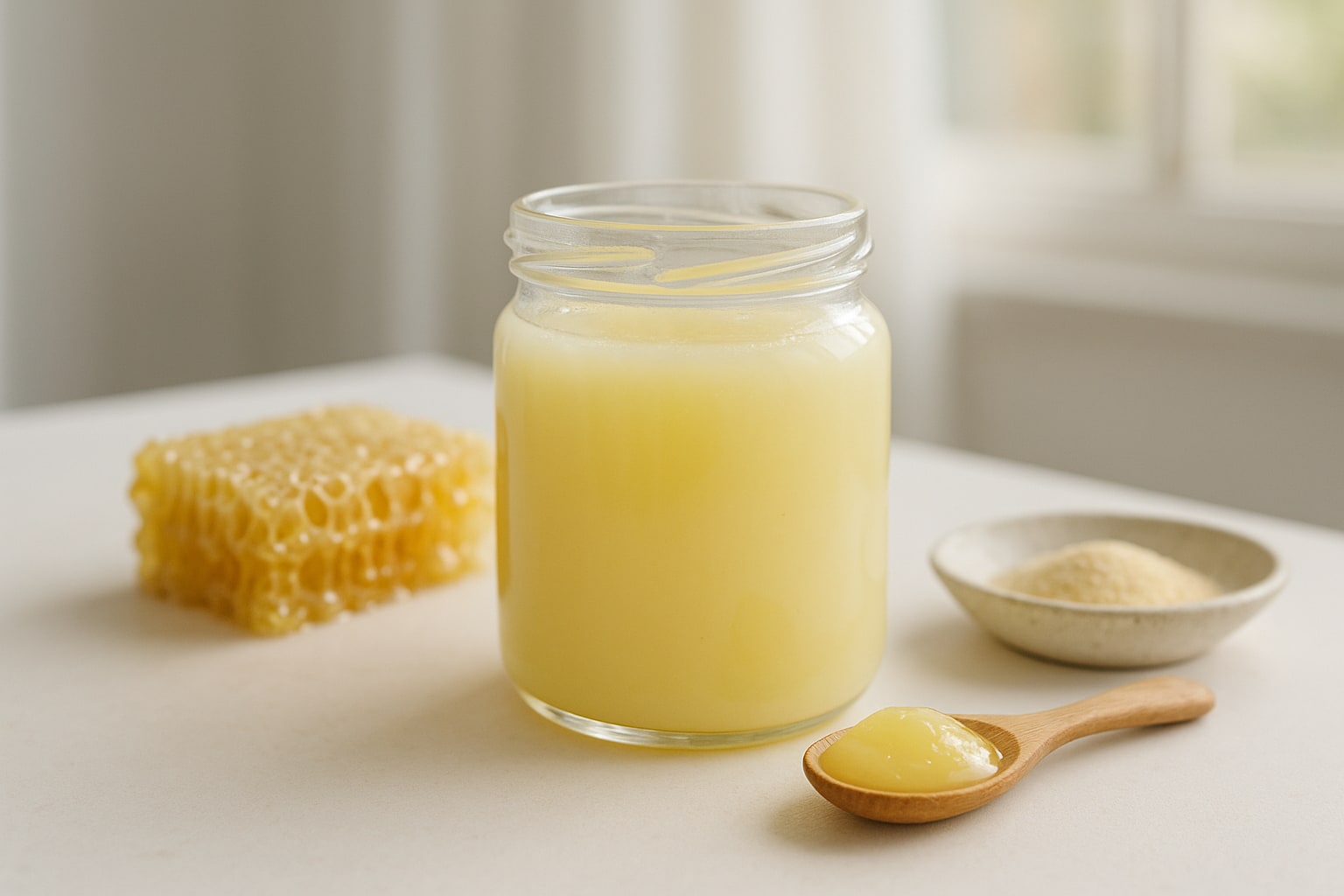
Royal jelly is one of those things you buy with good intentions and end up forgetting at the back of the fridge. And that’s a shame, because if you’ve paid for a jar of fresh royal jelly from a beekeeper, letting it go to waste between the ketchup and the expired yogurts is throwing money away.
Let’s get to the point: what it actually is, how fresh differs from freeze-dried, and how to store it so it lasts as long as it should without losing the properties you’re paying a premium for.
What royal jelly is and why it spoils so easily
Royal jelly is the secretion that worker bees produce in their hypopharyngeal glands to feed the larvae and, above all, the queen bee throughout her life. Hence the name. It is a creamy, whitish paste with a taste somewhere between sour and spicy that puts people off the first time they try it.
The problem: it is a living and fragile product. It contains proteins, free amino acids, B-group vitamins (especially B5 and B6), fatty acids such as 10-HDA (a quality marker), and minerals. All of these degrade with light, heat, and oxygen. That’s why you won’t find it on a shelf at room temperature if it’s truly fresh.
Fresh vs. freeze-dried royal jelly: the differences that matter
This is where people get confused. Let’s take it step by step.
Fresh royal jelly is harvested from the royal cells, filtered, and packaged as it is, without processing. It retains 60-70% water and its entire molecular structure intact. Freeze-dried royal jelly goes through a vacuum drying process at low temperature (below -40 °C) that removes the water and leaves a concentrated powder.
In terms of concentration, 1 g of freeze-dried royal jelly is roughly equivalent to 3 g of fresh. That sounds good, but the nuance lies in bioavailability: fresh royal jelly retains active enzymes and volatile compounds that are partially lost in any process, however gentle. Freeze-dried wins on storage (it withstands room temperature) and on exact dosing, but loses part of its enzymatic profile.
Honest summary: if you’re going to take it in a short course (2-3 months) and have access to a trusted beekeeper, go fresh. If you travel, if you forget to put things in the fridge, or if you’re buying for 6 months, freeze-dried in capsules.
How it is produced and why 10-HDA is the key
10-hydroxy-2-decenoic acid (10-HDA) is the marker that laboratories use to verify authenticity and quality. Good-quality fresh royal jelly contains between 1.4% and 2% 10-HDA. Less than 1.4% is suspicious: it is either adulterated or poorly stored.
When you buy, ask for an analysis. A serious beekeeper has one. If someone sells you a jar with no traceability or lab testing, that’s a bad sign.
Benefits of royal jelly: what the evidence says and what it doesn’t
Here we need to be cautious. Royal jelly is rich in proteins, B-group vitamins, and essential amino acids, and because of its composition it is traditionally credited with a revitalizing effect during periods of fatigue, seasonal changes, or convalescence.
What is described in the scientific literature: an effect on markers of subjective fatigue, an interesting nutritional contribution in diets poor in micronutrients, and the antioxidant activity of 10-HDA.
What we won’t say: that it cures anything. Or that it replaces a treatment. Or that it is a miracle against tiredness if you sleep 5 hours and eat poorly.
If you’re interested in the beekeeping world to complement your breakfast, also take a look at how bee pollen is taken and what it really provides — it is a common complement to royal jelly.
How to take fresh royal jelly: dose and timing
The usual dose for adults is 250-500 mg per day (a portion the size of a small pea), taken on an empty stomach, dissolved under the tongue for 1-2 minutes before swallowing. Sublingual absorption makes better use of the compounds than sending it straight to the stomach.
Courses are usually planned in cycles of 4-6 weeks, twice a year (autumn and spring). Important allergy warning: if you are allergic to bee venom or pollen, consult your doctor first. No joking about this.
Taste: sour, slightly spicy, with a bitter aftertaste. Many people find it hard. Tip: follow it immediately with a teaspoon of raw honey. Mixing it directly into the honey also works, but you lose precision in the dose.
How to store royal jelly in the fridge
Here is the heart of the article. Specific rules:
- Temperature: between 2 and 5 °C. Fridge, coldest area (back, not the door).
- Container: airtight opaque glass, preferably amber or cobalt blue. Never clear plastic or oxidizable metal lids.
- No direct light: UV light degrades B vitamins within days.
- Clean, dry spoon every time you use it. Never dip in a coffee spoon.
Under these conditions, fresh royal jelly lasts up to 18 months from harvest while retaining its properties. Once the jar is opened, the clock runs faster: ideally consume it within 3-4 months.
Freezing? Yes, it can be done. Frozen at -18 °C it lasts up to 24 months without significant degradation. Thaw it in the fridge, never at room temperature or in the microwave.
Freeze-dried royal jelly, on the other hand, lasts 2-3 years at room temperature in its original container, always in a dry place away from light.
Signs that royal jelly has gone bad
- Intense or dark yellow color (fresh is ivory white or pale cream).
- Rancid or fermented smell.
- Very liquid texture or obvious separation of phases.
- Excessively bitter or metallic taste.
If in doubt, don’t take it. It’s not worth the risk.
Frequently asked questions
Can I take fresh royal jelly every day of the year?
It is recommended to do so in cycles of 4-6 weeks followed by a break. Taking it continuously for months provides no additional benefit.
Is it suitable for children?
In reduced doses (100-200 mg) and always after consulting the pediatrician, especially if there is a history of allergies.
Can it be mixed with hot tea or coffee?
No. Heat above 40 °C degrades enzymes and vitamins. Take it directly or with honey at room temperature.
Is organic royal jelly better?
It guarantees that the bees were not fed industrial sugar syrups and that the foraging area is free of synthetic pesticides. Yes, the premium is worth it if the producer is reputable.