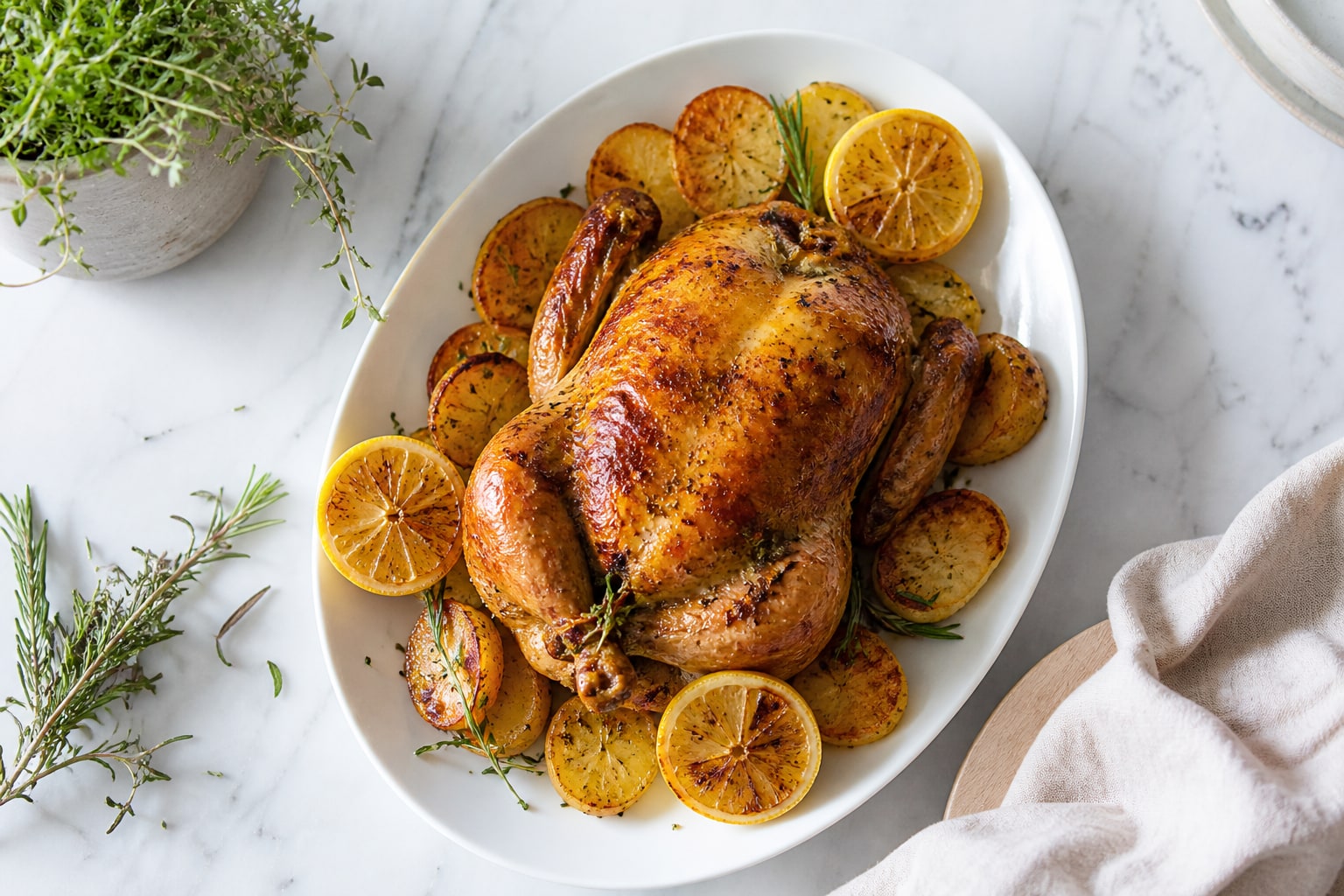
Roast chicken with lemon and bakery-style potatoes
The recipe for whole roast chicken with lemon and bakery-style potatoes, with exact cooking times based on the weight of the bird and the trick to get the skin truly crispy.

Oven-roasted chicken on a Sunday lunchtime, with the house smelling of lemon and garlic from noon onwards. Simple as that, and just as good. It’s the dish you make when your parents come over for lunch, when you want to impress without overcomplicating things, or when you simply fancy something spoon-and-fork that doesn’t need you watching the stove all afternoon.
Roast chicken with bakery-style potatoes is a lifelong classic, the one your grandmother made on Sundays with the free-range chicken from the henhouse, and it still works today with a decent farm chicken from the market. There’s no restaurant trick here, just oven, time and patience. And one key thing that almost nobody gets right: drying the skin before it goes in.
Ingredients for 4 people
- 1 whole chicken of approx. 1.6–1.8 kg (ideally free-range or farm-raised if you can find one)
- 2 lemons (one for juice, one sliced for the inside)
- 6 cloves of garlic unpeeled
- 4 sprigs of thyme fresh (or 1 teaspoon of dried thyme)
- 2 sprigs of rosemary fresh
- 60 ml of extra virgin olive oil
- 40 g of butter at room temperature
- 1 kg of potatoes waxy or Monalisa variety (for bakery-style)
- 1 onion large
- 200 ml of chicken stock (homemade or good-quality carton)
- Coarse salt and freshly ground black pepper
Step-by-step preparation
- Take the chicken out of the fridge 1 hour before cooking it. Having it at room temperature is what makes the difference between a chicken that cooks on the outside and one that truly roasts.
- Dry the skin thoroughly with kitchen paper, both outside and inside the cavity. This is the step almost everyone skips, and it is responsible for 80% of crispy skin. Wet skin = skin that steams, never browns.
- Mix the butter with the juice of one lemon, salt and pepper. Separate the skin from the breast with your fingers (taking care not to tear it) and work the mixture between skin and meat. This flavours the bird from within without burning the surface.
- Fill the cavity with the sliced lemon, 3 cloves of garlic and the thyme and rosemary sprigs. Truss the legs with kitchen string so the bird cooks evenly.
- Preheat the oven to 200 °C with top and bottom heat. While it heats up, cut the potatoes into 0.5 cm slices and the onion into fine julienne. Arrange them on the base of a roasting dish, season with salt and pepper and drizzle with the olive oil.
- Place the chicken on the bed of potatoes, breast side up. Brush the skin with a drizzle of oil and add the remaining 3 cloves of garlic around it.
- Put it in the oven at 200 °C for the first 20 minutes to seal and brown the skin. Lower to 180 °C and continue cooking according to the weight (see table).
- Halfway through cooking, pour the chicken stock over the potatoes (not over the skin) so they don’t dry out, and stir gently.
- For the last 10 minutes, raise the heat back to 200 °C so the skin finishes well browned and crispy.
- Check doneness by piercing the thickest part of the thigh: the juices should run clear, never pink. If you have a kitchen thermometer, aim for 75 °C in the centre of the thigh.
- Let the chicken rest for 10 minutes outside the oven before carving. This rest redistributes the juices within the meat; if you cut it straight out of the oven, they all run out onto the dish.
As a quick reference, the total oven time varies according to the weight of the bird:
| Weight of chicken | Approx. total time at 180–200 °C |
|---|---|
| 1.2 – 1.4 kg | 60–70 minutes |
| 1.5 – 1.8 kg | 75–90 minutes |
| 2.0 – 2.2 kg | 95–110 minutes |
The rule that usually works is to allow about 20 minutes per 500 g, plus an extra 15–20 minutes of margin so the skin browns properly. If you’ve already worked out cooking times by weight in other recipes, the same principle applies to salt-baked sea bass, where the time is also adjusted per kilo.
Tips and variations
- If the skin isn’t browning properly in the last few minutes, switch on the grill for 2–3 minutes, keeping a close eye on it: it goes from golden to burnt in no time.
- For a version with more garlic intensity, add a whole head cut in half alongside the potatoes; it confits in the chicken juices and becomes creamy enough to spread on bread.
- If you don’t have fresh thyme or rosemary, a mix of Provençal herbs (1 teaspoon) works as a reasonable substitute, though the result is less aromatic.
- Bakery-style potatoes also go well alongside other oven-roasted vegetable dishes, as with Catalan escalivada, where oven time and temperature are just as decisive.
- Naturally gluten-free if you use homemade stock or a certified gluten-free carton; check the label if someone in the household has coeliac disease.
Pairing and serving
A young red made from Garnacha grapes or a full-bodied white such as Verdejo pairs well with the richness of the chicken and the citrus note of the lemon. If you prefer beer, a well-chilled lager cleanses the palate between mouthfuls of potato. Serve the carved chicken directly on the potatoes, with the juices from the dish spooned over, and a simple green salad on the side to cut through the fat.
Frequently asked questions
Can the chicken be left marinating the night before? Yes. Rub the mixture of butter, lemon and herbs under the skin, cover it and keep it in the fridge for up to 12 hours. Take it out 1 hour before roasting so it loses the chill.
How long does it keep in the fridge once cooked? For 2 to 3 days in an airtight container. Reheat in the oven at 160 °C for about 15 minutes so the skin doesn’t go soggy in the microwave.
Can it be frozen? Yes, both the chicken and the potatoes keep well for up to 2 months frozen separately. Defrost in the fridge the night before and reheat in the oven; never in the microwave if you want to salvage some crispiness.
What if the chicken weighs more than 2 kg? Add time proportionally according to the table (around 20 minutes more for every extra 300–400 g) and always check by piercing the thigh before deciding it’s done. The weight is a guide, but clear juices are the definitive test.




0 comentarios · Comentar