Sea bass in salt: how to calculate the salt and cooking time per kilo
The exact formula for calculating grams of salt and minutes in the oven per kilo of sea bass, with a reference table and the egg white trick so the crust doesn't crack.
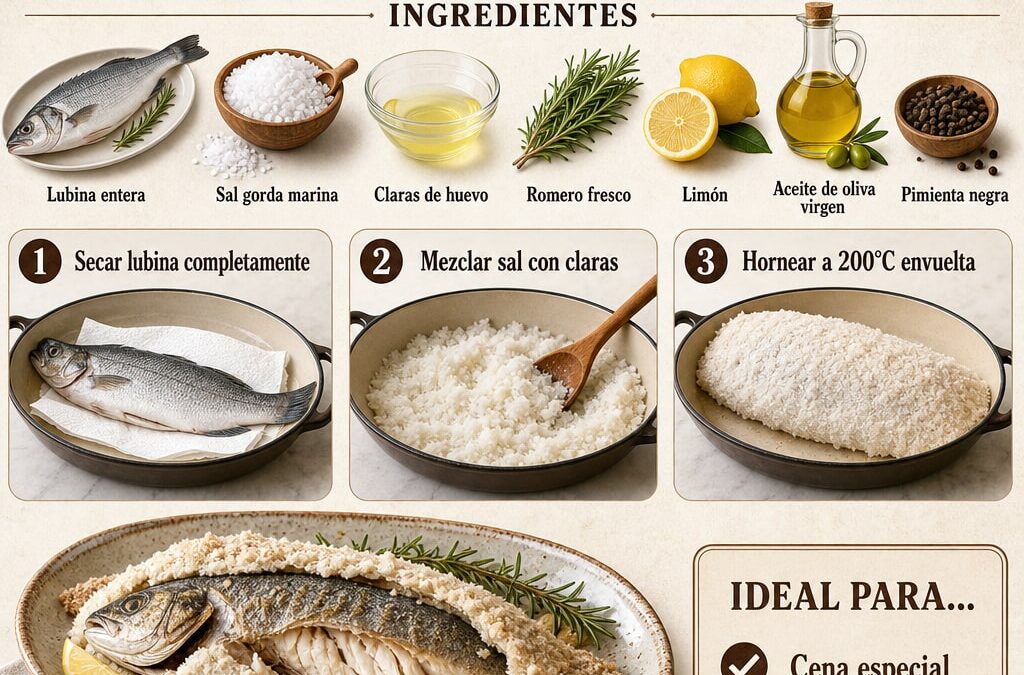
There are dishes that look like they come from an expensive restaurant and are, in fact, some of the easiest to make at home. Salt-baked sea bass is the perfect example. It has no sauce, no frying, and you don’t have to keep an eye on a sofrito. It needs a whole fish, coarse salt, and an oven that can stay still. The problem isn’t the technique: it’s that almost nobody calculates the amount of salt and the time correctly based on the weight of the fish, and so you end up with dry sea bass or, worse, sea bass that’s still half raw inside while looking perfect on the outside.
This is what you want when you’d like to impress without spending the afternoon in the kitchen: a Sunday lunch, a dinner with the in-laws, a day when you’ve picked up a decent wild sea bass at the fishmonger’s and don’t want to spoil it. I’ll give you the numbers, not “to taste”, because here taste is measured in grams.
Ingredients
For 4 people (one sea bass of 1.2-1.5 kg, or two smaller pieces):
- 1 sea bass, large portion, whole, not scaled or fully gutted (the belly is left closed or only the cavity is cleaned, but with skin and scales intact)
- 2.5 kg of coarse marine salt (coarse, not fine; fine salt compacts poorly and doesn’t form a crust)
- 2 egg whites
- 1 sprig of fresh rosemary or thyme (optional, for the cavity)
- 1 lemon
- Extra virgin olive oil for the final dressing (about 60 ml)
- Freshly ground black pepper
Nothing else. If your fishmonger offers to remove the scales “so it looks finer”, tell him no. The scales are what protect the flesh from direct salt and keep the fish from tasting salty.
Step-by-step preparation
- Prepare the sea bass: ask the fishmonger to gut it through the gills, without opening the belly from the outside. That way the salt doesn’t come into direct contact with the flesh. Dry the skin well with kitchen paper, inside and out. Moisture = a crust that won’t set.
- Mix the salt: in a large bowl, mix the coarse salt with the 2 egg whites until it has the texture of wet sand, like for building a sandcastle. The egg white acts as glue and is what makes the crust come off whole when you crack it, instead of crumbling.
- Make the salt bed: on an oven tray, spread a layer of salt 1.5-2 cm thick, the size of the sea bass.
- Place the fish: put the sea bass on top, put the rosemary or thyme inside the cavity and a few lemon slices. This isn’t decorative: it perfumes the flesh from within during cooking.
- Cover completely: cover the whole sea bass with the rest of the salt, pressing with your hands so there are no gaps. The head and tail can poke out a little, no problem.
- Bake at 200°C, top and bottom heat, no fan, for the time shown in the table below according to the weight.
- Rest for 5 minutes outside the oven before breaking the crust. The fish keeps cooking through residual heat and the juices settle.
- Break the crust with the back of a spoon or a small mallet, at the table, in front of the guests if you want to put on a show. Remove all the salt and the skin, which will come away stuck to it.
How to calculate the amount of salt per kilo of fish
The proportion that really works is 2 kg of coarse salt for each kilo of fish, counting the weight of the whole piece (with head and bones, as you weigh it at the fishmonger’s). You don’t need to weigh the salt to the exact gram, but do respect the proportion: if you fall short, the crust won’t close properly and will crack when baking; if you go too far over, it takes longer to form an even crust and you waste salt without gaining anything.
For a sea bass of 1.2-1.5 kg, we’re talking about between 2.4 and 3 kg of salt. Yes, it seems like a lot, but it’s what you need for the crust to completely seal the fish and act as an oven inside the oven.
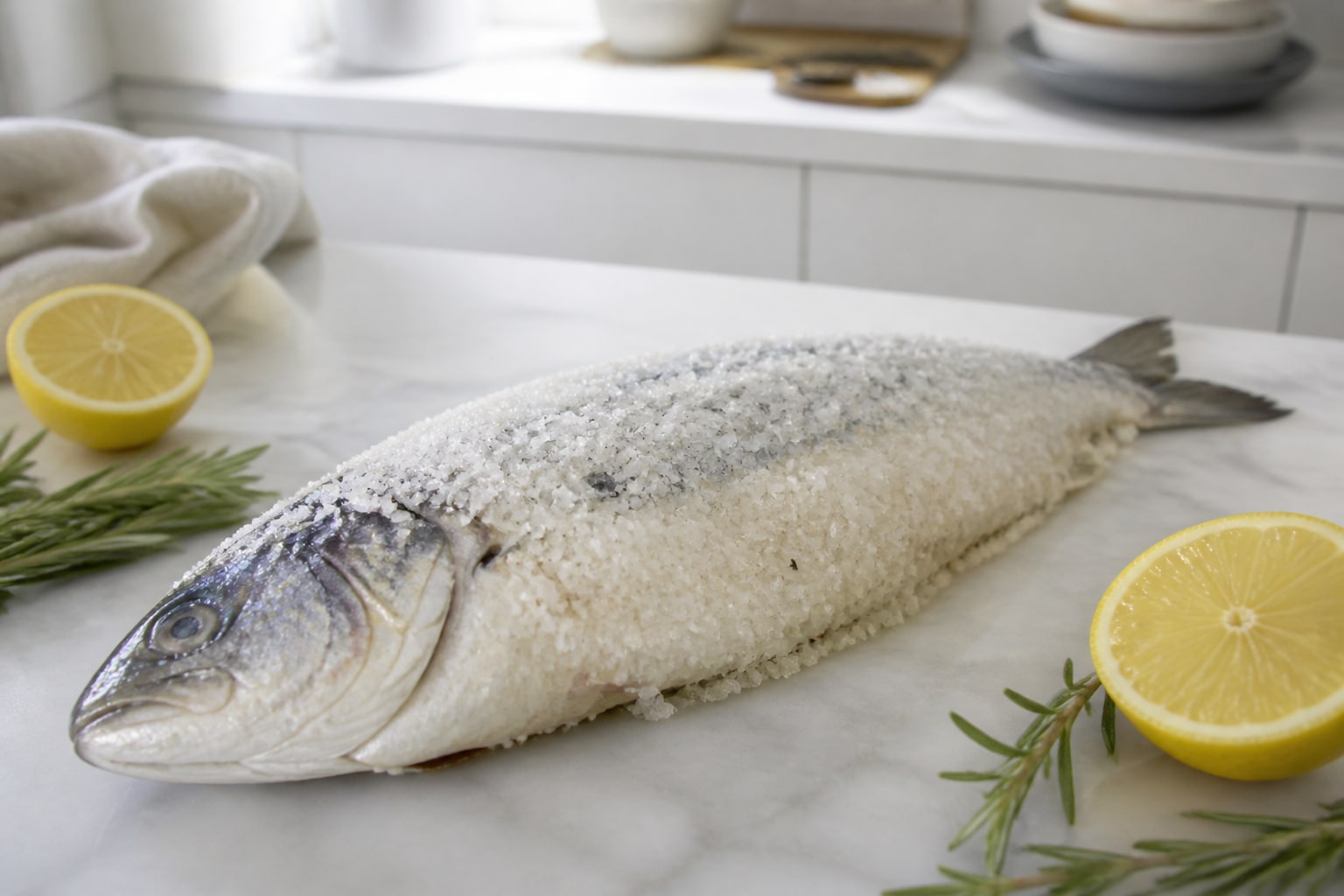
Cooking time by weight: reference table
This is the thing people get wrong most often at home: they estimate the time “by eye” and either overcook or undercook. The rule that works with the oven at 200°C is 20 minutes per kilo, plus 5 minutes of margin for whole pieces with the head on.
| Weight of the sea bass | Oven time at 200°C | Rest after the oven |
|---|---|---|
| 0.8 – 1 kg | 20-22 minutes | 5 minutes |
| 1 – 1.3 kg | 25-28 minutes | 5 minutes |
| 1.3 – 1.6 kg | 30-32 minutes | 5-7 minutes |
| 1.6 – 2 kg | 35-38 minutes | 7 minutes |
If you cook two small pieces at the same time on the same tray, count the time of the larger piece, not the sum of both.
Oven temperature: why 200°C and not more
At 200°C with top and bottom heat, the salt crust hardens evenly without the outside burning before the inside reaches temperature. If you go up to 220-230°C you save a few minutes, but the risk of the salt toasting excessively and transmitting bitterness is higher. Don’t use air or a fan: it dries the crust unevenly and can crack it early, letting direct salt reach the flesh.
How to tell if the sea bass is done
The old fishmonger’s trick: insert a metal skewer or a long toothpick into the thickest part, near the head, and count to five. Take it out and touch it to your lower lip. If it’s really hot (not lukewarm), the fish is ready. Another reliable sign: when you break the crust, if the sea bass’s eye is white and opaque (not red or glassy), it’s done. The skin comes away easily from the flesh when you lift it with a fork.
Tips and variations
- Without egg white: you can make the crust with just salt and a little water (about 150 ml per 2 kg of salt), but it breaks more easily and into smaller pieces. The egg white is what gives that whole, almost theatrical crust.
- With herbs in the salt itself: if you mix the salt with lemon zest or a handful of chopped dill, the aroma passes through the skin during cooking. Subtle, but noticeable.
- For those without a trusted fishmonger: if the sea bass doesn’t come with intact scales or has any cuts, wrap it first in dampened baking paper, then add the salt on top. It doesn’t look as impressive, but it prevents excess salt from getting in through the skin wounds.
- Two fish in the same oven: if you make two sea bass, leave at least 3-4 cm between the salt beds so the heat circulates evenly.
Pairing and how to serve it
This dish calls for a white wine with pronounced acidity and little oak: an Albariño from Rías Baixas or a Verdejo from Rueda work well, because they cleanse the palate of the fat from the olive oil in the final dressing. Serve the boned sea bass at the table, with a drizzle of raw extra virgin olive oil on top and nothing more: no sauces or garnishes that mask the flavour. If you want something on the side, some separately made panadera potatoes or a escalivada are more than enough, without competing with the fish.
FAQ
Can you make salt-baked sea bass without an oven, just in a pan or on the barbecue? It’s not the same. The crust needs enveloping, constant heat, which only a closed oven provides. On a covered barbecue it can work, but you have to watch the temperature because it tends to be more uneven.
Does salt-baked sea bass come out salty inside? No, if you respect the proportion, keep the scales intact and don’t open the belly completely. The salt only comes into contact with the skin, which acts as a barrier. If you notice it’s salty, the skin probably had a cut.
How long does cooked salt-baked sea bass keep in the fridge? Once the crust is removed and it’s boned, it keeps 1-2 days in the fridge, well covered. Freezing after cooking isn’t recommended because the texture becomes floury when thawed.
Does this recipe work for other fish, like gilt-head bream? Yes, gilt-head bream takes exactly the same proportion of salt and the same times by weight. It also works with red porgy or similar-sized snapper.
What do I do with the leftover salt, can it be reused? No. Once baked with the fish, it absorbs fat and juices, so it’s thrown away. It isn’t suitable for cooking again.




0 comentarios · Comentar