Kabuki Raw in Casares: sushi overlooking the Mediterranean from a castle in Málaga
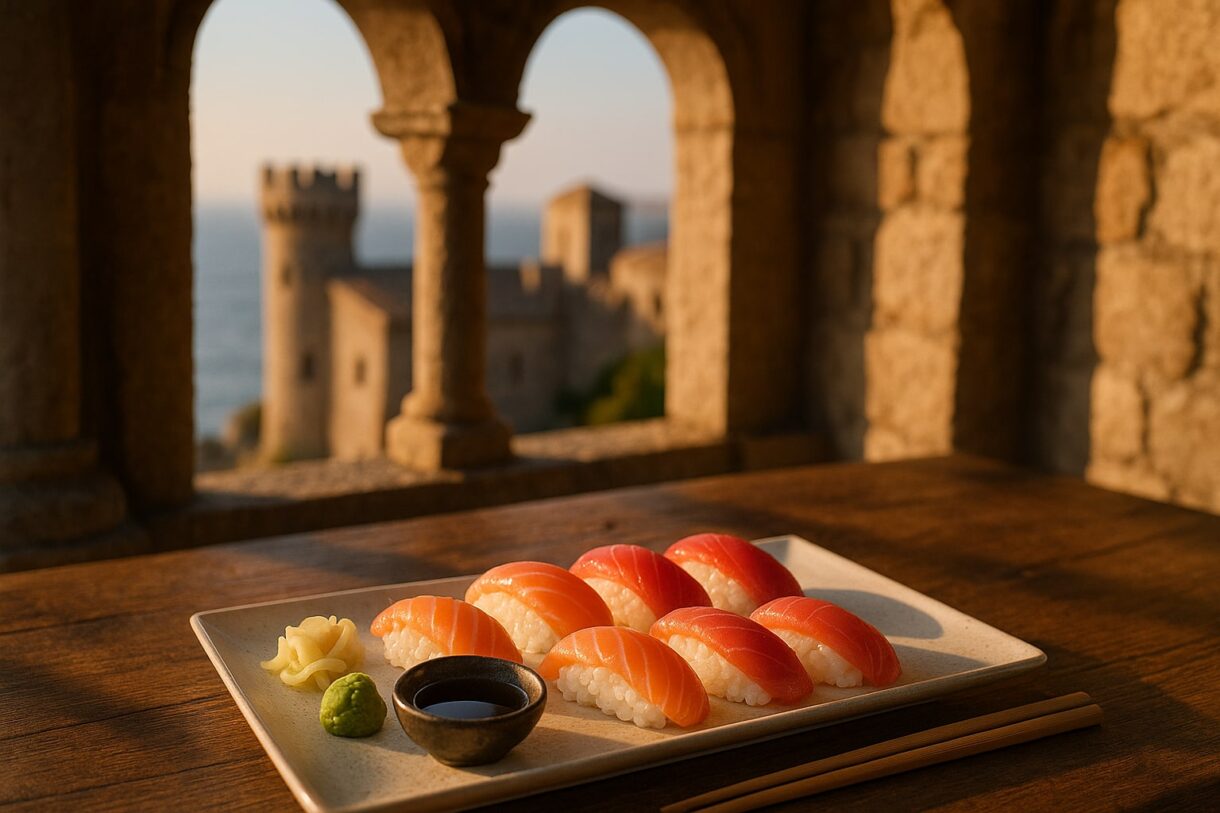
We went to Kabuki Raw: a Michelin-starred Japanese restaurant in Casares
We went on a late-May Thursday, late dinner, with an anniversary in the mix. The excuse was good and so was the place: Kabuki Raw, the Japanese restaurant with a Michelin star located inside the Finca Cortesín resort in Casares (Málaga). Booked three weeks ahead, drove right to the door, and had that odd feeling of eating high-end sushi with the Mediterranean below and the Casares castle silhouetted in the distance.
A heads-up from the start: this is not a neighborhood Japanese place for a quick uramaki. It’s a long, expensive, very deliberate dinner. If you go with the right expectations, it works beautifully. If you’re after quantity, you’ll be disappointed.
The setting: inside Finca Cortesín, with views and quiet
Kabuki Raw sits within the Finca Cortesín hotel, a five-star grand luxury property on the western Costa del Sol, between Marbella and Sotogrande. You access it through the resort itself: you pass the gatehouse, park for free, and are guided to the restaurant. No street, no traffic.
The dining room is small—around 30 seats including the bar—with dark woods, low lighting, and a sushi counter where you can sit and watch the team at work. We asked for a table by the window and got it right: you see the garden and, beyond it, the sea. Zero noise. You can talk without raising your voice, which is rare these days. Accessibility is good, with no awkward steps.
An important detail: it isn’t a restaurant for small children. Not by rule, but because of its pace and price. And the dress code calls for “smart casual”: forget swimwear and flip-flops, even if you’re coming straight from the pool.
The menu: Japanese technique, Andalusian produce
This is where Kabuki Raw separates itself from standard Japanese food. The house—Grupo Kabuki, the same group as Ricardo Sanz in Madrid—has spent years crossing Japanese cuisine with Spanish produce, and in Casares the pantry is first-class: bluefin tuna from the almadraba, Estepona prawns, Andalusian extra virgin olive oil, Iberian cured meats. All of it makes it onto the menu.
We went for the long tasting menu (there’s a shorter one too). Here are the dishes that stood out most:
Starters
- Usuzukuri of butterfish with truffle oil: paper-thin cuts, the fish almost raw, the truffle well dosed. It opens at a low key, competently.
- Toro nigiri with bone marrow: this one is the real thing. The toro (the fattiest part of the bluefin tuna) barely seared, with warm bone marrow on top. It melts. One of the best bites of the night.
- Tartare of white Estepona prawn with cured egg yolk: local produce brought into Japanese technique. The prawn is sweet, the yolk has just the right salinity. Good.
Mains
- Sashimi of wild sea bass with yuzu ponzu: correct, nothing more. The fish is impeccable, but the ponzu overpowers the flavor.
- Iberian pork presa robata: a piece of Iberian pork grilled on a Japanese charcoal grill (robata), seared on the outside and pink inside. Perfect doneness, marinated in miso. This is where the fusion with Spanish produce is clearly visible.
- Creamy rice with smoked eel: a nod to Mediterranean rice. It isn’t the star dish, but it works.
Dessert
- Matcha tea ice cream with Sierra de Cazorla PDO olive oil and flaky salt: good EVOO with matcha is an addiction. They closed on a high note.
We drank a dry sake recommended by the sommelier and a glass of Albariño to go with the first bites. The wine list has depth, with a good showing of Spanish references and a serious section of sakes.
The service: Japanese in rhythm, Andalusian in warmth
The service runs like clockwork. They serve when it’s time, explain each dish without being tedious, and know how to make genuine recommendations. We asked about pairings and the sommelier didn’t go for the most expensive wine; he went for the one that fit. You notice that, and appreciate it.
One caveat: the time between courses stretches out after the halfway point of the menu. If you’re used to dinner in an hour and a half, this isn’t it. Plan for a good three hours.
Price: how much dinner at Kabuki Raw costs
Let’s get to the point. The long tasting menu is around €175-195 per person without drinks (prices shift with the season and product availability; check the official Finca Cortesín website before booking). With a sake and wine pairing, add another €70-90 per head.
Our final bill came to about €540 for two, with the long menu, two glasses of wine, two sakes, water, and coffee. It isn’t a whim for an ordinary Tuesday. It’s an occasion dinner.
Can you go cheaper? Yes: the short menu comes to roughly €120-140 per person, and you can also eat à la carte, ordering individual pieces of sushi and sashimi, with an average bill of around €90-110 per person if you keep an eye on it.
For context, if you like starred restaurants with their own character, in eastern La Mancha there’s another stop worth the detour: Maralba in Almansa plays in a similar league with very different produce.
What Kabuki Raw is and why it matters in Málaga
Kabuki Raw is the Andalusian outpost of the Kabuki group, founded by chef Ricardo Sanz, a pioneer in Spain of Japanese cuisine with Mediterranean produce. It opened at Finca Cortesín in 2009 and has held a Michelin star continuously for years. It is, to this day, the only Japanese restaurant with a star in the province of Málaga.
That makes it an obligatory reference when answering the question “where to eat high-end sushi in Málaga” or “best sushi on the Costa del Sol” with real judgment rather than hearsay. There’s currently no other Japanese venture in the entire province that combines this kind of recognition, this location, and Andalusian pantry.
Its role goes beyond the plate: it has been one of the drivers of luxury gastronomic tourism on the western Costa del Sol, alongside Sotogrande and Marbella. Many guests stay at the resort itself and chain together golf, spa, and dinner. Others—like us—come only for dinner.
Getting there and booking
Casares is about 45 minutes by car from the city of Málaga and 25 minutes from Marbella, via the A-7. The resort has its own car park. Reservations can be made through the Finca Cortesín website or by phone, and in high season (June to September) it’s wise to request a table 3-4 weeks in advance. They close some weekdays in low season; check before making the trip.
A tip: ask for a table by the window if you’re going at sunset. The light falls over the garden and you can see the white village of Casares perched on the mountain as if it were a stage set. Choose the bar if you’re dining alone or as a couple and want to watch the itamae at work.
Verdict: 3 hams
Rating: 🍖🍖🍖 (3 hams — essential, I’d bring someone special.)
Kabuki Raw isn’t for every budget or every dinner. But when it’s time to celebrate something and you’re down south, it’s one of those places where the money shows on the plate: first-class produce, very refined technique, service that matches, and a location that helps a lot. The Japanese–Andalusian fusion isn’t posturing; it works because the local produce is treated with the respect it deserves.
Who it’s for: anniversaries, business lunches with a decent budget, travelers who want a “destination” dinner on the Costa del Sol. Who it isn’t for: a quick dinner, families with small children, anyone looking for quantity at a low price. Would I go back?: yes, next time to the bar and with the short menu. Booking: essential, several weeks ahead in summer.
If you’re interested in the world of almadraba tuna that appears here in nigiri form, in its purest version and at the fish-market level I cover in this report on the ronqueo in Barbate. And if you’re craving more Japanese cuisine integrated into Spanish cooking, miso as an enhancer for broths and stews is a good next step from home.
Tasty Things We were in... Málaga #atun #estrella-Michelín #gambas #Málaga #restaurante #sushi
 Lumara: the essence of Extremadura finds its home in Chamberí
 How to Make an Authentic Valencian Paella Step by Step (for 4 people, at home and in Valencia)
 Zhen and Chinese New Year: A Menu That Turns Madrid into Shanghai
Comentarios cerrados